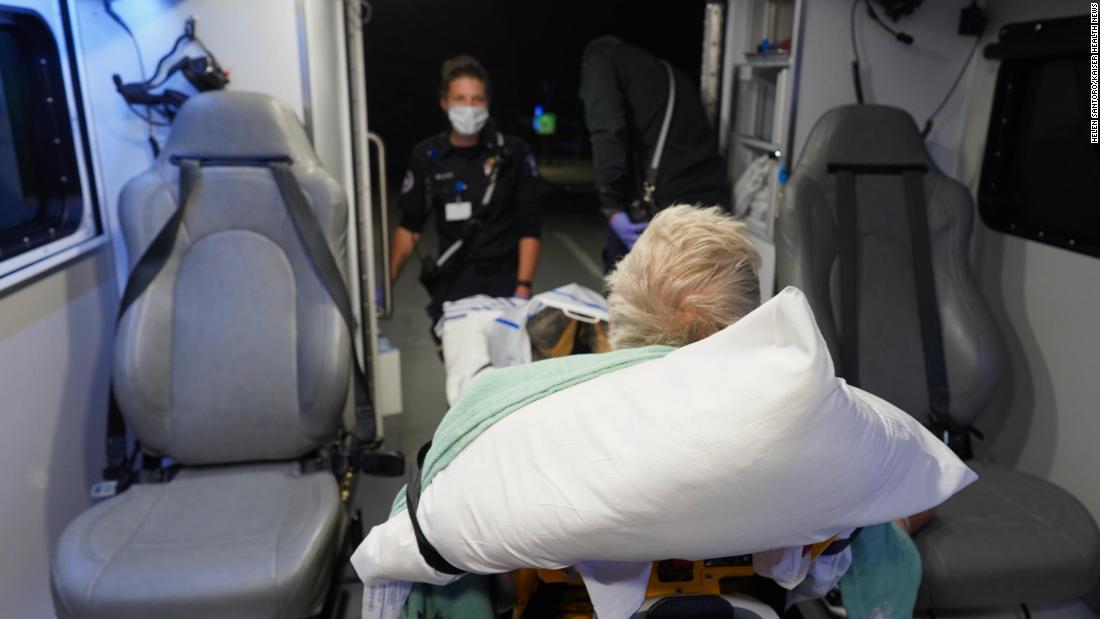
As pandemic fills hospital beds, paramedics spend more time moving patients and less on emergencies
CNN
The night after Thanksgiving, a small ambulance service that covers a huge swath of southwestern Colorado got a call that a patient needed an emergency transfer from the hospital in Gunnison to a larger one with an intensive care unit 65 miles away in Montrose.
The patient — a 78-year-old man — was experiencing atrial fibrillation, an irregular heartbeat that usually isn't life-threatening. But for patients like this one with chronic health conditions, a history of cardiac issues and high blood pressure, the condition can cause a stroke or heart failure.
Workers from Gunnison Valley Health Paramedics rolled the patient, who was on a gurney, out of the hospital and into the frigid night air. AnnieGrace Haddorff, the emergency medical technician on call, helped load the patient into the ambulance and jumped into the driver's seat. Paramedic Alec Newby got into the back and hooked the patient up to a blood pressure cuff; a pulse oximeter, which measures heart rate and blood oxygen saturation; and an electrocardiogram, which records the heart's electrical activity.


Travelers have been dealing with worsening airport wait times as ICE agents deploy to more than a dozen airports. Follow for live news updates.

President Donald Trump voted in Tuesday’s state House special election by mail even as he suggested on Monday that “mail-in voting means mail-in cheating.”

CNN’s 5 Things AM brings you the news you need to know every morning.

The Supreme Court on Tuesday will consider the legality of a policy championed by President Donald Trump during his first term that prevented scores of migrants arriving at the southern border from starting the process of applying for asylum.

A young, well-liked facilities manager at the Kennedy Center has gone from being described as “in charge of HVAC and toilets” to head of the renowned arts institution.

Democrats in Florida are hoping to capitalize on the party’s recent special election overperformances and come out on top Tuesday in a special state House election for a Palm Beach district that includes President Donald Trump’s Mar-a-Lago residence.

The Supreme Court on Monday appeared ready to limit mail-in ballots, a move that would reinforce the justices’ pattern of shrinking voter protections and that has, at bottom, favored Republican interests and the Trump administration.

An Air Canada plane traveling from Montreal collided with an emergency vehicle on the runway at New York City’s LaGuardia Airport in the late hours of Sunday night, killing two pilots and injuring dozens of people.

Top Senate Republicans on Capitol Hill believe their party is unified behind a plan to reopen the Department of Homeland Security. Now, they need to sell the plan to Democrats.

Markwayne Mullin will serve as Donald Trump’s next Department of Homeland Security secretary, elevating the US senator to helm the agency at the center of the president’s controversial immigration enforcement effort and an ongoing shutdown.

President Donald Trump’s sudden turnabout and, according to him, rapidly advancing peace talks made for an abrupt shift in the administration’s approach to the Iran war.

The Supreme Court’s conservative majority appeared dubious of state laws that allow the counting of mail ballots that arrive at election offices after Election Day as justices heard oral arguments in a challenge to Mississippi’s five-day grace period for mail ballots.

The chief district judge in New Jersey appointed Robert Frazer, a career prosecutor, to serve as US attorney for the state, ending for now a dispute over the legality of the office’s leadership that threatened to derail criminal investigations.