Are fingerprints unique? Not really, AI-based study finds
CTV
Published this week in the journal Science Advances, the paper seemingly upends a long-accepted truth about fingerprints: They are not, Guo and his colleagues argue, all unique.
“Do you think that every fingerprint is actually unique?”
It’s a question that a professor asked Gabe Guo during a casual chat while he was stuck at home during the Covid-19 lockdowns, waiting to start his freshman year at Columbia University. “Little did I know that conversation would set the stage for the focus of my life for the next three years,” Guo said.
Guo, now an undergraduate senior in Columbia’s department of computer science, led a team that did a study on the subject, with the professor, Wenyao Xu of the University of Buffalo, as one of his coauthors. Published this week in the journal Science Advances, the paper seemingly upends a long-accepted truth about fingerprints: They are not, Guo and his colleagues argue, all unique.
In fact, journals rejected the work multiple times before the team appealed and eventually got it accepted at Science Advances. “There was a lot of pushback from the forensics community initially,” recalled Guo, who had no background in forensics before the study.
“For the first iteration or two of our paper, they said it’s a well-known fact that no two fingerprints are alike. I guess that really helped to improve our study, because we just kept putting more data into it, (increasing accuracy) until eventually the evidence was incontrovertible,” he said.
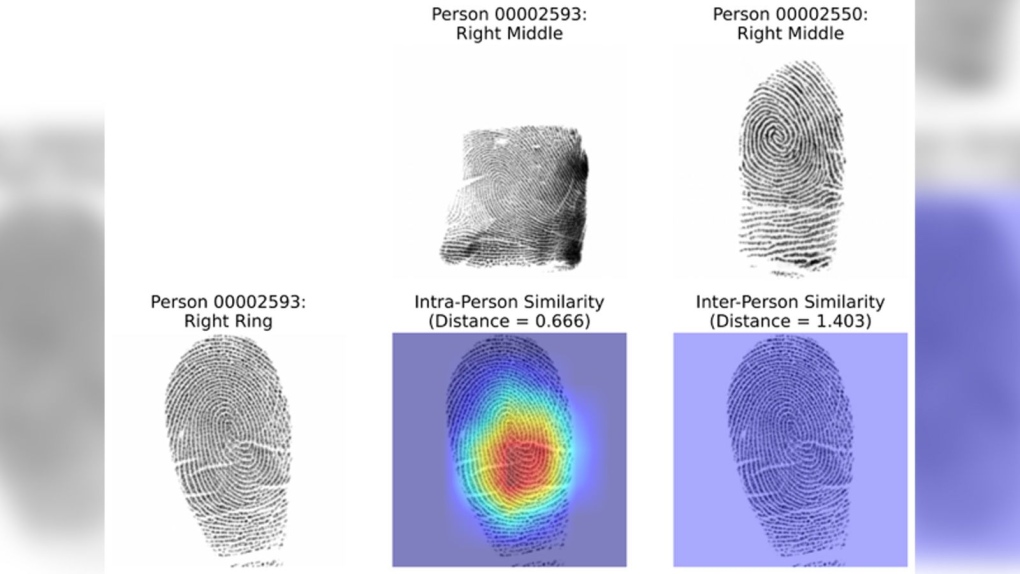
To get to its surprising results, the team employed an artificial intelligence model called a deep contrastive network, which is commonly used for tasks such as facial recognition. The researchers added their own twist to it and then fed it a US government database of 60,000 fingerprints in pairs that sometimes belonged to the same person (but from different fingers) and sometimes belonged to different people.
As it worked, the AI-based system found that fingerprints from different fingers of the same person shared strong similarities and was therefore able to tell when the fingerprints belonged to the same individual and when they didn’t, with an accuracy for a single pair peaking at 77% — seemingly disproving that each fingerprint is “unique.”


Tyson Atleo, a hereditary leader of the Ahousaht First Nation, says the creation of three new forestry areas to be managed by his community and two others on the west coast of Vancouver Island marks the realization of a long-standing promise.

As artificial intelligence continues to reshape industries worldwide, Canadian universities are emerging as key players – not only in developing technology but in teaching students how to use it responsibly.

Switching up your exercise routine does more than fight boredom. Engaging in varied forms of movement may significantly boost your longevity, according to research.

A seven-bedroom, five-bathroom home in Ottawa’s Rothwell Heights neighbourhood is currently the most expensive home on the market in the capital.

David Suzuki, the geneticist-turned-environmentalist, who is days away from his 90th birthday, reflected on his legacy as he prepared to release his latest book, “Lessons from a Lifetime,” which compiles photos and stories from his life, as well as testimonials written by those he inspired.

Microsoft subsidiary Bethesda said Tuesday hit space exploration game “Starfield” will appear on rival Sony’s PlayStation 5, effectively ending the practice of keeping some releases exclusive to Xbox consoles.

A woman visiting her family in Canada from the United States became ill and was admitted to the hospital, and without travel insurance, the family was shocked to get a bill for more than $110,000.

Renowned Canadian angler Jeff Gustafson back in Kenora Ont. after Bassmaster Classic absence.

A special weather statement remains in effect for Toronto Tuesday morning with winds gusting up to 80 km/h in some areas after an overnight snowfall.

Fraudsters are using seniors as tools in online scams without their knowledge.

Using medical or recreational marijuana to ease symptoms of numerous mental health conditions doesn’t work, according to two new analyses of existing gold-standard research.

A haunting whale song discovered on decades-old audio equipment could open up a new understanding of how the huge animals communicate, according to researchers who say it’s the oldest such recording known.

Despite the delays for the NASA’s Artemis II mission around the moon and back, a space medicine researcher says the crew, which includes Canadian astronaut Jeremy Hansen, are physically ready for when the time comes to launch.