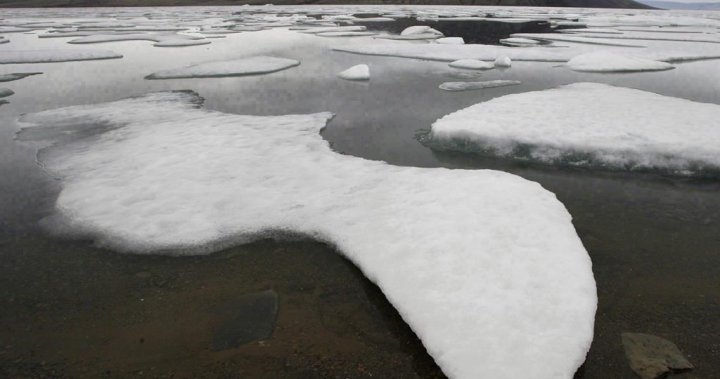
Arctic rainy days are likely to double by 2100. Here’s why
Global News
The study used climate modelling to predict changes in precipitation under a high level of greenhouse gas emissions from 2015 to 2100.
While the Arctic is better known for blankets of snow than rain clouds, new research suggests the number of rainy days in the region will roughly double by the end of this century.
The study, published in the American Geophysical Union journal Earth’s Future, used climate modelling to predict changes in precipitation under a high level of greenhouse gas emissions from 2015 to 2100. It found that not only will there be more rainfall in the Arctic by 2100, it will occur earlier in the spring and expand further toward the center of the Arctic Ocean and inland Greenland.
Lead author Tingfeng Dou, a climate scientist at the University of Chinese Academy of Sciences, said this will mean “the arrival of a new Arctic.”
“In the past, rainfall was primarily limited to the edges of the Greenland ice sheet,” he said in a press release.
The study’s authors, researchers from China and the Netherlands, said more frequent and intense rainfall in the Arctic is expected to increase permafrost melt, releasing large amounts of greenhouse gases, as well as reduce snow cover, and speed up sea-ice loss.
They said it’s also anticipated to result in more rain-on-snow events, where rain falls on existing snowpack and freezes, resulting in an icy crust on top of or within the snow. That can have serious consequences for foraging animals like reindeer, as their food is trapped under the ice, and socio-economic impacts for people who rely on them for food, clothing, transportation and cultural practices.
“Even ordinary rainfall can be regarded as an extreme event in polar regions,” Dou said.
Mark Serreze, director of the National Snow and Ice Data Center with the University of Colorado Boulder, who was not involved in the recent study, researches rain-on-snow events and their impact on human environment systems like reindeer herding. He said there have been cases where tens of thousands of reindeer and muskox have died because they couldn’t forage following rainfall.


Canada is amongst several nations who 'condemn in the strongest terms recent attacks by Iran on unarmed commercial vessels in the Gulf.'

Gas prices in Canada have been climbing sharply since the Iran war began, but how much higher they could go is unclear as consumers struggle with the higher cost of living.

The Oscar-winning actor has denied all allegations against him and maintains that the incidents raised in the lawsuits either did not happen or were consensual.

European leaders have deflected entreaties from U.S. President Donald Trump to send military assets to secure the Strait of Hormuz.

All six crew members of a KC-135 Air Force refueling aircraft were killed last week in a plane crash over friendly territory in western Iraq, supporting operations against Iran.

U.S. Director of National Intelligence Tulsi Gabbard testified that the regime remains intact and Tehran and its proxies remain capable of attacking U.S. and allies' interests.

James 'Jimmy' Gracey was reported missing after he didn't return to the short-term rental where he was staying with friends during spring break.

The U.K. Health Security Agency described the event as 'rapidly evolving' and warned of the potential for further cases.

U.S. benchmark crude fell US$1.24 to US$94.53 per barrel. Brent crude, the international standard, rose to US$104.17 per barrel. That's down from more than US$106 on Monday.

Volodymyr Zelenskyy urged Ukraine's allies not to forget about his country, and suggested the U.S. and others should make use of Ukraine's anti-drone technology during the war.

Trump’s visit to China is seen as an opportunity to build on a fragile trade truce, but it has become tangled in his effort to find an endgame to the war in Iran.

White House economic adviser Kevin Hassett said oil tanker traffic in the Strait of Hormuz starting to move is "a sign of how little Iran has left."

The secretary of Iran’s Supreme National Security Council, and the head of the Revolutionary Guard’s all-volunteer Basij force, were “eliminated last night," Israel said.