Arctic fossil is northern-most rhino species ever found
CBC
Millions of years ago, a pony-sized, hornless rhino wandered through the woods and munched on leaves in what is now northern Nunavut, making it the northern-most rhino ever found.
A new study published on Tuesday identifies it as a new species, and offers an intriguing explanation for how it got there.
Epiatheracerium itjilik was about the size of a modern Indian rhinoceros and far smaller than an African rhino, standing about a metre at the shoulder, said Danielle Fraser, lead author of the new study published in the journal Nature Ecology and Evolution.
Researchers found more than 70 per cent of the animal's skeleton in the Haughton Crater on Devon Island, about 1,000 kilometres north of the Arctic Circle — beating the record for the northern-most rhino previously set by a Yukon specimen.
From its skull, teeth and other bones, they were able to learn a lot about it.
The wear on its teeth showed it was in early to middle adulthood.
Natalia Rybczynski, a paleobiologist at the Museum of Nature and Carleton University who co-authored the new study, said the researchers believe the rhino was female. That's due to the small size of some lower teeth that tend to be much larger in male rhinos.
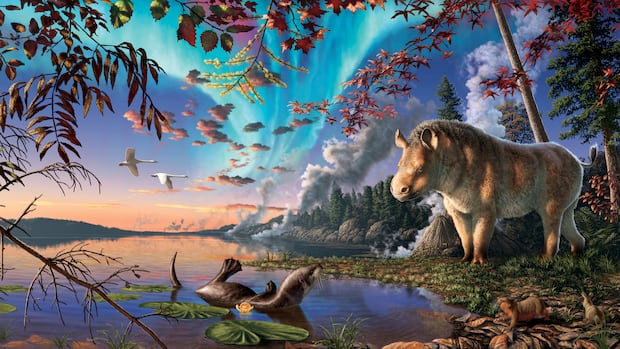
In an artist's reconstruction, a furry rhino with wide-set nostrils and no horn stands at the edge of a lake near lilies, swans and an otter-like creature. In the background, there is a forest of pine and spruce, alongside maple, birch and alder in fall colours, and northern lights fan across the twilit sky.
"I wanted the artist to make the rhino look like a pony in winter," said Fraser, head of paleobiology at the Canadian Museum of Nature in Ottawa.
While the climate was similar to that of southern Ontario today, winters would have been snowy, and Fraser reasoned that the animal would have had to stay warm during long dark winters in its polar home.
In fact, its species name is the Inuktitut word for "frosty" or "frost" and was chosen by Jarloo Kigutak, an Inuit elder from Grise Fiord who worked with some of the paleontologists on fossil collecting trips on Devon Island and Ellesmere Island.
Fraser said the new species walked on four toes instead of the three that most rhinos used: "It's a little bit of a weirdo in that sense."
Interestingly, the fact that it didn't have a horn isn't unusual — most fossil rhinos were hornless, despite the "horned nose" name that comes from their modern descendants.
Overall, though, the new species is quite different from the dozens of fossil rhino species that roamed North America. Instead, it has been added to a genus of similar species found in Europe, Epiatheracerium.


Toronto resident Winhan Wong's lung cancer journey began in 2016, with a nagging cough that just wouldn't go away.

Last month, Assembly of First Nations National Chief Cindy Woodhouse Nepinak pointed out on social media that history was made this year because there are a record 164 female chiefs serving across the country.

Most of humanity has a great propensity to think in the short-term, but generally, long-term considerations — air pollution, deforestation and emissions, for example — just aren't our thing.

As the COVID-19 pandemic began to unfold in early April 2020, Kolter Bouchard was just weeks into fatherhood when he noticed a lump on his neck.

Advocates and health care providers say they remain concerned about First Nations kids seeking services under Jordan's Principle even after the Canadian government’s recent promise of $1.55 billion in funding.

Contrary to science fiction, black holes are not portals to other dimensions or cosmic vacuum cleaners that swallow up everything around them.

An attempt to preserve files documenting some of the worst harms caused by Indian Residential Schools could soon head to Parliament.

A new survey suggests about three million Canadian adults are currently taking GLP-1 drugs such as Ozempic or Mounjaro and that many more would like to, but cost is a barrier.

For years, people living in Canada’s north have reported an increasing numbers of polar bears on shore, venturing into communities and encountering humans.

When Maureen Hayes first tested her Ottawa home for radon a little over a year ago, the initial reading was far below Canada's current threshold to take action.

Debate over legislation to update animal testing rules will resume next month, with one lawyer fearing it will end important research into cardio-vascular disease without proper debate.

Sam Pratt was around 13 when he first saw people talking about "looksmaxxing" on YouTube.

A group advocating on behalf of Indigenous people who cross the Canada-U.S. border says it’s disappointed by new travel advice from the federal government.