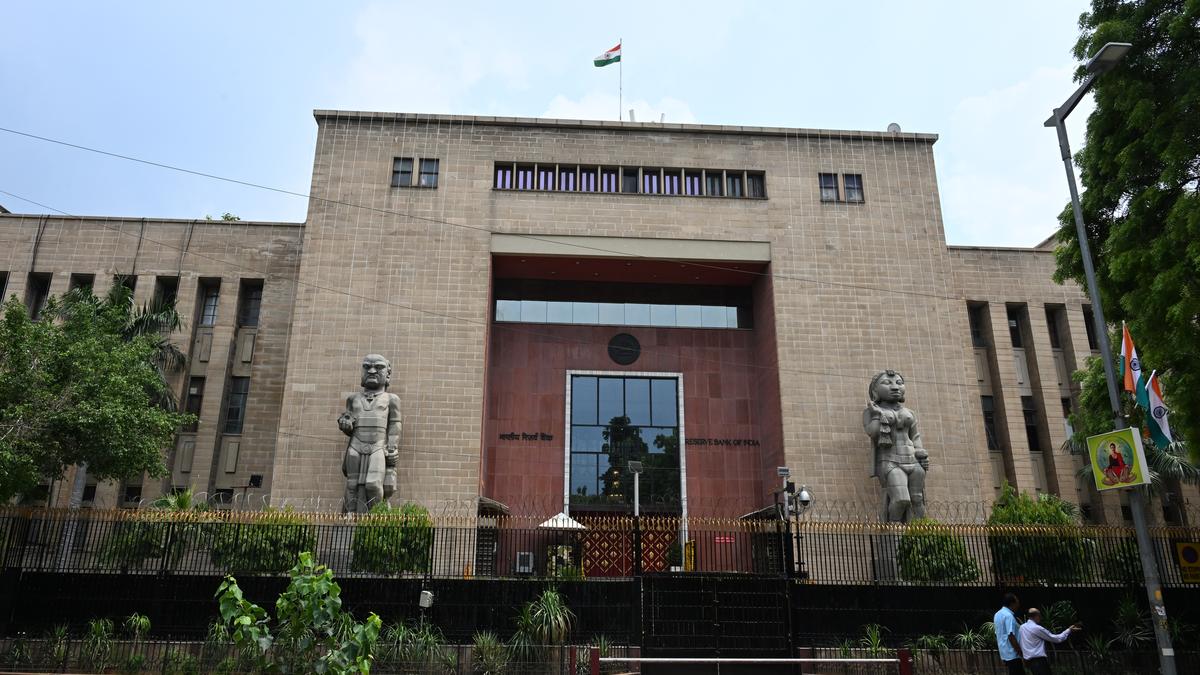
Any faltering from inflation target could undermine prospects of Indian economy: Patra
The Hindu
Monetary Policy Committee holds rates steady to align inflation with 4% target, citing persistent food inflation challenges.
The Monetary Policy Committee’s (MPC) steadfast approach to align inflation durably to the 4% target guided its decision to hold on to the policy rates, the minutes of the MPC meeting released by the Reserve Bank of India (RBI) on Thursday showed.
“The wedge between headline and food inflation has been widening, and stalling the alignment of the former with the target,” MPC member & Deputy Governor Michael Debabrata Patra said.
“Taking into account double digit inflation in salient food categories such as cereals, pulses, spices and vegetables for several months, empirical evidence points to a rise in the time varying persistence of food inflation, i.e., it is taking longer to revert to its trend after a shock,” he pointed out.
Stating that there was also evidence of the time varying trend of food inflation increasing, negating the gains made through core disinflation, he said higher trend food inflation was spilling over into inflation expectations of households and consumer confidence.
“In the case of the former, even their current perceptions have now started rising along with outer-term expectations. The recent assessment of the neutral rate of interest suggests that the disinflationary stance of monetary policy is appropriate, especially given the persisting positive gap between actual inflation outcomes and the target,” he mentioned.
Emphasising that monetary policy is an instrument for modulating aggregate demand, he said food-price shocks may originate outside the realm of monetary policy and initially manifest themselves in supply mismatches, but when their effects stay in the inflation-formation process, they can propagate through second-order effects and get generalised to which monetary policy cannot be insensitive.
“Persistently rising prices are always and everywhere a reflection of too much demand chasing too less supply even if it is a supply shortfall that starts the price spiral,” he observed.


The Thane police have arrested two co-founders of cryptocurrency exchange platform CoinDCX in connection with an alleged fraud of Rs 71.6 lakh, officials said

Meta Chief Executive Mark Zuckerberg is building a CEO agent to help him do his job, the Wall Street Journal reported

Insurance penetration and density are often misunderstood and do not reveal how many families are insured or whether they would be financially secure if the main earning member were to die. The real issue is not reach but adequacy, as households may have life insurance but not enough cover to replace lost income, leaving them financially vulnerable.

Five top firms lose ₹1 lakh crore in market value, with HDFC Bank experiencing the largest decline of ₹56,124.48 crore.

L&T confirms 95% of its West Asia project sites are safe, while addressing logistics challenges amid ongoing regional conflicts.

Mines Ministry to auction 19 critical mineral blocks on March 23, expanding strategic resources for clean energy and technology sectors.

Mines Ministry to auction 19 critical mineral blocks on March 23, expanding strategic resources for clean energy and technology sectors.

Five top firms lose ₹1 lakh crore in market value, with HDFC Bank experiencing the largest decline of ₹56,124.48 crore.

HDFC Bank terminates three senior officials over client onboarding issues at its DIFC branch amid ethical concerns following chairman's resignation.

Air India CEO warns of potential flight cuts and reduced travel demand due to rising fuel costs amid ongoing Gulf conflict.

Options are widely used by retail traders to speculate on the value of the stock for immediate gains and such behaviour in large scale can distort the market

India achieves 1 billion tonne coal production for the second consecutive year, ensuring stable energy supply and economic growth.

Generic drugmakers in India launch affordable Semaglutide versions, targeting a $1 billion diabetes and weight loss market.