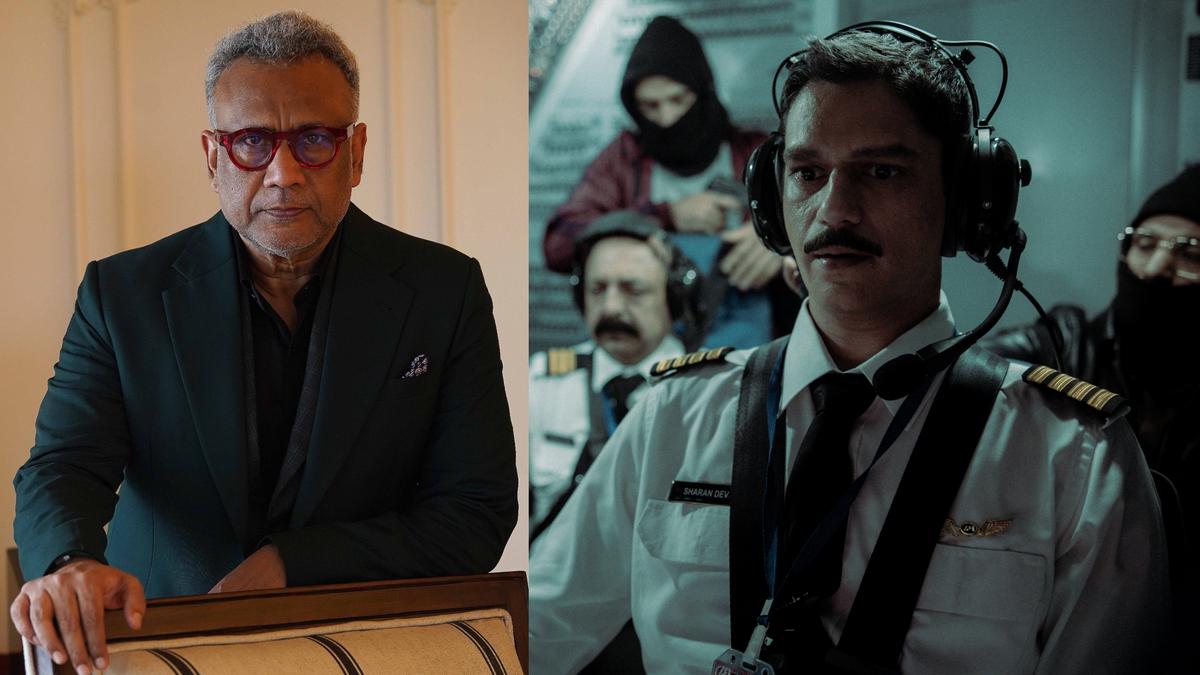
Anubhav Sinha on ‘IC 814: The Kandahar Hijack’: I’m not in the business of saving or glorifying people
The Hindu
As ‘IC 814: The Kandahar Hijack’ evokes memories of the episode that shook the morale of the nation, director Anubhav Sinha says he has tried to be as truthful as possible
Once wedded to Bollywood shindig, Anubhav Sinha, in recent years, has emerged as a gutsy chronicler of events that have threatened the idea of India. Finding his metier with Mulk, Anubhav went on to lend voice to the socio-politically deprived in Article 14, Anek and Bheed. Still remembered for the action-packed Sea Hawks on Doordarshan, this week, the seasoned director is diving into streaming waters with IC 814: The Kandahar Hijack.
Based on Captain Devi Sharan’s book, the six-episode-long Netflix series puts one of independent India’s biggest intelligence and security failures in perspective. In 1999, Anubhav says, he was in Mumbai, making music videos. “It was a phase of my life when I was busy making money and have no tragic memories of the period. But my director friends, Sudhir Mishra, Anurag Kashyap, and Hansal Mehta say I was politically aware at that time as well. Having grown up in Banaras and studied at Aligarh Muslim University, I had to be. In UP, siyasat (politics) is discussed at tea stalls and I frequented them often in both the cities.”
The six-episode series depicts personalities who are part of the security apparatus even today. Was he conscious? “I am not in the business of saving or glorifying people. Something happened, I did my research as authentically as possible, and here it is,” avers Anubhav.
Excerpts from an interview:
When I was approached, Netflix already had a script based on Captain Devi Sharan’s book on the incident. However, when I read it, I couldn’t agree to the project because the captain’s perspective was limited to what happened inside the aircraft. I wanted to know and tell more. So I rewrote it with screenwriter Trishant Srivastava who was part of the writing team before I joined. We approached passengers and officials and referred to news reports. Then (journalist) Adrean Levy came in with interesting insights from outside India.
We must understand that the hijack happened just months after big events like Pokharan II and the Kargil incursion. It was not easy for the government. Two hundred lives were at stake and it was a coalition government in the saddle. If you know about the times you will understand the film better, but if you don’t, you will still get a sense of the complexities involved.
Sensitivity, sarkari or otherwise, is like the audience — you can’t second guess it. One of the problems was that we were slow to react in Amritsar and it is something several bureaucrats from the time have publicly accepted. My thing is that one should not have malice in mind while telling the story. If the story is based on a truth, one should try to remain as truthful as possible. I have lifted all the curtains on the incident. You can put your camera wherever you like; you will only see the truth.


South African naturalist Steve Boyes speaks on ghost elephants, ancestral tracking, and Werner Herzog’s documentary exploring Angola’s elusive highland giants

Actor-director Amol Palekar will receive META's Lifetime Achievement award for 2026 on March 25 in New Delhi.

India's artists unite against rising censorship, advocating for creative freedom and support for marginalized voices in the arts.

Written and directed by Kunal, the film also stars Sparsh Shrivastava and Vanshika Dhir

This year, Bharatnatyam artistes will present the Tyagaraja Aradhane as a dance performance

This year, Bharatnatyam artistes will present the Tyagaraja Aradhane as a dance performance

The actor, along with director Sushant Shah, speak about their upcoming series ‘Chiraiya’, Divya’s process of working on the dialect, Sushant’s approach to telling a story about women, and more

An independent video, ‘Feel the Spark’ by Raleigh Rajan with vocals by Ciera Dumas that celebrates Tamil literary giants, garnered 1.4 million views in less than 36 hours.

In ‘Jack Ryan: Ghost War’, John Krasinski is back as the savvy CIA analyst, diving headfirst into a high-stakes mission that unravels a deadly conspiracy and pits him against a rogue black-ops unit

Shriram Bharatiya Kala Kendra’s Shankarlal festival showcased rare ragas, radiant artistry, and inclusive performances, from Pt Madhup Mudgal’s serene morning ragas to Ramana Balachandran’s Saraswati veena.

Explore "Threads that Bind: The Kantha Project," an exhibition in Delhi reimagining kantha as a medium of repair and renewal.

Sean Penn skips the Oscars to meet Ukraine's Zelenskyy, who praises him as a "true friend" amid the war.

The teaser of Tamil star Suriya’s much-awaited film with director Venky Atluri, titled Vishwanath and Sons, was unveiled by the makers on Monday