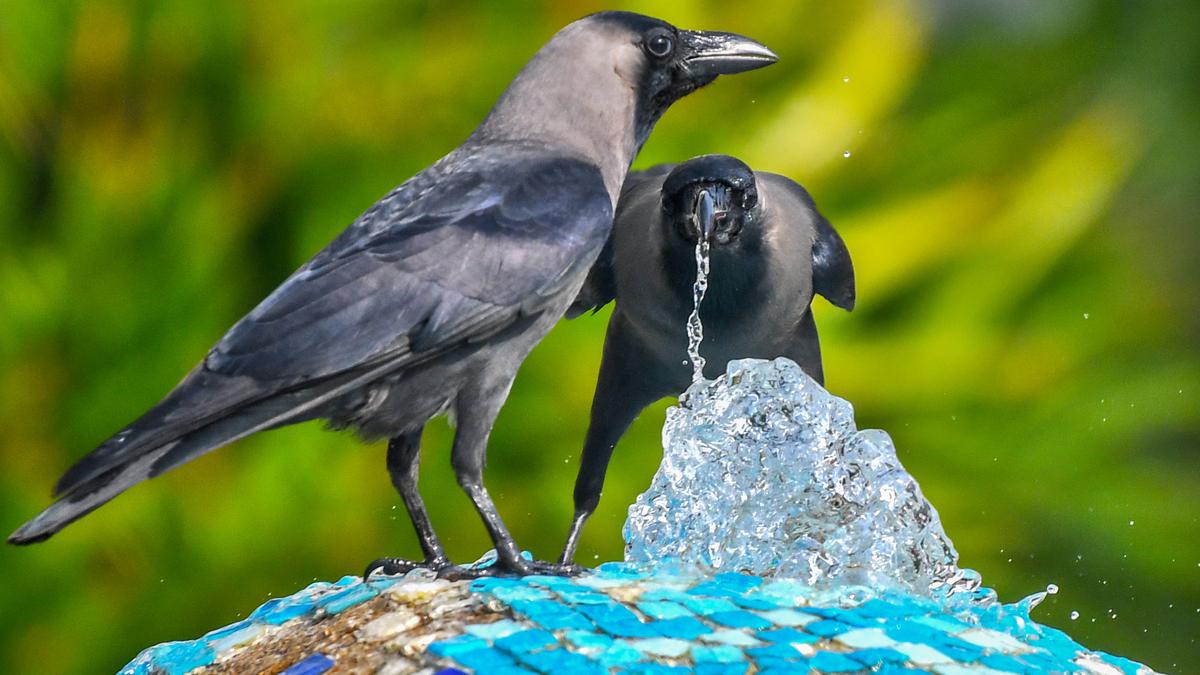
Animal personalities can trip up science, but there’s a solution
The Hindu
Individual behavior patterns may skew studies. A new approach called ‘STRANGE’ could help, by taking into account the habits, tendencies and life experiences of the creatures under scrutiny
Several years ago, Christian Rutz started to wonder whether he was giving his crows enough credit. Rutz, a biologist at the University of St. Andrews in Scotland, and his team were capturing wild New Caledonian crows and challenging them with puzzles made from natural materials before releasing them again. In one test, birds faced a log drilled with holes that contained hidden food, and could get the food out by bending a plant stem into a hook. If a bird didn’t try within 90 minutes, the researchers removed it from the dataset.
But, Rutz says, he soon began to realize he was not, in fact, studying the skills of New Caledonian crows. He was studying the skills of only a subset of New Caledonian crows that quickly approached a weird log they’d never seen before — maybe because they were especially brave, or reckless.
The team changed their protocol. They began giving the more hesitant birds an extra day or two to get used to their surroundings, then trying the puzzle again. “It turns out that many of these retested birds suddenly start engaging,” Rutz says. “They just needed a little bit of extra time.”
Scientists are increasingly realizing that animals, like people, are individuals. They have distinct tendencies, habits and life experiences that may affect how they perform in an experiment. That means, some researchers argue, that much published research on animal behavior may be biased. Studies claiming to show something about a species as a whole — that green sea turtles migrate a certain distance, say, or how chaffinches respond to the song of a rival — may say more about individual animals that were captured or housed in a certain way, or that share certain genetic features. That’s a problem for researchers who seek to understand how animals sense their environments, gain new knowledge and live their lives.
“The samples we draw are quite often severely biased,” Rutz says. “This is something that has been in the air in the community for quite a long time.”
In 2020, Rutz and his colleague Michael Webster, also at the University of St. Andrews, proposed a way to address this problem. They called it STRANGE.
Why “STRANGE”? In 2010, an article in Behavioral and Brain Sciences suggested that the people studied in much of published psychology literature are WEIRD — drawn from Western, Educated, Industrialized, Rich and Democratic societies — and are “among the least representative populations one could find for generalizing about humans.” Researchers might draw sweeping conclusions about the human mind when really they’ve studied only the minds of, say, undergraduates at the University of Minnesota.


Explore 2026's wallpaper trends in India, highlighting botanicals and handmade designs that enhance modern homes with nature-inspired aesthetics.

Mercedes-Benz CLA 250+ with EQ Technology review: design, performance, range and features explained. Discover how the new electric CLA combines advanced AI, long range, fast charging and futuristic styling for the next generation of luxury EVs.

AI tool for sparrow conservation

BTS’s comeback with ‘Arirang’ marks a major global music event. When does the album release, and where can you watch their concert live stream? We have all the details

The 2026 U.S. cholesterol guidelines urge starting screening and treatment at 30 to prevent cardiovascular disease effectively.

Olam Festival 2026 in Thiruvananthapuram returns March 27-29 with 120+ vendors, music, art, and cultural zones.

A few storytellers in Thiruvananthapuram share their journeys, challenges, and evolving methods on World Storytelling Day, inspiring young minds.

76-year-old Kurian Jacob from Kerala triumphs with seven medals, including five golds, at the Open Masters Games in Abu Dhabi.

Explore the nature of the human mind as an emergent property of brain activity and complex neural interactions.

CERN's Large Hadron Collider discovers the Xi-cc-plus particle, enhancing understanding of quantum mechanics and baryon behavior.

Vibha Batra’s latest book, Spotless (Hachette India) is a novel in verse for young adults

In its first edition, the Madras Art Salon spotlights the works of journalist and artist Narayan Lakshman at The Botanical Club, a social space in the British Deputy High Commission, Chennai

Cholesterol enhances melanoma cell invasion by making nuclei squishier, revealing a potential treatment target in cancer progression.