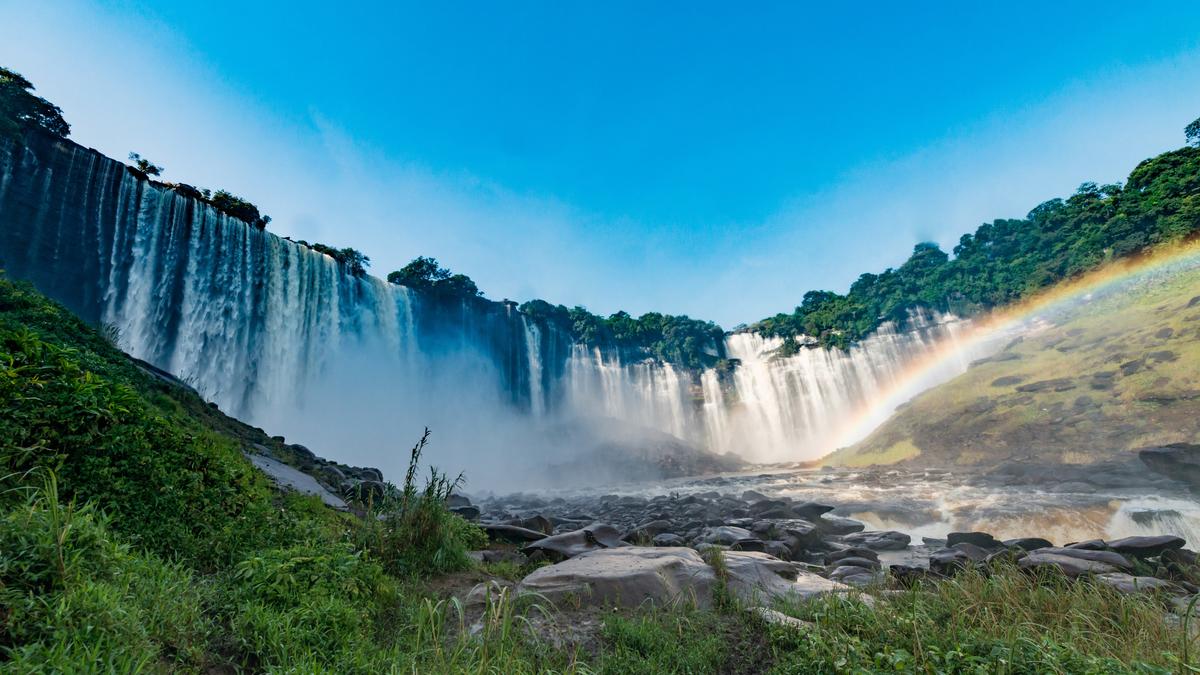
Angola: Land of endless discovery
The Hindu
Angola: A diverse country in southwestern Africa with rich history, culture, wildlife, and natural beauty.
Angola, in southwestern Africa, is the seventh largest country in the continent and the second-largest Portuguese-speaking nation in the world. Roughly square shaped, Angola is bordered by the Republic of the Congo in the northwest, the Democratic Republic of the Congo in the north and northeast, Zambia in the southeast, Namibia to the south, and the Atlantic Ocean in the west. The capital and largest city is Luanda, while the currency is the Angolan Kwanza.
Angola was colonised by Portugal until became a separate nation in 1975. It was the last African country to gain independence from Portugal.
A narrow coastal strip extends from north to south along the Atlantic Ocean. From the coast, hills and mountains rise inland into a great escarpment. The Bié Plateau, also known as the Central Plateau of Angola, takes up most the central region. The longest river is the Cuanza, which is also the only river wholly within the country that is navigable. In south-central Angola is the Huíla Plateau. The highest mountain is Mount Moco, which reaches an elevation of 2,620 m above sea level.
The three major ethnic groups are the Ovimbundu, the Mbundu and the Bakongo. While the official language is Portuguese, more than 40 other languages — mostly belonging to the Bantu group — are spoken here. Close to 70% of the population is urban. The country’s birth rate is among the highest in the world, while the life expectancy is among the lowest. The population is young; nearly half the people are under the age of 15.
Food in Angola is a melange of local flavours and Portuguese influences. Funge, or cassava flour stirred into boiling water and typically eaten with stew, is a staple dish. Chicken muamba is an aromatic stew often considered to be the country’s national dish. Other common dishes include mufete (a classic grilled fish), calulu (fish stew), kizaca (cassava leaves mixed with ground peanuts) and catatos (caterpillars fried with garlic).
Since Angola has varied ecosystems, it is home to a diverse range of fauna including leopards, elephants, lions, hyenas, giraffes, zebras, buffaloes, wildebeests, hippos and monkeys. The skies abound in more than 900 species of birds. The giant sable antelope, the national symbol of Angola, is endemic to the region and is held in great regard by the people. It was believed to have been wiped out during the long civil war but rediscovered in 2004.


The government plans to amend the FCRA, introducing new regulations for NGO asset management and accountability for key functionaries.

The draft policy for “Responsible Digital Use Among Students”, released on Monday by the Department of Health and Family Welfare, has recommended that parents set structured routines with clear screen-time rules and prioritise privacy, safety, and open conversation with children on digital well-being.

Police Observer Sushant Kumar Saxena conducts surprise inspection at Shencottai police station, reviewing warrants and security arrangements ahead of elections.

Andhra Pradesh government to launch key projects in April, focusing on industrial growth and infrastructure development, says Nara Lokesh.

Lok Sabha refers the Corporate Laws (Amendment) Bill to a JPC amid opposition concerns over CSR provisions dilution.

SHG members in Kanniyakumari use snakes and ladders to raise election awareness and boost voter turnout.

Government accelerates consultations for early implementation of the Women’s Reservation Act to ensure women’s representation in 2029 elections.

CM A. Revanth Reddy distributes ₹1 crore insurance cheques to families of deceased Electricity department employees, enhancing financial security for workers.

The Bengaluru Traffic Police (BTP) registered 634 cases of drunk driving during a week-long special enforcement drive conducted across the city between March 16 and March 22.

GHMC intensifies action against property tax defaulters, seizing properties and offering a One Time Settlement scheme for payments.

CCB arrests three drug peddlers in Mangaluru, seizing ₹2.5 lakh worth of MDMA and other valuables.

TVK's 28 candidates in Puducherry include former BJP MLAs, a sitting Independent, and a retired police IG.

BRS submits notice on private member bill to Speaker