Ancient skeleton found in Mexico cave threatened by train
The Hindu
Some of the oldest human remains in North America have been discovered in sinkhole caves.
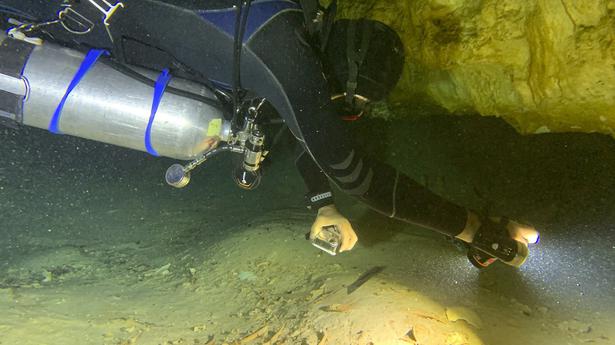
A prehistoric human skeleton has been found in a cave system that was flooded at the end of the last ice age 8,000 years ago, according to a cave-diving archaeologist on Mexico's Caribbean coast.
Archaeologist Octavio del Rio said he and fellow diver Peter Broger saw the shattered skull and skeleton partly covered by sediment in a cave near where the Mexican government plans to build a high-speed tourist train through the jungle.
Given the distance from the cave entrance, the skeleton couldn't have gotten there without modern diving equipment, so it must be over 8,000 years old, Del Rio said, referring to the era when rising sea levels flooded the caves.
“There it is. We don't know if the body was deposited there or if that was where this person died,” said Del Rio. He said that the skeleton was located about 8 metres underwater, about a half-kilometre (one third of a mile) into the cave system.
Also Read: Georgian archaeologists find 1.8-million-year-old human tooth
Some of the oldest human remains in North America have been discovered in the sinkhole caves known as “cenotes” on the country's Caribbean coast, and experts say some of those caves are threatened by the Mexican government's Maya Train tourism project.
Del Rio, who has worked with the National Institute of Anthropology and History on projects in the past, said he had notified the institute of the discovery. The institute did not immediately respond to questions about whether it intended to explore the site.


Explore 2026's wallpaper trends in India, highlighting botanicals and handmade designs that enhance modern homes with nature-inspired aesthetics.

Mercedes-Benz CLA 250+ with EQ Technology review: design, performance, range and features explained. Discover how the new electric CLA combines advanced AI, long range, fast charging and futuristic styling for the next generation of luxury EVs.

AI tool for sparrow conservation

BTS’s comeback with ‘Arirang’ marks a major global music event. When does the album release, and where can you watch their concert live stream? We have all the details

The 2026 U.S. cholesterol guidelines urge starting screening and treatment at 30 to prevent cardiovascular disease effectively.

Olam Festival 2026 in Thiruvananthapuram returns March 27-29 with 120+ vendors, music, art, and cultural zones.

A few storytellers in Thiruvananthapuram share their journeys, challenges, and evolving methods on World Storytelling Day, inspiring young minds.

76-year-old Kurian Jacob from Kerala triumphs with seven medals, including five golds, at the Open Masters Games in Abu Dhabi.

Explore the nature of the human mind as an emergent property of brain activity and complex neural interactions.

CERN's Large Hadron Collider discovers the Xi-cc-plus particle, enhancing understanding of quantum mechanics and baryon behavior.

Vibha Batra’s latest book, Spotless (Hachette India) is a novel in verse for young adults

In its first edition, the Madras Art Salon spotlights the works of journalist and artist Narayan Lakshman at The Botanical Club, a social space in the British Deputy High Commission, Chennai

Cholesterol enhances melanoma cell invasion by making nuclei squishier, revealing a potential treatment target in cancer progression.