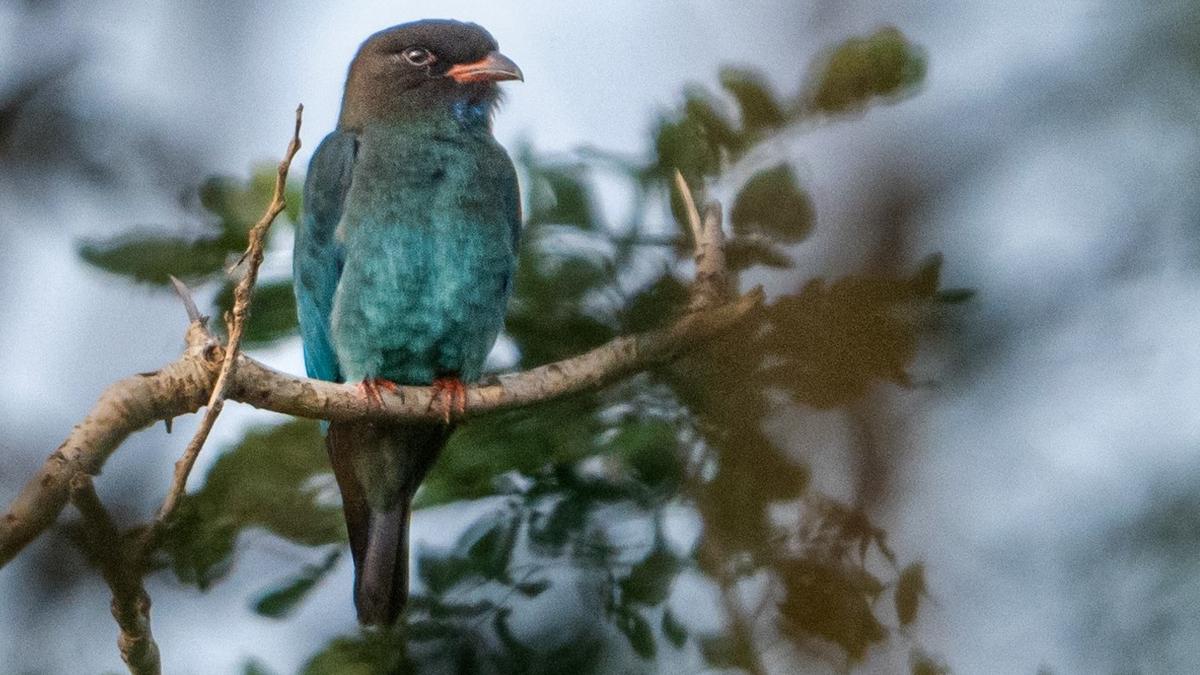
An Oriental dollarbird ‘stops by’ Chembarambakkam lake
The Hindu
The previous documented sighting of a dollarbird in Chennai was at Guindy National Park in 2016; as far as the city goes, this species is among the rarest of rare passage migrants
The birding community’s relationship with any rare passage migrant is best outlined by the connection with an estranged, implacably bitter friend. If a meeting happens, it would be unplanned and fleeting. Often, the chasm would have grown wider than a hippo’s fully extended maw, the last interaction would be as removed from memory as the star Earendel from earth, that when a chance encounter does materialise, the person might go unrecognised at first sight.
On the morning of December 15, 2024, at the Chembarambakkam lake, an Oriental dollarbird (Eurystomus orientalis), at first clap of a pair of eyes, did not cause a sharp intake of breath. Instead, it caused the viewer’s brow to be knitted in mystified concentration.
Two brothers, S. Sathyakumar and S. Sivakumar and their common friend Saravanan Manian had been poking around (as only birders can) in a moderately wooded section caressing the outer perimeter of the Chembarambakkam lake.
That is when this dollarbird fell on Sathyakumar’s eyes, magnified by his binoculars. He saw the bird perched on a tree, but did not “see” it for what it was. He dismissed it as a parakeet explaining the bluish-green tint as a filter effect engineered by the early morning light. A doubt creeping closely on the heels of this judgement, he asked himself if he was missing something.
He sidestepped the idea of raising this question with the other two birders, fearing they would mock him with friendly laughter for failing to call a parakeet a parakeet. Derisive laughter gift-wrapped in friendliness can sometimes have the effect of friendly fire, unintended but still deadly.
“I came around to asking Saravanan to look at the bird through his camera viewfinder. He clicked it. It turned out to be a dollarbird,” says Sathyakumar with a half-suppressed laugh.
Birds generally get identified much before they are fully seen. A cursory look at a part of the bird — a diagnostic feature in ornithology speak — is all it takes to realise what the rest of it looks like. And out pops the bird’s name. They call it GISS. With rare passage migrants, GIFF hardly works, especially when the bird has not showed up for extended periods of time. These birders travel far to bird, and they have seen the dollarbird in its wintering ground in Kerala. Else, the identification would have been much delayed.


Assembly polls 2026: Follow updates from The Hindu on the upcoming elections in five States, on March 22, 2026

Currently, only the services in the 32 series stop at the section of the road adjacent to the Broadway terminus, temporarily closed on account of reconstruction work. Small traders association tells R. Ragu that ensuring the services now accommodated at the temporary terminus at Island Grounds stop at NSC Bose road would benefit visitors to the markets in Parrys

The Hindu photo feature on Aragam which is now known as book village. Photos and text by Imran Nissar

The silent reading movement in the Mylapore-Mandaveli-RA Puram area showed up first at Nageswara Rao Park around two years ago, with modest ambitions, when Balaji launched it along with other reading enthusiasts from the region. This initiative has now moved parks, and seems to set to get entrenched in one. Due to renovation work at Nageswara Park, the reading session became irregular. With the Nageswara Rao park work gaining more surface area, it had to be shifted elsewhere. And it seems set to continue with a newly discovered green patch in RK Nagar in the Sundays to follow.

Explore Tamil Nadu's upcoming four-cornered election contest, featuring key players DMK, AIADMK, TVK, and Naam Tamizhar Katchi.

Trump plans to deploy ICE officers for airport security unless Democrats fund the Department of Homeland Security amid ongoing shutdown.

Cuba experiences its second nationwide blackout in a week, exacerbated by an ongoing U.S. oil blockade and energy crisis.

Kamal Haasan urges Tamil media to avoid the term "censorship" in films, advocating for artistic freedom and recognition of certification.

Pottalurani residents boycott elections again, demanding closure of fish waste processing units impacting health and environment.

VCK leader Thirumavalavan emphasizes the need for local candidates amid concerns over past electoral losses due to outsiders.

Women teachers over 50 express discontent after Revenue Department denies blanket exemption from SIR and census duties in Karnataka.

Union Minister skips crucial NCTP meeting amid backlash over controversial Transgender Rights Bill, raising concerns within the community.

Former Minister Semmalai urges parties to limit freebies and prioritize development for Tamil Nadu's future prosperity.