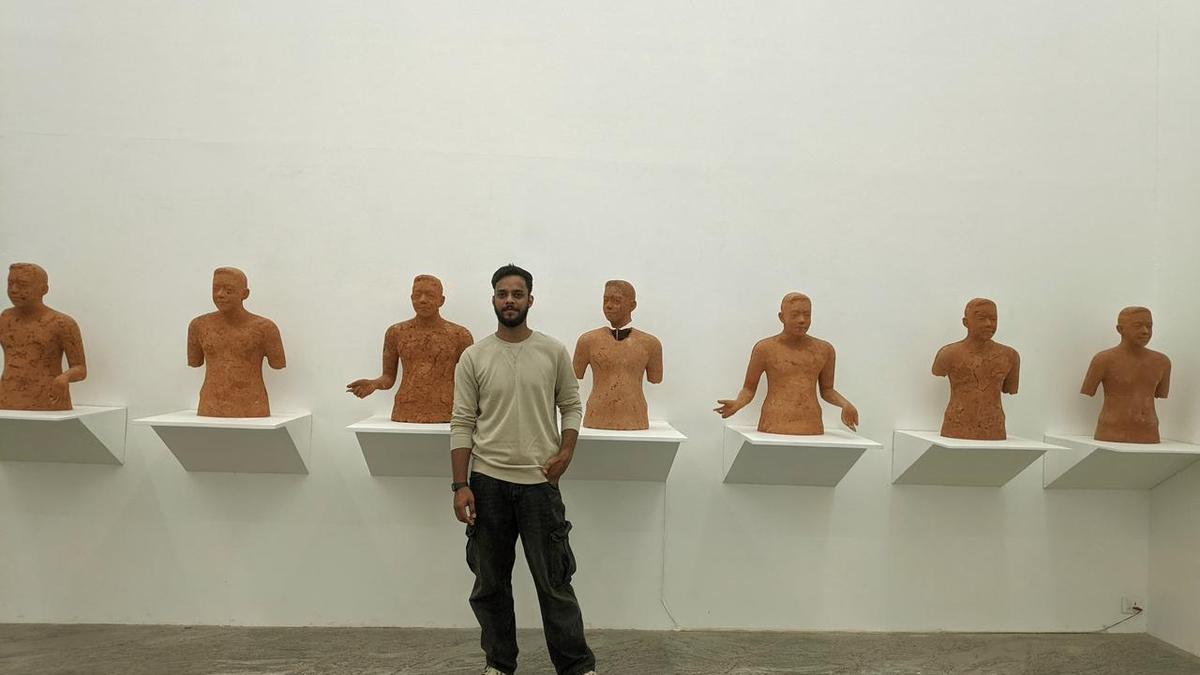
An eclectic collection of artwork on display at the College of Fine Arts’ annual show in Thiruvananthapuram
The Hindu
SEE is the annual show at the College of Fine Arts that features works by students and faculty
One of the first characters you meet at SEE is a terracotta sculpture by Ebin PR. Clothes wrinkled, the man sits listlessly in his chair. As you face him, you get the sense that you are blocking his view. His gaze is more intense than yours. SEE, the annual show presented by the students and faculty of the College of Fine Arts, Thiruvananthapuram, leaves you hanging.
Perhaps the charm of the show is its unwillingness to decode itself for the viewer. Many of the pieces, over 235 of them, are untitled. There is little to no explanation of content or context beyond a note with the artist’s name and the medium; the piece speaks for itself. The artwork is curious, disquieting, and altogether fantastic.
In one room, a terracotta head swivels to greet you. “I’m very self-obsessed,” says artist Chandan Gour lightly. “These are all self-portraits from my childhood.” He is talking about a collection of six life-size figures in various stages of completion and damage. The figure at the centre has a rotating head. Hailing from a family of artisans, his project continues its tradition while incorporating modern elements. There is a curious seventh piece next to these figures — a pile of broken limbs and terracotta shards. “It was a figure like the rest which was broken during the show. I decided to keep it. It’s still a part of the work. Besides, a lot of sculptures in historic sites and museums are broken.”
Sandra Thomas, who creates paper sculptures, also leans into the fragility of her work. Her piece, AM Agenda, features a life-size model of a rubber plantation worker and his dog. At first glance, it is impossible to not mistake it for an actual person. “Most sculptures are made of heavier materials. Made of a lightweight object like paper, the longevity of this sculpture is in question. It is a temporary piece,” she says. The focus of her art is on the everyday moments of working-class people.
Everyday life also finds its place in Eswar D’s art. Bent out of shape, a large granite key lies at the centre of his piece. The key is surrounded by plaster feet. “I wanted to depict how a mundane object like a key becomes central to your life. Even if it is old and battered, its absence makes you anxious. You walk around the house, looking for it.” It tells us how the person, represented through the plaster feet, is more fragile than the dependable granite of the key.
The technicolour world of Athul KP’s work illustrates a lack of control. “It is about the tangled experiences of life when you know what you should do but cannot. Sometimes, things just don’t move the way you want them to.” He uses a mix of acrylics and oil paints to recreate suffocation akin to a nightmare. The abstract nature of his work prioritises intensity of experience over literality.
Personal experience shapes art even in Rahul Buski’s work. “There is a violence to my art,” he says. Thalum thakraum represents Adivasi’s life through unique brushstrokes and dark hues. The violence that the Adivasi community faces is an undercurrent in all his works. If you look closely, you will notice that varambu — the ridges used to designate boundaries in fields — are a common feature in his art. In Rahul’s works, they are an ever-present reminder of the partitions in society. “It takes time to learn about yourself; your family, your education, your clothes, your food, your place in society.”


Explore 2026's wallpaper trends in India, highlighting botanicals and handmade designs that enhance modern homes with nature-inspired aesthetics.

Mercedes-Benz CLA 250+ with EQ Technology review: design, performance, range and features explained. Discover how the new electric CLA combines advanced AI, long range, fast charging and futuristic styling for the next generation of luxury EVs.

AI tool for sparrow conservation

BTS’s comeback with ‘Arirang’ marks a major global music event. When does the album release, and where can you watch their concert live stream? We have all the details

The 2026 U.S. cholesterol guidelines urge starting screening and treatment at 30 to prevent cardiovascular disease effectively.

Olam Festival 2026 in Thiruvananthapuram returns March 27-29 with 120+ vendors, music, art, and cultural zones.

A few storytellers in Thiruvananthapuram share their journeys, challenges, and evolving methods on World Storytelling Day, inspiring young minds.

76-year-old Kurian Jacob from Kerala triumphs with seven medals, including five golds, at the Open Masters Games in Abu Dhabi.

Explore the nature of the human mind as an emergent property of brain activity and complex neural interactions.

CERN's Large Hadron Collider discovers the Xi-cc-plus particle, enhancing understanding of quantum mechanics and baryon behavior.

Vibha Batra’s latest book, Spotless (Hachette India) is a novel in verse for young adults

In its first edition, the Madras Art Salon spotlights the works of journalist and artist Narayan Lakshman at The Botanical Club, a social space in the British Deputy High Commission, Chennai

Cholesterol enhances melanoma cell invasion by making nuclei squishier, revealing a potential treatment target in cancer progression.