An Alberta general strike raises many questions. Key among them are if — and when
CBC
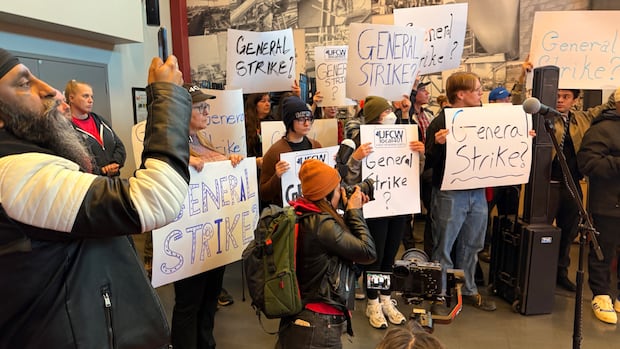
For the first time in more than 100 years Albertans are talking about a general strike, inflamed by the provincial government's use of the notwithstanding clause to force striking teachers back to work.
The Alberta Federation of Labour (AFL) includes 24 unions, representing 175,000 workers. Its president, Gil McGowan, also leads a larger collective called Common Front, which has agreed to treat an attack on some workers' rights as an attack on all workers’ rights.
McGowan has said unions will encourage workers — who are incensed by the provincial government’s suspension of bargaining rights — to volunteer for recall campaigns and prepare for a possible general strike.
But what are the legalities around a general strike? What moves could the Alberta government take to stop it? And if it does go ahead, when should it happen?
A general strike is when workers across multiple sectors refuse to work. The general strike being proposed by the AFL would not be legal because it could not fulfil the requirements outlined by the Alberta Labour Relations Board.
The board conditions for a legal strike or lockout are:
The issue of whether a general strike is legal is “an odd question,” according to James Muir, associate professor of history and law at the University of Alberta.
The main differences between legal and illegal strikes are protections granted to workers and the risk of overt punishment, he said.
Muir said general strikes can be a unifying tool, bringing together workers from different industries.
“These opportunities for large-scale protest moments, whether it's a day or six weeks, is an opportunity to really build that community, and that, in itself, can have a really significant impact on getting the political change that those groups of people want,” he said
In a legal strike, employees are not entitled to pay but they are still considered employees and cannot be terminated because they are on strike, according to the labour board.
An illegal strike is more precarious for workers, putting them at risk of fines or losing their jobs.
If the strike is unlawful, the board will order that it stop and may make other remedial orders. These would be filed with the clerk of the court and are then enforceable as court judgments. Knowingly violating a court order is considered contempt of court, with judicial discretion for penalties ranging from fines to imprisonment.
These types of ramifications during an illegal strike were felt by Alberta’s nurses in 1988.


Eight casinos across southwest B.C. have been sold to First Nations in the last two years, with the province's gambling scene set to be reshaped as a result.

Hamilton hosts the Junos Sunday, and the musical awards show is bringing tourists, musicians, concerts and a ton of themed events to the city this week.

The multi-million-dollar deal at the heart of a high-profile fight between the Canadian government and one of the world’s biggest carmakers contains multiple clauses about the company’s footprint in Ontario, according to a copy obtained by CBC Windsor.

In recent months, Calgary police have carried out three day-long safety blitzes, parading out dozens of officers to flood an area with their increased presence — at least, temporarily.

A national organization is seeking people with experience in Canada's forestry sector as they put together a working group that will examine ways to improve forest recovery following wildfires.

Ella Heyder is bracing for a breakup, even though she already moved out decades ago.

Shawne Hopkins never saw it coming.

Politicians return to Queen’s Park Monday for a shortened spring session, as Premier Doug Ford prepares to unveil his eight budget amid heightened global economic uncertainty.

Despite a recent announcement that a water supply pipeline will be build in Oneida Nation of the Thames, some members of the community say that's no excuse for taking water for granted.

As scandal has swirled around former prince Andrew Mountbatten-Windsor, questions and curiosity have also focused on his ex-wife, Sarah Ferguson, and their daughters, Princesses Beatrice and Eugenie.

Friday may have been the first day of spring, but winter storms are not over yet for Newfoundland.

While we officially welcomed spring last week, an incoming system will be a reminder that snow is still very much part of the new season, especially early on.

The future of a national historic site in Fredericton is up for discussion at meetings across New Brunswick in the next few weeks as the Anglican diocese considers what to do about costly repairs needed at Christ Church Cathedral.