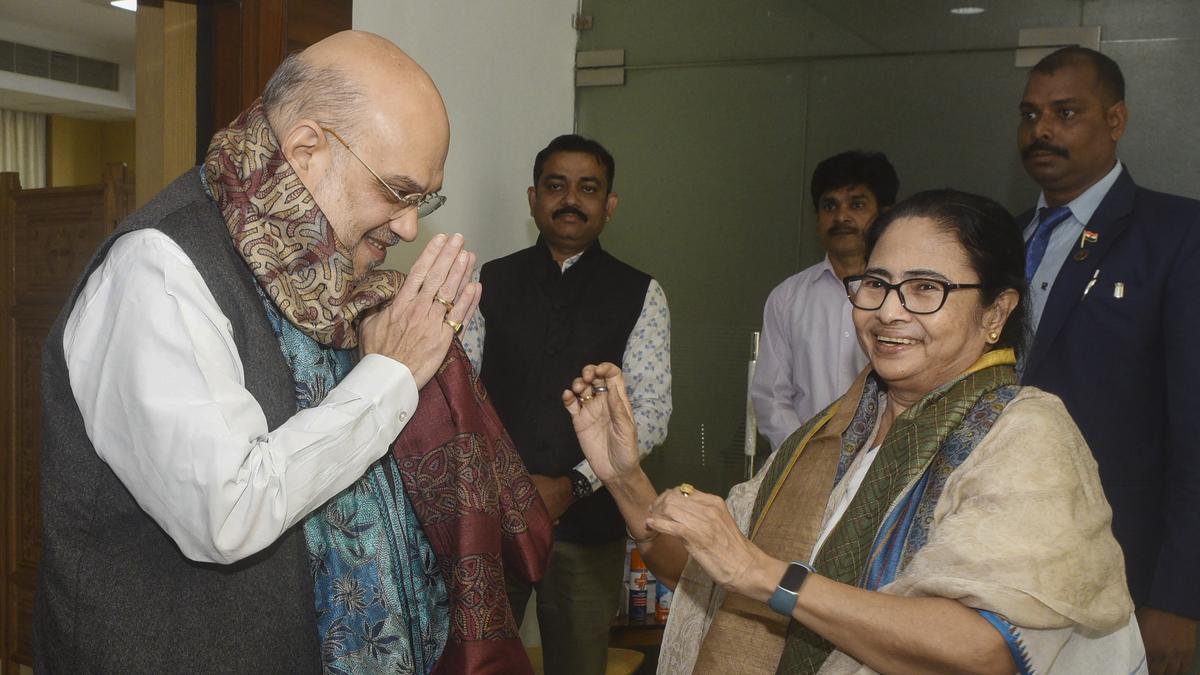
Amit Shah chairs EZC meeting in Kolkata with Mamata, Soren and Tejashwi
The Hindu
Home Minister also holds one-on-one meeting with Bengal Chief Minister in Kolkata
Union Home Minister Amit Shah on Saturday chaired the 25th Eastern Zonal Council meeting in Kolkata where representatives from four States including West Bengal Chief Minister Mamata Banerjee were present. The meeting which lasted for over two hours at the West Bengal State Secretariat was also attended by Jharkhand Chief Minister Hemant Soren, Deputy Chief Minister of Bihar Tejashwi Yadav and Ministers from Odisha alongside senior officials of the Ministry of Home Affairs and officials of the States.
Issues of cross-border smuggling and illegal infiltration along the India-Bangladesh border as well as left-wing extremism were raised at the meeting.
“The Union Home Minister said that Left Wing Extremism [LWE] has almost been eliminated from the Eastern region of the country and efforts should be made to sustain this decisive dominance... He stressed that efforts should be sustained as extremism should not re-emerge in LWE-free States and that these States should develop at par with other parts of the country,” a press statement by the Press Information Bureau said.
The statement also added that the Union Home Minister urged the Chief Minister to ensure the creation of a district-level mechanism of the NCORD (National Narcotics Coordination Portal) and hold regular meetings.
According to sources, while the Union Home Minister suggested that States should also share a responsibility for security of border areas along with Border Security Force (BSF), the West Bengal Chief Minister said that arms were being smuggled from other States into West Bengal. The meeting also assumes significance as all the four eastern States are ruled by Opposition parties.
After the meeting, Mr. Shah and Ms. Banerjee held a one-on-one meeting at the Chief Minister’s chamber on the 14 th floor of Nabanna Buildings. Though none of the leaders made any official statement about the meeting, the development assumes both administrative and political significance.


Horses shone at Auroville's 2026 event, showcasing equestrian talent through dressage, derby, and show jumping competitions.

Telangana Governor Shiv Pratap Shukla attends Bihar Foundation Day celebrations in Hyderabad, honoring Bihar's historical and cultural contributions.

Samsung workers protest for the reinstatement of 27 suspended employees, citing unfulfilled promises from the Labour Minister.

The Vice-Chancellor of Rajiv Gandhi University of Health Sciences (RGUHS) B. C. Bhagavan said on Sunday that the university will soon open a research centre on Yoga and Naturopathy on 60-acre land in Bengaluru.

UT Matters: Construction of Uppar drain road overbridge in Puducherry to be completed in four months, amid traffic regulations.

Union Minister Dharmendra Pradhan highlights Bharat Innovates' aim to elevate Indian deep-tech startups to the global stage.

In an exclusive interview, DMK MLA Ezhilan discusses Tamil Nadu's 2026 elections, party structure, and local governance challenges.

Minister Satish Jarkiholi asserts confidence in retaining Davangere and Bagalkot seats in upcoming bypolls amid addressing internal discontent.

Sunil Ambekar of RSS emphasizes national unity, defending road prayer restrictions and promoting awareness of shared ancestry in India.

Opposition MPs and activists voice strong concerns against proposed amendments to the Transgender Persons Act at a Delhi hearing.

Four Assam police commandos injured in an extremist attack during a gunfight in Tinsukia district, officials report.

Campaigning intensifies in Ernakulam district as candidates engage voters ahead of the crucial Assembly polls.

Lord Rama rides Hanumantha Vahanam on sixth day of Brahmotsavams in Tirupati