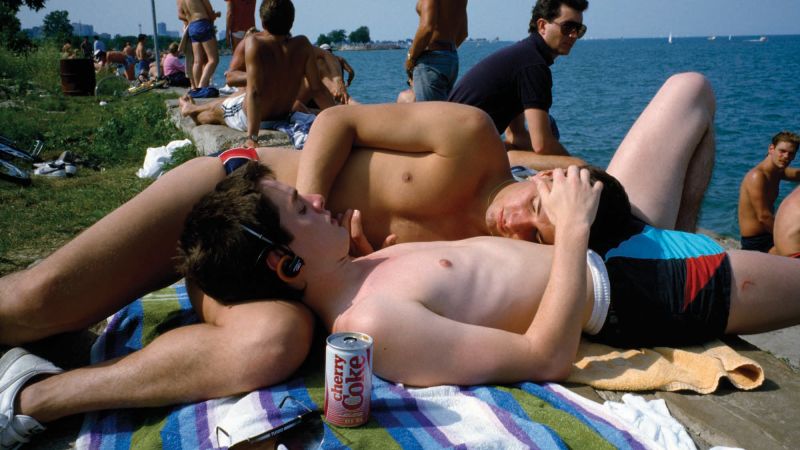
Amid the AIDS crisis, this photographer documented a sunlit haven for gay men
CNN
A tender image of love on Chicago’s lakefront, taken by Doug Ischar, was archived for decades. Now, his 1985 series “Marginal Waters” is being resurfaced in a new exhibit at the MCA Chicago.
In a grassy outcrop along Lake Michigan’s deep blue waters, two young men pictured in a color slide photograph relax on towels, shirtless and curled against each other. Along the rocky ledges, other men chat and sunbathe, bicycles and shoes abandoned on the ground. A vintage Cherry Coke can — one of the image’s only markers of time — gives the intimate scene a subtle feeling of an idyllic advertisement, and a sense of nostalgia. Decades later, that feeling is more acute: the gay beach in Chicago where it was taken no longer exists, memorialized today by a 2.5-acre garden in memory of those who lost their lives to AIDS. The image, shot by then-aspiring photographer Doug Ischar, is part of his series “Marginal Waters,” capturing the summer of 1985 as gay Chicagoans gathered at the Belmont Rocks, which became both a site for pleasure and solace as the AIDS epidemic devastated LGBTQ+ life. The lakefront stretch was a haven until the early 2000s, when it was demolished and refortified to prevent coastal flooding. “(The photos) document a way of life that I thought was very particular and also feared was, in a sense, doomed,” Ischar said in a video call with CNN. Pockets where gay men could be open and relaxed in the US were rare, and the disease, ignored by the government for years, only stigmatized the community further during a time of peril. “I feared the life of gay men would be forced back underground and hidden away, as it was for centuries,” he added. At the time, Ischar, who made the series during his graduate studies at California Institute of the Arts, found there was little interest in his work. But, decades later, encouraged by gallerists, he began bringing them out of the archives. Now, some of those images, including of the unnamed couple, are included in the exhibition “City in a Garden: Queer Art and Activism in Chicago” at the Museum of Contemporary Art Chicago. The expansive group show, which opens in July, positions the city as an underrecognized hub for LGBTQ+ art and social action. According to the show’s curator, Jack Schneider, US cities beyond New York City and San Francisco are often overlooked in their contributions to queer history; “City in a Garden” aims to broaden that scope. “(‘Marginal Waters’) were some of the first artworks I thought of when I started to think of this exhibition,” Schneider said. “I find them profoundly melancholic. They’re bright, leisurely and romantic at times. But beneath this surface-level serenity, the AIDS crisis (had) ravaged this community.” In 1985, and four years into his presidency, Ronald Reagan had only just publicly acknowledged the epidemic for the first time, and effective treatments were still years away. As Ischar recounted, people within the community were dying every day.


With his maxi leopard print Chanel bag, the pop star issued a loud and proud proclamation that he got his hands on one of the most in-demand, status-bestowing styles of the moment.

Millions more adults should consider starting cholesterol-lowering medications earlier to reduce their risk of heart attack and stroke, according to new medical guidance.

At Paris Fashion Week, there were luxuriously plain black dresses and coats of the kind favored by Carolyn Bessette Kennedy, models strutting down runways with theatrical flourishes, and in some cases, no cellphones in sight.

Roughly one-third of respondents – equivalent to more than 82 million Americans – said they have had to cut back on at least one daily living expense to cover their health care bills, according to a new survey.

Before South African high school students complete their final exams, they first walk the red carpet, pulling out all the stops for their celebratory matriculation, or ‘matric,’ balls. The photographer Alice Mann documented the increasingly lavish dances for five years in her new book, “The Night is Young.”

The drug leucovorin was touted by the Trump administration in September as a potential treatment for thousands of children with autism. Now, some parents and guardians of children with autism say they feel abandoned by the US Food and Drug Administration’s new stance on leucovorin.

The prescription drug leucovorin is getting a label update, though it’s not what that the US Food and Drug Administration suggested might be coming during a White House briefing in September, when officials touted the drug as a potential treatment for thousands of children with autism.

With the release of “The Bride!” we asked scholars, film curators and experts in Mary Shelley’s work why so few women have tackled the Frankenstein story — and the impact that has on how we make sense of the 200-year-old tale.

In front of the Louvre Pyramid, Eileen Gu stepped out this week wearing a set of diaphanous wings — a fitting ensemble for an Olympic athlete whose sport sends her airborne.

Meagan Johnson recently spent four days calling dozens of pharmacies around Austin, Texas, trying to fill a prescription for her son, Jack.

Evidence is mounting that the wildly popular weight-loss medicines known as GLP-1s may also hold potential for treating addiction, and the field may be on the verge of obtaining desperately needed answers through more study.

Known for her blistering pace and powerful shots, the soccer player is having a Barbie made in her likeness as the toymaker names her as role model of the year.

The Screen Actors Guild Awards are back with a new name — and a thematic dress code.