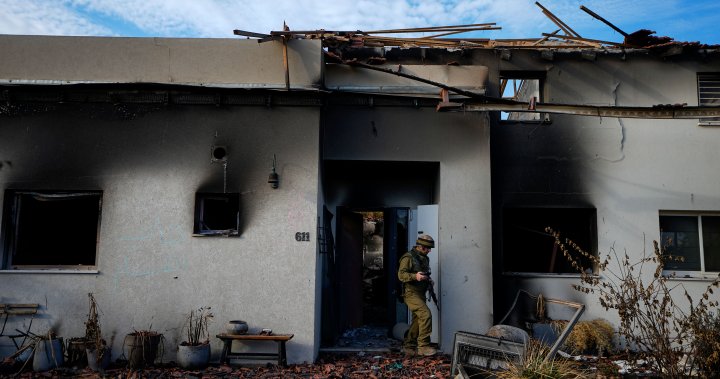
Amid Israel-Hamas conflict, what are the rules of war?
Global News
International law breaches can also trigger sanctions — such as those imposed on Russia over the invasion of Ukraine — and in rare cases draw UN-authorized military intervention.
Hamas and Israel have both been accused of breaking international law during their latest conflict, and the United Nations says it is collecting evidence of war crimes by all sides.
Enforcing the law amid the fog of war is difficult. Holding perpetrators to account once conflicts are over has often proved elusive.
Here is a look at some of the issues.
The rules of armed conflict are governed by a set of internationally recognized laws and resolutions, including the United Nations charter, which prohibits aggressive wars but allows countries the right to self-defense.
Battlefield behavior has international humanitarian laws including the Geneva Conventions, drawn up after World War II and agreed on by almost every nation.
The four conventions agreed upon in 1949 set out that civilians, the wounded and prisoners must be treated humanely in wartime. They ban murder, torture, hostage-taking and “humiliating and degrading treatment” and require fighters to treat the other side’s sick and wounded.
The rules apply both to wars between nations and conflicts, like that between Israel and Hamas, in which one of the parties is not a state.
Another key document in the law of war is the founding Rome Statue of the International Criminal Court, which defines as war crimes acts including intentional attacks on civilians, civilian settlements or humanitarian workers, destroying property where not militarily necessary, sexual violence and unlawful deportation.


Iran's foreign minister said the U.S. attacked Kharg and Abu Musa islands from locations in the United Arab Emirates, a claim the UAE rejected.

Citing "a more contested environment", British Prime Minister Keir Starmer and his Irish counterpart Micheal Martin said the exercises would begin in September.

Only one in four (23 per cent) Canadians approve while, 16 per cent are unsure either way. Forty-two per cent were found to strongly disapprove.

Countries around the world are grappling with skyrocketing costs for key commodities like oil and fertilizer as the war with Iran continues to upend global trade.

The U.S. Central Command said the crash followed an unspecified incident involving two aircraft in “friendly airspace,” and that the other plane landed safely.

Water treatment centres in the Persian Gulf region are under threat amid the Iran war, with desalination plants in areas like Bahrain taking damage from strikes.

John Gradek said that the price of jet fuel is up about 30 per cent and the cost of fuel represents about 30 per cent of an airline's operating costs.

Iran's unrelenting attacks on shipping traffic and energy infrastructure in the Persian Gulf pushed oil back above $100 a barrel on Thursday.

Concerns were raised in a document sent to British Prime Minster Keir Starmer in December 2024 when he was considering appointing Peter Mandelson.

Canada and a group of dozens of other countries have agreed to release 400 million barrels of oil from their strategic reserves as the Iran war threatens the global supply.

Iran's military command said on Wednesday the world should be prepared for oil to hit US$200 a barrel, as three more ships came under attack in the blockaded Gulf.

Iran launched new attacks against Israel and Gulf Arab countries, while Israel carried out airstrikes on Iran and Lebanon, where it is battling Hezbollah militants.

The department said it is also seeing fewer Canadians take government-assisted travel options as flights gradually resume in certain parts of the region.