Americans just can’t quit their giant, gas-burning trucks
CNN
American drivers are still in love with big, gas-burning trucks and SUVs, and automakers are as eager ever to build them – even as US electric vehicle sales continue to climb.
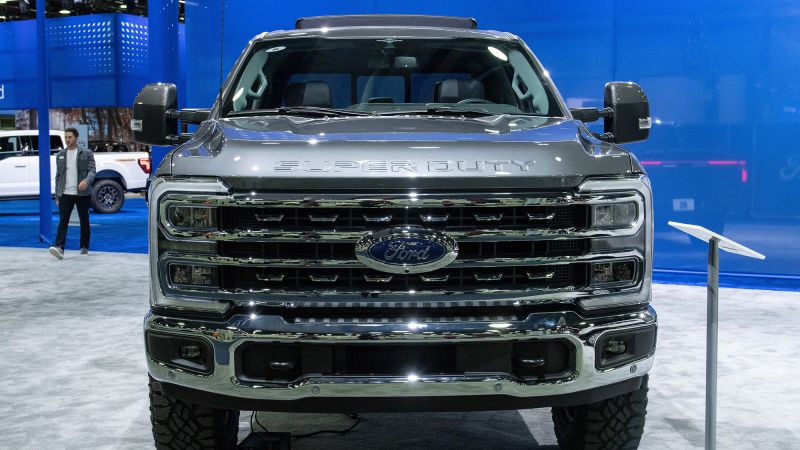
American drivers are still in love with big, gas-burning trucks and SUVs, and automakers are as eager ever to build them – even as US electric vehicle sales continue to climb. Although traditional automakers have pledged to invest tens of billions of dollars to transition to EVs in the coming decade, they’re making a renewed bet on those large gasoline-powered vehicles that they expected to move away from. The surprising change is in part because consumer demand for EVs has not lived up to expectations, and it is partly because the demand for large gasoline powered trucks and SUVs is keeping prices, and profits, in that part of the market very strong. A prime example of traditional automakers’ changing views of electric vehicles can be found in the Ford assembly plant in Oakville, Ontario, just outside of Toronto. Last year, when Ford was negotiating with the Unifor, the union that represents Canadian auto workers, the company promised it would build a new three-row EV at its plant in Oakville, Ontario, starting as soon as 2025. But in April, it hit the brakes on those plans and put the roll-out of the EV model on hold until at least 2027. “The additional time will allow for the consumer market for three-row EVs to further develop and enable Ford to take advantage of emerging battery technology,” Ford said in a statement at that time. When – and if – it does move ahead with the new three-row EV, it might look to build it at a US or Canadian plant, or it might look to a lower cost factory in Mexico. Last month, Ford announced plans for a different vehicle to be built at the Oakville plant in its place: Super Duty trucks, a larger version of Ford’s F-series trucks that remain Ford’s best selling vehicles. Ford said it will build 100,000 of the Super Duty trucks a year in Oakville starting in 2026, even while maintaining production of the trucks at its plants in Kentucky and Ohio.


The national average price for a gallon of regular unleaded gasoline is on the verge of hitting $4 for the first time since 2022.

Oil prices rose Monday after the United States and Iran threatened fresh attacks on energy facilities in the Middle East, including power plants, signaling that the conflict may yet escalate.

The war in Iran is pushing up prices for already-strained farmers, with higher costs for fertilizer and energy on top of last year’s tariffs. And the increasing pressure on American agriculture could lead to even bigger price tags at the grocery store.

If you only watched Fox News over the weekend, you didn’t hear about President Donald Trump’s widely condemned reaction to Robert Mueller’s death.

Oil prices rose Sunday after President Donald Trump threatened to “obliterate” Iran’s power plants if the Strait of Hormuz is not reopened by Monday evening.

Defense Secretary Pete Hegseth has been taking steps to thwart news coverage of the Pentagon for more than a year. Now he has finally met some resistance.

Defense Secretary Pete Hegseth has been taking steps to thwart news coverage of the Pentagon for more than a year. Now he has finally met some resistance.

Gerald Rodriguez, the general manager of an NPR affiliate in rural Colorado, expected federal funding for public media to shrink. He didn’t expect it to disappear almost overnight.

The much-touted new tax breaks for tips, overtime, seniors and car loan interest have a lot of income tax filers expecting a big bump in their refunds this year – or a big cut in their tax bill.

Looking out his shop window, across the street, just to the right, Paloma Clothing co-owner Mike Roach sees one of Portland, Oregon’s, most expensive gas stations.

Oil and liquefied natural gas tankers moving through the Strait of Hormuz carry around 20% of the world’s supply. But for countries on the Persian Gulf, the waterway is more than just an energy route – it’s a lifeline for more than 100 million people.

A California jury has largely sided with Twitter shareholders who accused billionaire Elon Musk of defrauding them by intentionally driving down the social media company’s stock ahead of his $44 billion acquisition in 2022.

The war with Iran is disrupting global oil flows, damaging energy infrastructure and raising fears of prolonged conflict. But gold, usually considered a safe haven during periods of economic uncertainty, has slumped.