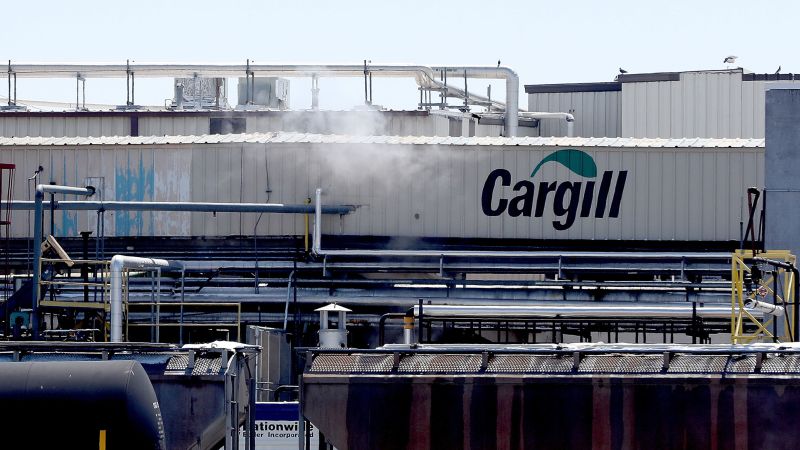
America’s biggest private company is laying off thousands of workers
CNN
Cargill, the megasized Minnesota-based food production giant, is laying off about 5% of its global workforce as food commodity prices drop.
Cargill, the megasized Minnesota-based food production giant, is laying off about 5% of its global workforce as food commodity prices drop. Cargill is America’s largest privately held company, according to Forbes, and is also the world’s largest agricultural commodities trader. In a statement to CNN on Monday, the company said the changes are part of “a long-term strategy” set earlier this year. Cargill is big into the ingredients business. In simpler terms, the company is the middleman distributing grains, meat and other farm products around the world. It had profited heavily during the pandemic and its aftermath, thanks to inflation and geopolitical turmoil throwing food prices into disarray. But now, grocery prices are dropping. On top of that, the number of US cattle is down, according to the US Department of Agriculture. Cargill has invested to be one of the largest beef processors in North America. Bloomberg reported earlier this year that the famously tight-lipped behemoth’s profits had fallen to $2.48 billion in the fiscal year ending in May. This was less than half of the record $6.7 billion it made from 2021 to 2022, and also the lowest profit since 2016. Cargill has more than 160,000 employees, according to its 2024 report, though it does not regularly release financial reports. That means there will be an estimated 8,000 cuts. Brian Sikes has been the company’s president and CEO since 2023.


Artificial intelligence could widen the problem of income inequality, said BlackRock CEO Larry Fink in his annual letter to shareholders.

Stocks soared and oil prices fell after President Donald Trump on Monday said the United States would postpone further strikes on Iran’s energy infrastructure, pending the outcome of negotiations.

The national average price for a gallon of regular unleaded gasoline is on the verge of hitting $4 for the first time since 2022.

Oil prices rose Monday after the United States and Iran threatened fresh attacks on energy facilities in the Middle East, including power plants, signaling that the conflict may yet escalate.

The war in Iran is pushing up prices for already-strained farmers, with higher costs for fertilizer and energy on top of last year’s tariffs. And the increasing pressure on American agriculture could lead to even bigger price tags at the grocery store.

If you only watched Fox News over the weekend, you didn’t hear about President Donald Trump’s widely condemned reaction to Robert Mueller’s death.

Oil prices rose Sunday after President Donald Trump threatened to “obliterate” Iran’s power plants if the Strait of Hormuz is not reopened by Monday evening.

Defense Secretary Pete Hegseth has been taking steps to thwart news coverage of the Pentagon for more than a year. Now he has finally met some resistance.

Defense Secretary Pete Hegseth has been taking steps to thwart news coverage of the Pentagon for more than a year. Now he has finally met some resistance.

Gerald Rodriguez, the general manager of an NPR affiliate in rural Colorado, expected federal funding for public media to shrink. He didn’t expect it to disappear almost overnight.

The much-touted new tax breaks for tips, overtime, seniors and car loan interest have a lot of income tax filers expecting a big bump in their refunds this year – or a big cut in their tax bill.

Looking out his shop window, across the street, just to the right, Paloma Clothing co-owner Mike Roach sees one of Portland, Oregon’s, most expensive gas stations.

Oil and liquefied natural gas tankers moving through the Strait of Hormuz carry around 20% of the world’s supply. But for countries on the Persian Gulf, the waterway is more than just an energy route – it’s a lifeline for more than 100 million people.