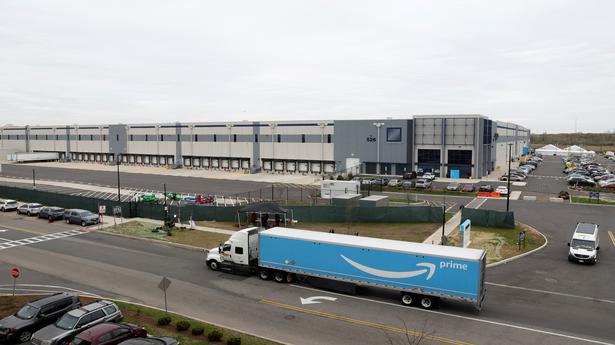
Amazon’s net loss prompts query: Has it built too many warehouses?
The Hindu
Amazon will spend less on fulfilment projects this year than last, while transportation investments will be flat to slightly down.
In recent years, Amazon.com Inc has spent billions of dollars on new warehouses that cut into profits, explaining to investors that it had no choice but to meet ever-rising consumer demand.
(Sign up to our Technology newsletter, Today’s Cache, for insights on emerging themes at the intersection of technology, business and policy. Click here to subscribe for free.)
It turns out, Amazon may have built too much, too soon, analysts say.
The world's largest online retailer on Thursday reported $2billion in incremental costs from having excess fulfilment and transportation capacity, a dramatic shift from just two years ago when Amazon had to turn away merchants' goods because it had room only for vital supplies.
The company is lowering its capital expenditure plans for 2022, its Chief Financial Officer Brian Olsavsky said. Amazon will spend less on fulfilment projects this year than last, while transportation investments will be flat to slightly down.
The new reality began to emerge halfway through 2021. Amazon was on track to double its warehouse and delivery network, a feat necessitated by consumers' embrace of at-home shopping toavoid COVID-19 infections in stores. For the first time, space was not the retailer's main constraint; it was labour to staff facilities fully. At Amazon's scale, that meant hiring 270,000 workers in six months.
After the Christmas holiday, consumer demand dwindled, as always. Online sales dipped from a year ago, Amazon's results showed. Brick-and-mortar stores beckoned shoppers once the Omicron wave subsided, and still others faced a choice between buying goods and filling their cars with high-priced gas. Amazon says order patterns have remained the same.


Meta Chief Executive Mark Zuckerberg is building a CEO agent to help him do his job, the Wall Street Journal reported

Insurance penetration and density are often misunderstood and do not reveal how many families are insured or whether they would be financially secure if the main earning member were to die. The real issue is not reach but adequacy, as households may have life insurance but not enough cover to replace lost income, leaving them financially vulnerable.

Five top firms lose ₹1 lakh crore in market value, with HDFC Bank experiencing the largest decline of ₹56,124.48 crore.

L&T confirms 95% of its West Asia project sites are safe, while addressing logistics challenges amid ongoing regional conflicts.

Mines Ministry to auction 19 critical mineral blocks on March 23, expanding strategic resources for clean energy and technology sectors.

Mines Ministry to auction 19 critical mineral blocks on March 23, expanding strategic resources for clean energy and technology sectors.

Five top firms lose ₹1 lakh crore in market value, with HDFC Bank experiencing the largest decline of ₹56,124.48 crore.

HDFC Bank terminates three senior officials over client onboarding issues at its DIFC branch amid ethical concerns following chairman's resignation.

Air India CEO warns of potential flight cuts and reduced travel demand due to rising fuel costs amid ongoing Gulf conflict.

Options are widely used by retail traders to speculate on the value of the stock for immediate gains and such behaviour in large scale can distort the market

India achieves 1 billion tonne coal production for the second consecutive year, ensuring stable energy supply and economic growth.

Generic drugmakers in India launch affordable Semaglutide versions, targeting a $1 billion diabetes and weight loss market.

Indian and Asian refiners eye Iranian oil purchases as U.S. waives sanctions amid energy crisis linked to the Iran-Israel war.