Along the Indian-Myanmar border, living in a limbo Premium
The Hindu
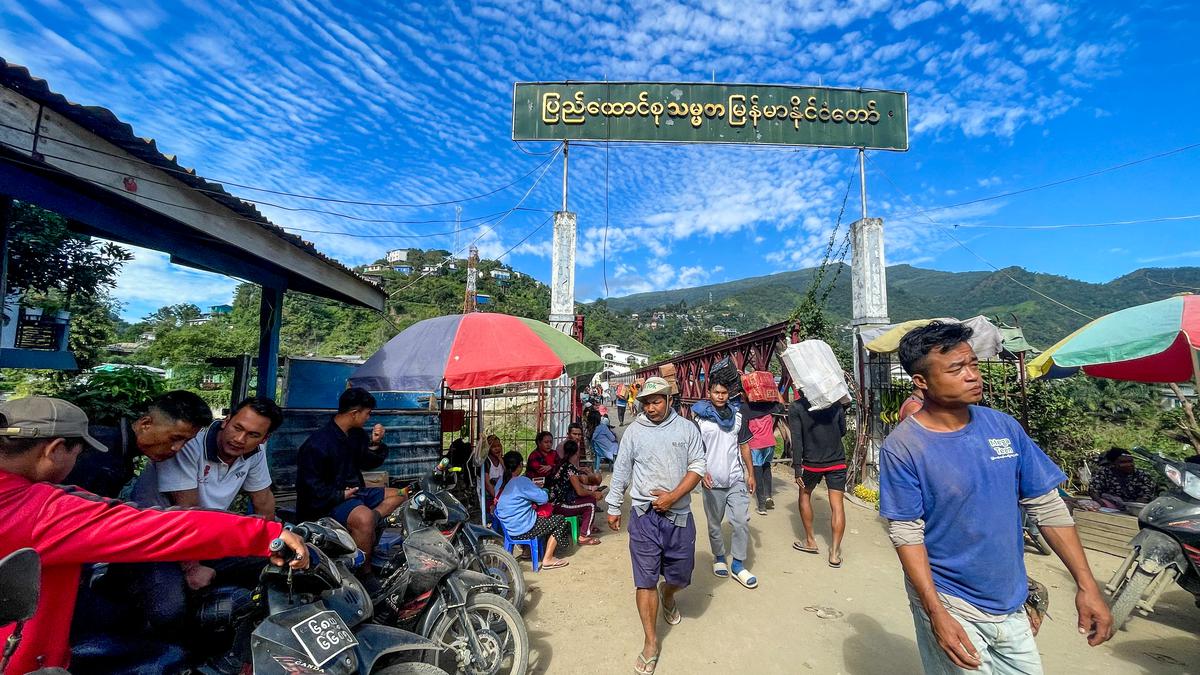
With Myanmar in the grip of violence, its citizens have been fleeing to India and seeking shelter in Mizoram or Manipur. But they now face an uncertain future as the Indian government has decided to fence the 1,643 km-long India-Myanmar border and end the Free Movement Regime
Soon after the Tatmadaw, or Myanmar’s military, seized power in a coup d’etat in February 2021 by displacing the National League for Democracy (NLD)-led government, Sumi, 18, fled the country. She crossed the border into India and finally secured a job in Treasury Square, the administrative hub of Aizawl, Mizoram’s capital.
Sumi was not too worried about leaving her home in Tedim, the second largest town in Myanmar’s Chin State, for Aizawl, covering 255 kilometres over five days by public transport. “She knew she would be among her own people in this foreign land that is much safer and more peaceful than ours,” says Margaret Ngaihi, Sumi’s family acquaintance.
Sumi became Margaret’s apprentice. Margaret, too, had left Tedim about 40 years ago to work at the house of L.R. Sailo, a former director of Mizoram’s Information and Public Relations Department at Treasury Square. Margaret says Sumi, from the Chin community, did not take long to settle down at the house of Sailo, a Mizo.
Margaret had left Tedim under similar circumstances in the 1980s. Myanmar, then called Burma, was under the military dictatorship of Ne Win. The Free Movement Regime (FMR) which promotes local trade and allows residents along the 1,643 km-long India-Myanmar border to move up to 16 km into each other’s territory without travel documents, was not in place then; the agreement between India and Myanmar was implemented only in 2018. She married a Mizo and they had two sons.
“The Chins and Mizos belong to the same ethnic stock. They were inhabiting Zogam (the land of the Zo people) for ages before the British divided our homeland in the 1800s. Marriages and other social interactions between people on either side of the international border are quite common in these parts. It is also not unusual for children in Myanmar to study in Mizoram,” says Sailo. Zogam comprises present-day Mizoram, the Chin State of Myanmar, and areas beyond.
Margaret has occasionally visited her relatives in Tedim. “The civil war has been forcing our people to hunt for jobs abroad. The younger lot in Myanmar prefer Malaysia, which is where Sumi lives now, but we cannot think of a better place than Mizoram, the land of our own people,” Margaret says. Mizoram currently shelters about 35,000 people displaced from Myanmar, Bangladesh, and Manipur.
She is not aware of the geopolitics in the region, specifically about Manipur’s insistence on fencing the India-Myanmar border to block the entry of refuge-seekers from the civil war-torn country. In January, Home Minister Amit Shah announced that the Centre would fence the entire border to restrict free movement into India. But discussions in the neighbourhood on the fencing have made her understand that it might not be easy for her people to travel across the border as easily as she and Sumi did, four decades apart.


Saudi Arabia expels Iranian military staff amid escalating tensions and ongoing missile attacks during the U.S.-Israeli war on Iran.

Russia claims control of Potapivka village in Ukraine's Sumy region amid ongoing military efforts to establish a buffer zone.

Iranian missile strikes on Israeli towns cause widespread damage and injuries, marking a significant escalation in the ongoing conflict.

As Gor makes first trip as U.S. Special envoy to South Asia, Delhi watches strategic signals closely
Sergio Gor's inaugural trip as U.S. Special Envoy to South Asia signals strategic U.S. engagement amid regional tensions.

Slovenians vote in a tight election between liberal and populist candidates, impacting the country's future domestic and foreign policies.

Netanyahu asserts U.S.-Israel alliance fights Iranian threats, emphasizing global security after missile strikes on Israeli and European targets.

Israeli settlers attack Palestinian villages in the West Bank, causing injuries and destruction amid ongoing settlement expansion.

Britain asserts no evidence of Iran planning missile strikes on Europe, despite Israeli claims of missile capabilities.

UNESCO reports over half of countries have banned phones in schools due to concerns about attention, cyberbullying, and social media impact.

Analysis reveals a U.S.-operated Patriot missile likely caused a pre-dawn explosion in Bahrain, injuring numerous civilians.

Sri Lanka raises fuel prices by 25% amid ongoing West Asia conflict, impacting petrol and diesel costs significantly.

Iran strikes near Israeli nuclear research center as Trump threatens attacks on Iranian power plants
Iran's missile strikes near Israel's nuclear site escalate tensions as Trump threatens retaliation against Iranian power plants.

Saudi Arabia intercepts one of three ballistic missiles targeting Riyadh amid ongoing regional tensions and threats from Iran.