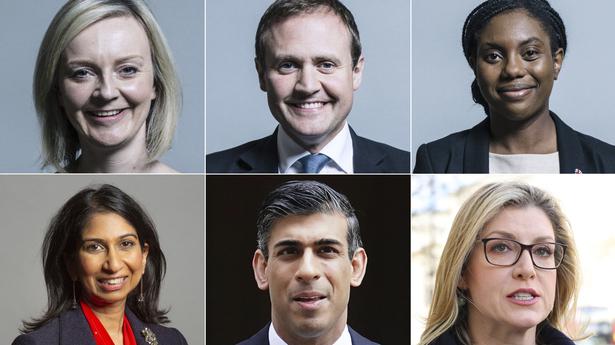
All you need to know about the British prime ministerial race
The Hindu
The contest is now down to five candidates after the second ballot of Conservative party lawmakers with former Finance Minister Rishi Sunak in the lead
The story so far: The second round of voting by Conservative Party MPs to replace outgoing Prime Minister Boris Johnson as the leader of the Tories and the new British Prime Minister, concluded on Thursday, July 14. The candidate leading the race is former British Finance Minister Rishi Sunak, whose resignation led to a flurry of ministers stepping down from Mr. Johnson’s government, leading to the PM’s resignation.
The new Prime Minister of the United Kingdom will not be elected through a general election but through internal ballots in the Conservative Party, which still holds a majority.
The Opposition Labour party had asked for a motion of confidence in the government and in Mr. Johnson, as they want him to step down with immediate effect as opposed to when the new Prime Minister is finally elected. The Labour motion was rejected by the government on July 11 as the norm is to table a straightforward motion to test the confidence of the House in the government, without naming the Prime Minister. Labour’s motion would have put Tory lawmakers in a tricky situation as it would require them to show alignment with the government and Mr. Johnson to win the vote. Losing a no-confidence vote would trigger general elections.
Instead, the government decided on July 13 to introduce a motion of confidence in itself, a vote on which is expected by next week, according to the BBC.
Graham Brady, the chair of the 1922 Committee or the Conservative Private Members' Committee of influential Tory parliamentarians or backbencher MPs who do not hold any government posts, drew up a timetable of the process to elect the new leader.
July 12: Nominations to be the new leader of the Conservative Party formally opened and also closed. At this stage, a candidate needed the backing of 20 MPs including one proposer, one seconder, and 18 other party lawmakers.
July 13: The first round of voting by 358 Conservative MPs to shortlist candidates from those who cleared the nomination stage. Candidates need at least 30 votes in the first round to advance to the next.


Modi and Dissanayake discuss energy cooperation, West Asia conflict, and global supply chain disruptions in a recent phone call.

Russia launches a massive drone and missile attack on Ukraine, signaling the potential beginning of a spring offensive.

U.S. official Elbridge Colby emphasizes India's vital role in the Indo-Pacific, highlighting mutual benefits despite existing differences.

Philippine President Marcos declares national energy emergency amid Middle East conflict, ensuring fuel and essential goods supply stability.

Mohammad Baqer Zolqadr appointed as Iran's new security chief, succeeding Ali Larijani after his assassination.

Israel plans to occupy southern Lebanon amid escalating violence, targeting Hezbollah and causing widespread destruction and civilian casualties.

Trump reveals Secretary Hegseth was pivotal in discussing military action against Iran amid escalating tensions in the Middle East.

Iran arrests 466 individuals for online activities threatening national security amid ongoing tensions with Israel and the U.S.

China protests to Japan over a break-in at its Tokyo embassy, demanding a thorough investigation and accountability.

After securing a historic mandate in Nepal’s polls, Balendra Shah and the RSP face the task of navigating the West Asia conflict and managing ties with India, China and the U.S.

A magnitude 7.6 earthquake struck near Tonga, prompting evacuations but no tsunami warnings or immediate damage reports.

Iran launches missile attacks on Israel, rejecting Trump's negotiation claims as 'fake news,' escalating regional tensions and market volatility.

A large explosion at Valero refinery in Port Arthur, Texas, prompts shelter-in-place order for nearby residents, no injuries reported.