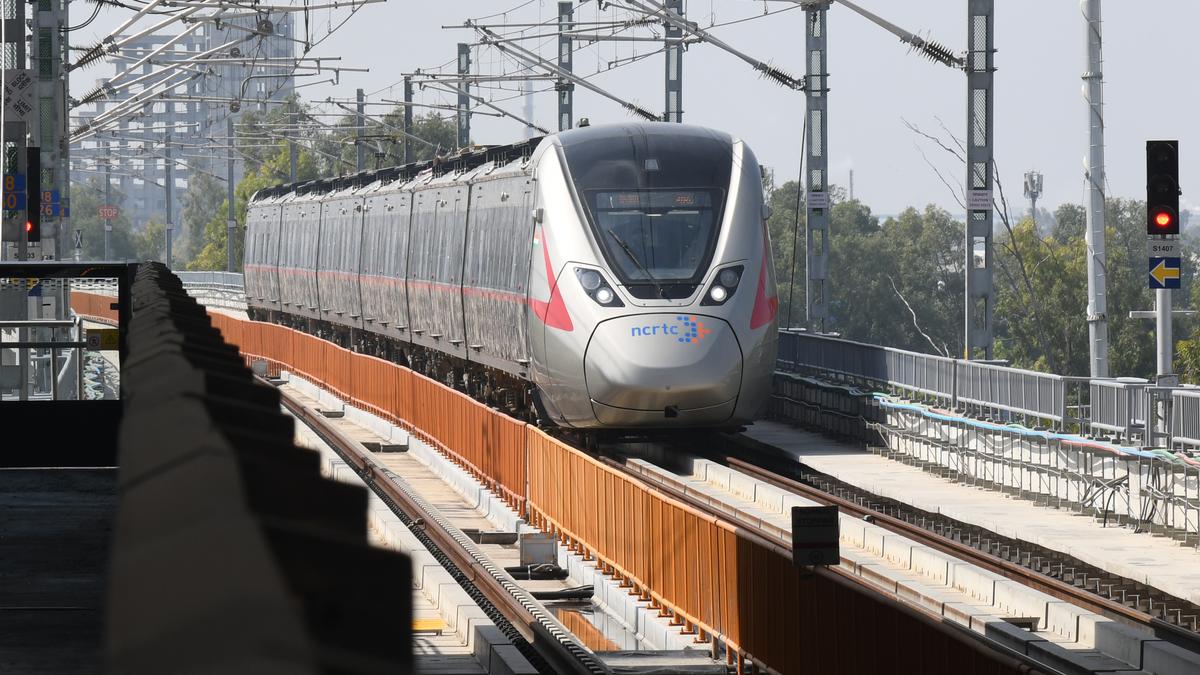
All set for launch, RapidX offers high-speed travel, modern amenities at affordable price
The Hindu
RapidX, a high-speed train, begins services on a 17-km stretch of the Delhi-Meerut RRTS. It boasts an average speed of 100 km/hr, with five standard coaches, one reserved for women, and a premium coach. Tickets cost ₹20-100, with free travel for children under 90 cm. Commuters can enter stations from service lanes, purchase QR code-based tickets, and use NCMC cards. Platforms have PSDs, safety handles, CCTVs, and first aid kits. 50% of staff are women, with preference given to locals.
Modern amenities and inclusive infrastructure await commuters all set to hop on the high-speed train, RapidX, which will begin services on a 17-km stretch of the Delhi-Meerut Regional Rapid Transit System (RRTS) after its inauguration by Prime Minister Narendra Modi on Friday.
The train will stop at five stations painted in turquoise and beige — Sahibabad, Ghaziabad, Guldhar, Duhai, and Duhai Depot — on the stretch, which is part of the 82-km Delhi-Meerut corridor that is expected to be fully operational by 2025.
The Hindu took a ride on RapidX ahead of its maiden journey and witnessed the train, which boasts an average speed of 100 km/hr, zoom past cars on the Delhi-Meerut Expressway.
The train has five standard coaches, with one reserved for women, and a premium coach. While a ticket for a seat in the standard coach costs ₹20, passengers have to shell out double that amount to enjoy a ride in the premium coach. End-to-end travel in a standard coach will cost a total of ₹50 and ₹100 in the premium coach. Travel is free for children whose height is below 90 cm.
Commuters can enter the stations from gates located on the service lanes of the expressway. Parking space is available for those using personal vehicles to reach the stations. Multiple entry/exit points have been provided on either side of the road at every station. A foot overbridge has been constructed for those who wish to cross the road to take a train ride or reach the bus terminal.
QR code-based paper tickets can be purchased from ticket counters or ticket vending machines (TVMs) installed at the stations using currency notes, bank cards, or unified payments interface (UPI).
The TVMs can also be used to recharge National Common Mobility Cards (NCMC). The RRTS will allow commuters to use any NCMC card from the first day of operations.


The government plans to amend the FCRA, introducing new regulations for NGO asset management and accountability for key functionaries.

The draft policy for “Responsible Digital Use Among Students”, released on Monday by the Department of Health and Family Welfare, has recommended that parents set structured routines with clear screen-time rules and prioritise privacy, safety, and open conversation with children on digital well-being.

Police Observer Sushant Kumar Saxena conducts surprise inspection at Shencottai police station, reviewing warrants and security arrangements ahead of elections.

Andhra Pradesh government to launch key projects in April, focusing on industrial growth and infrastructure development, says Nara Lokesh.

Lok Sabha refers the Corporate Laws (Amendment) Bill to a JPC amid opposition concerns over CSR provisions dilution.

SHG members in Kanniyakumari use snakes and ladders to raise election awareness and boost voter turnout.

Government accelerates consultations for early implementation of the Women’s Reservation Act to ensure women’s representation in 2029 elections.

CM A. Revanth Reddy distributes ₹1 crore insurance cheques to families of deceased Electricity department employees, enhancing financial security for workers.

The Bengaluru Traffic Police (BTP) registered 634 cases of drunk driving during a week-long special enforcement drive conducted across the city between March 16 and March 22.

GHMC intensifies action against property tax defaulters, seizing properties and offering a One Time Settlement scheme for payments.

CCB arrests three drug peddlers in Mangaluru, seizing ₹2.5 lakh worth of MDMA and other valuables.

TVK's 28 candidates in Puducherry include former BJP MLAs, a sitting Independent, and a retired police IG.

BRS submits notice on private member bill to Speaker