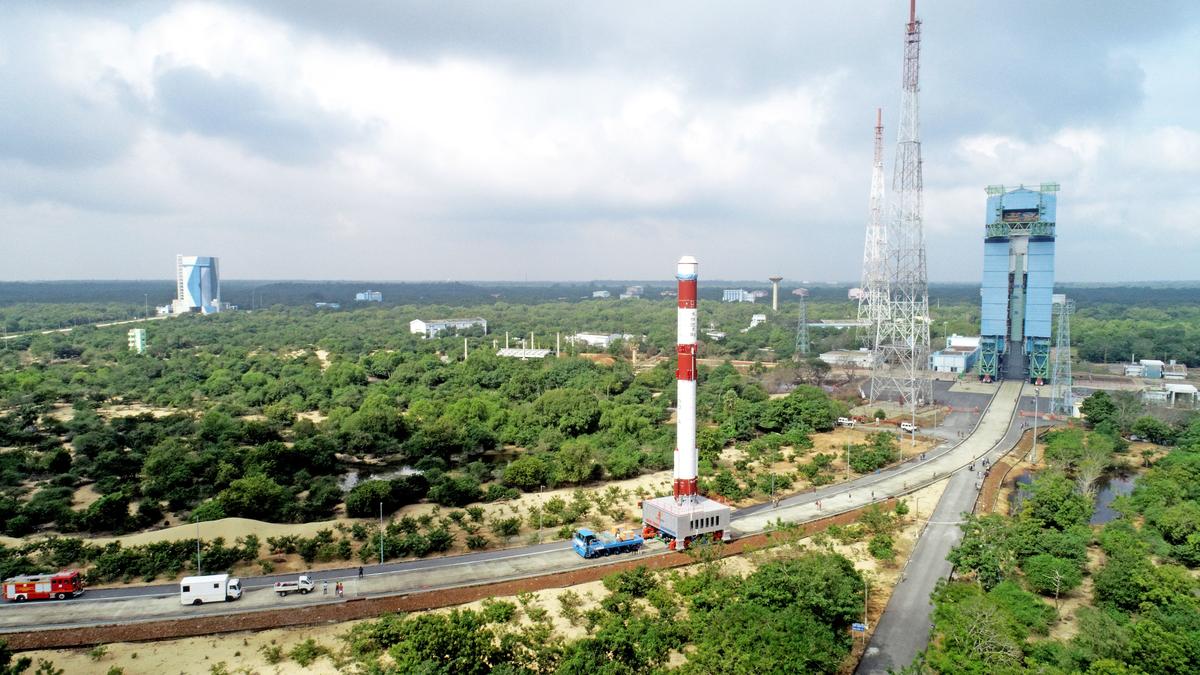
All eyes on PSLV-C60 mission as ISRO looks to end 2024 on a high Premium
The Hindu
ISRO's 2024 missions include PSLV-C59, Gaganyaan, and PSLV-C60, showcasing advancements in space technology and human spaceflight.
The Indian Space Research Organisation (ISRO) hopes to end 2024 on a high with an exciting mission on the launch pad to test technologies that will one day be used for interplanetary and human spaceflight. It also hopes to kickstart preparations for human spaceflight missions that have already been delayed for years.
PSLV-C59: The PSLV-C59 mission dedicated to NewSpace India Ltd. (NSIL) placed the European Space Agency’s (ESA) Proba-3 spacecrafts — short for ‘Project for Onboard Autonomy’ — into a highly elliptical orbit of 600 km x 60,500 km as planned 18 minutes after liftoff. The liftoff was from the Satish Dhawan Space Center’s first launch pad at 4:04 pm IST on December 5. This mission demonstrated the ability of ISRO’s Polar Satellite Launch Vehicle (PSLV) to launch a spacecraft into such orbits.
After the lunch, the ESA said the Yatharagga station in Australia began receiving telemetry from the satellite “almost immediately after separation”. The telemetry will be passed on to the ESA’s mission control centre in Belgium.
Gaganyaan: Ahead of its experimental flight of the Launch Vehicle Mark 3 (LVM-3) X in 2014, ISRO had wanted to test the vehicle’s ability to fly through the thickest part of the earth’s atmosphere. The organisation designed a suborbital flight for this with an altitude of 126 km and a range of 1,600 km from Satish Dhawan Space Centre. The vehicle didn’t carry a cryogenic engine in its third stage and didn’t reach earth orbit by design.
The LVM-3 X test flight also tested the reentry characteristics of the crew module using the Crew-module Atmospheric Re-entry Experiment (CARE). On December 18, 2014, the CARE module re-entered the earth’s atmosphere after separating from the rocket and performed a controlled landing in the Bay of Bengal using its thrusters and parachutes. This successful mission was an important precursor to India’s human spaceflight mission.
Ten years later on the same day, December 18, 2024, ISRO began assembling the human-rated LVM-3 (HLVM-3) for its first uncrewed mission. This was done by stacking the nozzle end segment of the S-200 solid rocket motor with the full flex seal nozzle at 8.45 am on December 18. This marked the official launch campaign for the HLVM-3 G1/OM-1 mission. ‘G1’ stands for the first Gaganyaan mission and ‘OM-1’ for the first orbital module mission. The orbital module consists of the crew module and a service module.
Just like the CARE mission preceded the human spaceflight mission, the SpaDeX — short for ‘Space Docking Experiment’ — is a predecessor to ISRO’s Bharatiya Antariksh Station (BAS) and the Chandrayaan-4 missions. SpaDeX will demonstrate in-orbit docking.


Erode district conducts first EVM randomisation for April 23 Assembly elections, ensuring transparency and fairness in allocation.

TNCC conducts public consultation in Erode to gather community input for its upcoming election manifesto.

CID to investigate sexual assault allegations against suspended Moodbidri Police Inspector P.G. Sandesh, reveals Home Minister Parameshwara.

A 50-year-old woman was found dead in southwest Bengaluru’s Kengeri in the early hours of Monday, the police said.

Papanasam dam's water level reaches 66.15 feet, with inflow at 76 cusecs and discharge at 300 cusecs.

Development without impact: Coastal residents of Kanniyakumari and Nagercoil constituencies voice discontent

Rampant encroachments in Tiruchi threaten pedestrian safety and traffic flow, undermining smart pavement initiatives and exacerbating congestion.

Discover Kerala's electoral history in 'Vottarivu,' a 201-page booklet released ahead of the 2026 Assembly elections.

Experts at a floriculture conference in Shivamogga stress the need to reduce greenhouse gas emissions and enhance soil carbon levels.

First randomisation of EVMs and VVPATs for Tiruchi and Perambalur districts completed with political party representatives present.

Puducherry elections see ongoing DMK-Congress rift over seat-sharing, leading to candidate conflicts on nomination day.

Einstein College and Sri Sarada College in Tirunelveli celebrated significant events, honoring academic excellence and cultural heritage.

Priyanka Gandhi criticises PM Modi's West Asia remarks, urging for a comprehensive Parliament discussion on the matter.