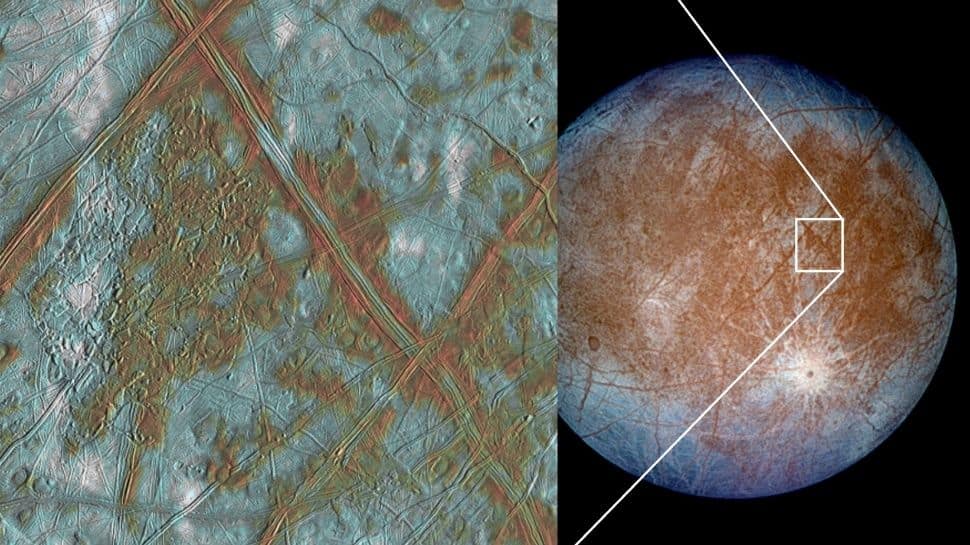
Alien life on Europa? Jupiter's moon may contain evidence of extraterrestrial life
Zee News
Among Jupiter's four moons known as Galilean satellites, Europa is the smallest, having been discovered by Galileo Galilei in 1610.
With regard to extraterrestrial life in our solar system, there would be little doubt that Europa, Jupiter's moon, is an excellent area to begin the search. Europa was discovered by Galileo Galilei in 1610, and it is the smallest of Jupiter's Galilean moons, which are four small satellites that circle the largest planet in our solar system.
Despite the fact that the Voyager spacecraft passed by Europa in the late 1970s and discovered strong indications of a liquid water ocean behind its ice shell, researchers will likely have difficulties studying the water samples because of the thickness of the icy crust, which might be as thick as 30 kilometres. Due to its thickness, the ocean previously appeared impossible for studies and analyses.
A groundbreaking new research published in 'Nature Communications' on Tuesday (April 19) shows that there may be a second way to sample Europa's deep seas.
Read also: Massive solar flare from the Sun could impact satellite communications: CESSI
In addition, the study notes that this ice shell's thickness and thermophysical structure are poorly constrained. Structure and dynamics are essential for "understanding both basic geophysical processes and the habitability of Europa."
