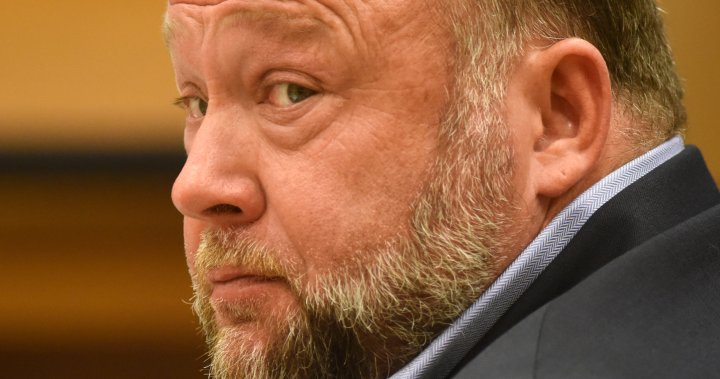
Alex Jones should be punished further for ‘evil’ Sandy Hook claims: lawyer
Global News
In a hypothetical calculation, the families' lawyers say punitive damages could total $2.75 trillion, but they have not asked for a specific amount.
A lawyer for Sandy Hook families said Monday that significant punitive damages need to be imposed on Alex Jones to deter him and other conspiracy theorists from continuing to tell their followers the 2012 Newtown shooting was a hoax, in addition to the nearly $1 billion he already has been ordered to pay victims’ relatives.
Attorney Christopher Mattei’s comments came during a video conference hearing before a Connecticut judge on how much punitive damages the Infowars host and his company, Free Speech Systems, should pay victims’ families. In a hypothetical calculation, the families’ lawyers say punitive damages could total $2.75 trillion, but they have not asked for a specific amount.
Judge Barbara Bellis said she will rule at a later date.
Jones’ lawyer, Norm Pattis, argued any punitive damages should be minimal, because last month’s $965 million jury verdict on compensatory damages is so large and “unparalleled” it is the functional equivalent of punitive damages. Mattei disagreed.
“Here, where— in our view— the conduct really rises to the level of reprehensible, evil, really just malicious conduct, there’s no situation in which … nominal punitive damages would be sufficient under the law,” Mattei told the judge. “There’s really no way any of us, I think, can wrap our minds around what kind of depravity it took for Mr. Jones to do what he did.”
Jones, based in Austin, Texas, continued to bash the trial as unfair and an assault on free speech rights. He has said he will appeal the verdict and already has asked for a new trial. He also said he doesn’t have $2 million to his name, so he can’t pay the verdict.
Pattis on Monday questioned how the jury arrived at the $965 million figure. He said there was no evidence at the trial of the net worth of Jones or Free Speech Systems.
“The jury came up with an unusual verdict,” Pattis said. “You will never come up with an algorithm that explains it. These numbers are simply unparalleled in Connecticut history, perhaps in the history of any case in the United States.”


Trump’s visit to China is seen as an opportunity to build on a fragile trade truce, but it has become tangled in his effort to find an endgame to the war in Iran.

White House economic adviser Kevin Hassett said oil tanker traffic in the Strait of Hormuz starting to move is "a sign of how little Iran has left."

The secretary of Iran’s Supreme National Security Council, and the head of the Revolutionary Guard’s all-volunteer Basij force, were “eliminated last night," Israel said.

Explosions were heard in Maiduguri, the Borno state capital, where Nigeria’s homegrown jihadi Boko Haram extremists have waged an insurgency for more than a decade.

Iran is reportedly allowing some ships to travel through the Strait of Hormuz, a vital shipping chokepoint to access the resource-rich Persian Gulf.

The institution cancelled all in-person exams on Monday, and the students' union called off events and shut down venues in response to the outbreak.

The Ministry of Energy and Mines announced a 'complete disconnection' of the country’s fuel-powered electrical system, plunging nearly 11 million people into darkness.

Abbas Omidi is one of 32 'senior officials' of Iran’s regime located in Canada.

About a fifth of global oil and liquefied natural gas normally passes through the Strait of Hormuz, a narrow passage of water between Iran and Oman.

Canada finished eighth in the gold-medal standings with just three. As for total medals, Canada placed sixth, with four silver and eight bronze.

Canada produced on average 5.3 million barrels per day of crude oil in 2025, according to the Canada Energy Regulator, making the upcoming production jump a 2.6 per cent increase.

Iran's foreign minister said the U.S. attacked Kharg and Abu Musa islands from locations in the United Arab Emirates, a claim the UAE rejected.

Citing "a more contested environment", British Prime Minister Keir Starmer and his Irish counterpart Micheal Martin said the exercises would begin in September.