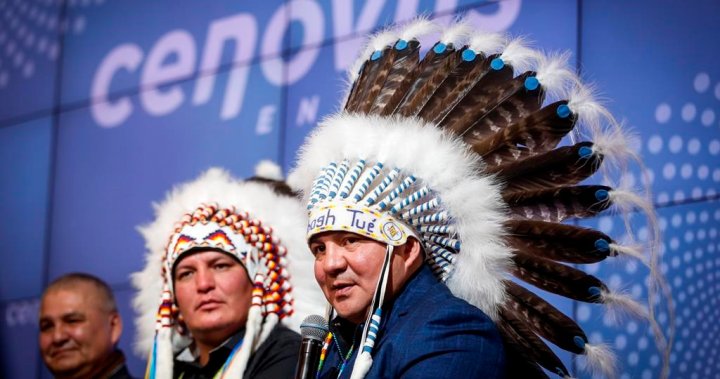
Alberta First Nations seek answers on carbon capture and storage plans
Global News
Seven Alberta First Nations have banded together to seek answers as industry and government move on plans to store greenhouse gases near traditional lands.
Seven Alberta First Nations have banded together to seek answers as industry and government move on billion-dollar plans to inject and store millions of tonnes of greenhouse gases underneath or adjacent to their traditional lands.
“We don’t know how pumping carbon underground will affect our lakes, our rivers — even our underground reservoirs,” said councillor Michael Lameman of Beaver Lake Cree Nation, one of the members of the Treaty 6 working group.
“(Industry’s) been vague, not very forthcoming.”
The working group includes Heart Lake First Nation, Beaver Lake Cree Nation, Whitefish Lake First Nation, Kehewin Cree Nation, Frog Lake First Nation, Cold Lake First Nations and Onion Lake Cree Nation. Saddle Lake Cree Nation is observing the group.
“There’s lots to be checked as far as the project relates to both the safety of the environment and the communities,” said Darryl Steinhauer, consultation co-ordinator for Whitefish Lake.
“The (carbon capture) project is inclusive of eight Nations where people are not only practising their treaty rights but living there day to day. Safety is a big concern.”
Industry says it’s doing its best.
“We are in the early stages of consultation with communities,” said a statement from Kendall Dilling, head of Pathways Alliance, which represents 95 per cent of Alberta’s oilsands production. “We are dedicated to working together with Treaty 6 First Nations and ongoing discussions will take place in a confidential manner.”


The group says MAGA Energy hasn't paid its lease for three years, and therefore the company is no longer allowed on their land in Edmonton.

The analysis by the Canadian Climate Institute says oilsands producers will pay an average of about 50 cents per oil barrel, if the minimum carbon price rises to $130 per tonne.

Between November 29 and February 27, authorities recorded 406 outbreaks of bird flu in domestic birds in 32 European countries and 2,108 outbreaks in wild birds, they said.

Dr. Michael Domeier, director of the Marine Conservation Science Institute, told Global News that they tag the adult females as they are the most interesting.

Regina’s recycling contamination is currently triple the limit and city is urging resident to change sorting habits now to avoid citywide fines and higher resident fees.

The study found that higher ultra-processed food intake at age three years was associated with adverse behavioural and emotional symptoms at age five years.

Edmonton's single-use waste rules were controversial and unpopular when introduced in 2023 — but new data shows the changes are having the intended effect of reducing garbage.

Carney's speech to Australia's parliament highlighted a soon-to-launch Canadian low earth orbit satellite network that experts say could soon compete with Elon Musk's Starlink.

The Pentagon said in a statement Thursday that it has “officially informed Anthropic leadership the company and its products are deemed a supply chain risk, effective immediately.”

Opioid overdose deaths in Canada are falling, but there's growing concerns on a certain veterinary tranquilizer being cut into fentanyl and other opioids.

The product is being recalled in Alberta, British Columbia, Manitoba, Ontario, Quebec and Saskatchewan due to 'undeclared almonds' being found.

Toronto Maple Leafs defenceman Chris Tanev is out for the rest of the season, the NHL team announced Wednesday.

A large swath of southern Alberta is under a snowfall warning, with up to 30 centimetres of snow forecast to fall in some areas before the snow tapers off by Saturday morning.