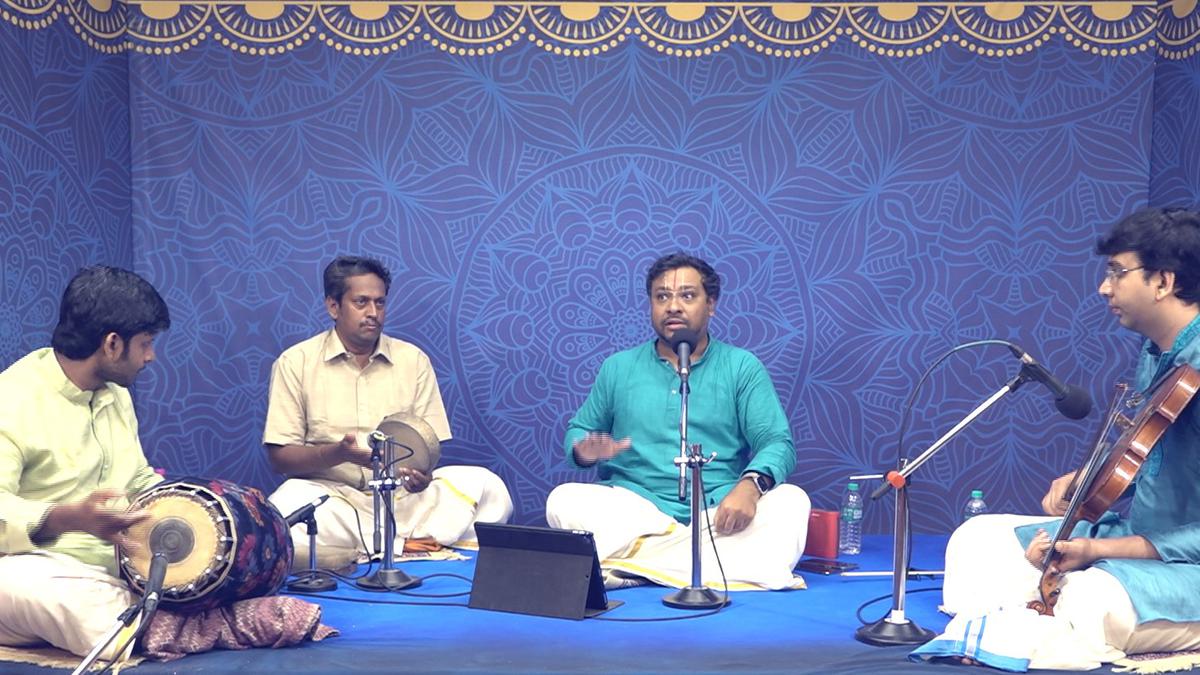
Akshay Padmanabhan sang choicest Tamil songs in a well-structured concert
The Hindu
Akshay Padmanabhan impresses with his choice of Tamil songs
At a recent festival, Mudhra featured some young artistes, who presented Tamil compositions. Akshay Padmanabhan, along with his team of musicians comprising Chidambaram Badrinath on the violin, N.C. Bharadwaj on the mridangam and Venkatramanan on the kanjira took up a diverse set of songs that encompassed a wide range of Tamil composers across time periods — starting with Kulashekara Azhwar and Kambar to vaggeyakaras like Prof. T.R. Subramaniam.
Akshay began the kutcheri with TRS’s Hamir Kalyani varnam ‘Senthil Vaazh’, singing it in both kaalams. This unique varnam that exhibits the potency of a seemingly gentle Hamir Kalyani (at times without its intrinsic kaarvais) provided an exciting start. Following a brief Nattai alapana, Bharathiar’s ‘Ganapathi Thaalai’ was presented. Some engaging kalpanaswaras that had playful shades of Tyagaraja’s ‘Jagadanandakaraka’ were sung by Akshay.
Pantuvarali was the vocalist’s choice as a prati-madhyama sub-main. Akshay’s alapana stood out for its sharp akaarams and briga usage. Violinist Badrinath matched up to Akshay in terms of creativity, exploiting the symmetry of the raga to bring out some distinctive phrases. Surprisingly, a set of verses from Vallalar’s Thiruvarutpa was presented in Adi tala. This piece in Pantuvarali ‘panniru kanmalar’ was tuned by Akshay’s guru P.S. Narayanaswamy. The composition, set in Tisra gati naturally facilitated Akshay to insert some embellishments in the form of brigas and micro sangatis. The neraval and swaras at ‘En iru kan maniye’, especially in mel kaalam were packed with energy, motivating Bharadwaj and Venkatramanan to chip in with their mathematical skills when Akshay attempted some kanakkus. Surely, he left the audience wanting more!
Akshay went on to sing Arunachala Kavi’s ‘Arivaar yaar unnai’, a chowka kaala piece in Mukhari before taking up ‘Thaaye thripurasundari’ in Shuddha Saveri. While vocalists usually take up kalpanaswaras at the upper shadjam (at ‘Thaye’) that comfortably begins at samam, Akshay adventurously opted to land his swaras at ‘Sharanam’. He splendidly took on the challenge of ending swaras at the lower rishabham, bringing out some flavourful kanakkus that blended in with the MPD phrase to not make the endings sound repetitive. Once again, this prompted the percussionists to tail the musicians with much involvement.
The main raga Thodi was handled in an exhaustive fashion as both Akshay and Badrinath dedicated about ten minutes each to elaborate the raga. The alapana was constructed meticulously by Akshay, exploring the evolution of each swara in the raga. The highlight was the singing of long-winding phrases that travelled across sthayis, but promptly circled back to centre themselves firmly around a chosen swara. Papanasam Sivan’s ‘Kundram kudi konda velava’ was presented with neraval and kalpanaswaras. The swaras represented a plethora of possibilities, as Akshay studded them with imaginative karvais and kanakkus.
The post-main section began with a viruttam ‘Nanmaiyum selvamum’ in Ragamalika from the Kamba Ramayanam, which was followed by ‘Mannupugazh kosalai’. An Ambujam Krishna piece ‘Kannanidam’ and a thillana in Sankarabharanam by Ponnaiah Pillai provided a fitting finale to the concert.


Actor-director Amol Palekar will receive META's Lifetime Achievement award for 2026 on March 25 in New Delhi.

India's artists unite against rising censorship, advocating for creative freedom and support for marginalized voices in the arts.

Written and directed by Kunal, the film also stars Sparsh Shrivastava and Vanshika Dhir

This year, Bharatnatyam artistes will present the Tyagaraja Aradhane as a dance performance

This year, Bharatnatyam artistes will present the Tyagaraja Aradhane as a dance performance

The actor, along with director Sushant Shah, speak about their upcoming series ‘Chiraiya’, Divya’s process of working on the dialect, Sushant’s approach to telling a story about women, and more

An independent video, ‘Feel the Spark’ by Raleigh Rajan with vocals by Ciera Dumas that celebrates Tamil literary giants, garnered 1.4 million views in less than 36 hours.

In ‘Jack Ryan: Ghost War’, John Krasinski is back as the savvy CIA analyst, diving headfirst into a high-stakes mission that unravels a deadly conspiracy and pits him against a rogue black-ops unit

Shriram Bharatiya Kala Kendra’s Shankarlal festival showcased rare ragas, radiant artistry, and inclusive performances, from Pt Madhup Mudgal’s serene morning ragas to Ramana Balachandran’s Saraswati veena.

Explore "Threads that Bind: The Kantha Project," an exhibition in Delhi reimagining kantha as a medium of repair and renewal.

Sean Penn skips the Oscars to meet Ukraine's Zelenskyy, who praises him as a "true friend" amid the war.

The teaser of Tamil star Suriya’s much-awaited film with director Venky Atluri, titled Vishwanath and Sons, was unveiled by the makers on Monday

A 'Golden' moment for a K-pop track at the Oscars.