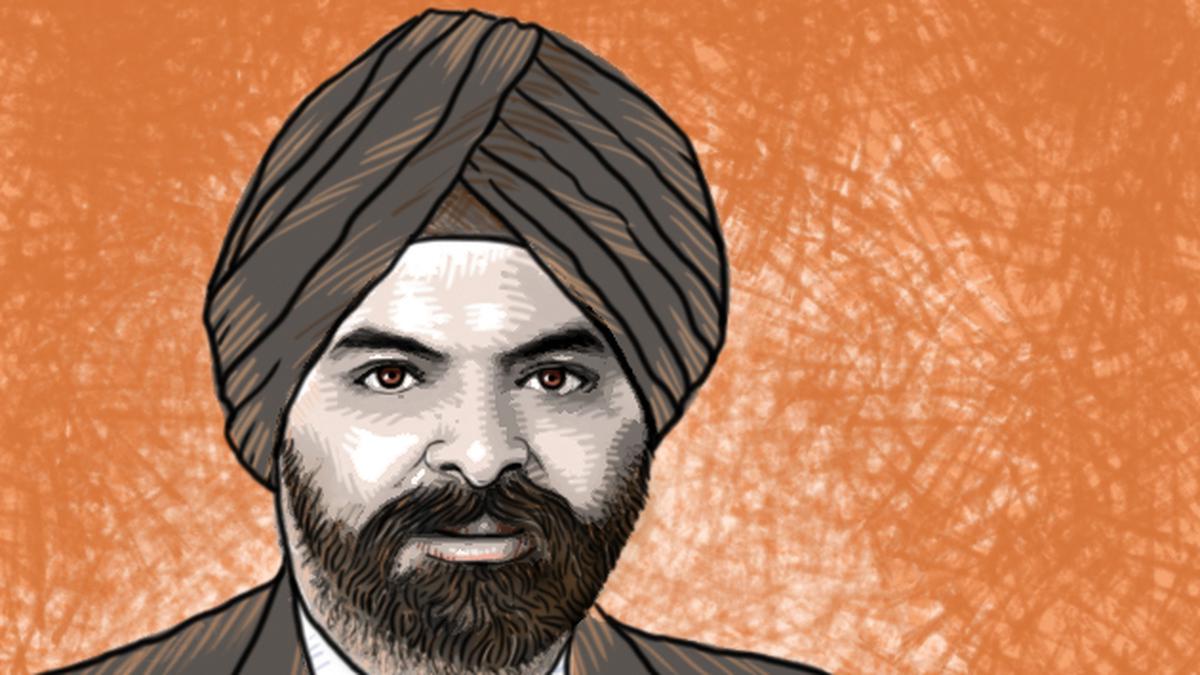
Ajay Banga | World Bank’s face of change Premium
The Hindu
Indian-origin corporate leader and former MasterCard CEO Ajay Banga is expected to become the next President of the World Bank, and the focus is on how he is going to help the 77-year-old institution tackle its several challenges from climate action to increasing lending
In an interview eight years ago with the Stanford Graduate School of Business, corporate veteran Ajay Banga, who was serving as the CEO of payment processing giant MasterCard at the time, spoke about one “tremendous” lesson from his 13-year career at Nestle. “You’re one person, but one person can make a difference,” he said. Almost a decade later, as he is expected to become the next President of the World Bank, the focus is on how Mr. Banga, 63, is going to help the 77-year-old institution tackle its several challenges, including pivoting its focus toward climate action and transforming its lending model.
Even with his best intentions and the best people, Mr. Banga says, the “idea that somehow a magic wand has arrived” is flawed. The former CEO, who is U.S. President Joe Biden’s sole nominee to lead the Bank, believes, nonetheless, that the multilateral lender can do a lot more and has ambitious plans to mobilise private sector money for its development projects.
The U.S. President, while announcing his nomination, described Mr. Banga as being “uniquely equipped” to lead the World Bank at a “critical moment in history”. “He has spent more than three decades building and managing successful, global companies that create jobs and bring investment to developing economies, and guiding organisations through periods of fundamental change,” Mr. Biden said.
Some observers believe Mr. Banga, who spent most of his career in the corporate world, may not be the right candidate to shake up the World Bank in a way it needs. Notably, the institution’s role in mitigating climate change is under most scrutiny right now as the current World Bank head, David Malpass, announced his resignation from the post earlier this year, more than a year before the end of his term, after a controversy over his refusal to comment on whether fossil fuels are contributing to global warming.
Some others, including the likes of Mr. Biden, and IMF chief Kristalina Georgieva, believe the corporate leader’s background from a developing country and his work on financial inclusion and diversity at his previous stints make him a good fit for the job.
Born in the Khadki cantonment of Pune in 1959 to an army officer father, Mr. Banga was inclined to a career in finance, receiving his bachelor’s degree in Economics from Delhi’s St. Stephen’s college. He then got himself an MBA from the prestigious Indian Institute of Management-Ahmedabad. Right out of college, he joined Nestle as a management trainee in 1981 and spent the next 13 years at the company.
After a short stint at PepsiCo leading its franchise expansion in India, Mr. Banga moved to the CitiGroup, also spending 13 years there and heading the bank’s business in the Asia-Pacific from Hong Kong. As he was on the decks to become CEO of the bank, he took up the role of President and Chief Operating Officer at MasterCard in 2009, moving to the U.S. Interestingly, the World Bank President nominee expressed in the same eight-year-old interview at Stanford that he left Citigroup as he didn’t see himself as the CEO of a bank, owing to the increasingly regulatory environment and less scope for innovation in the banking industry.


L&T confirms 95% of its West Asia project sites are safe, while addressing logistics challenges amid ongoing regional conflicts.

Mines Ministry to auction 19 critical mineral blocks on March 23, expanding strategic resources for clean energy and technology sectors.

Mines Ministry to auction 19 critical mineral blocks on March 23, expanding strategic resources for clean energy and technology sectors.

Five top firms lose ₹1 lakh crore in market value, with HDFC Bank experiencing the largest decline of ₹56,124.48 crore.

HDFC Bank terminates three senior officials over client onboarding issues at its DIFC branch amid ethical concerns following chairman's resignation.

Air India CEO warns of potential flight cuts and reduced travel demand due to rising fuel costs amid ongoing Gulf conflict.

Options are widely used by retail traders to speculate on the value of the stock for immediate gains and such behaviour in large scale can distort the market

India achieves 1 billion tonne coal production for the second consecutive year, ensuring stable energy supply and economic growth.

Generic drugmakers in India launch affordable Semaglutide versions, targeting a $1 billion diabetes and weight loss market.

Indian and Asian refiners eye Iranian oil purchases as U.S. waives sanctions amid energy crisis linked to the Iran-Israel war.

Iran war impacts pesticide prices, warning of a 20-25% rise and increased risk of counterfeit products during the kharif season.

India's forex reserves fell by $7 billion to $709.76 billion, according to RBI data for the week ending March 13.

Natco Pharma will launch its Semaglutide injection (multi dose vials) in the domestic market on Saturday.