AI and breast cancer: How a Canadian lab plans to use new tech to treat patients
Global News
A lab out of Waterloo, Ont., is taking breast cancer research to new heights by working to help patients receive proper treatment with their new technology.
As artificial intelligence continues to get more impressive, a lab out of Waterloo, Ont., is taking breast cancer research to new heights by working to help patients get proper treatment with their new technology.
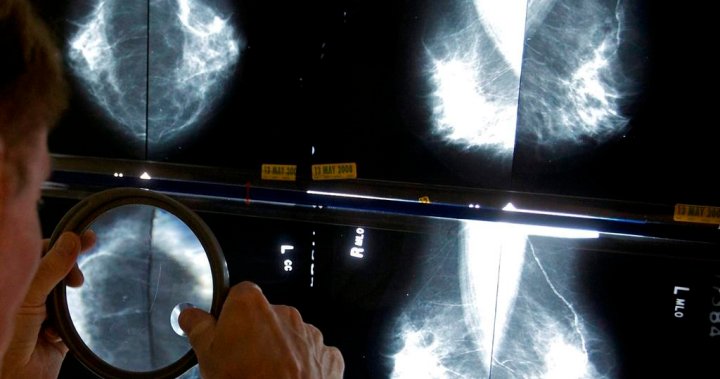
When patients get breast cancer, they typically undergo a type of imaging, like a magnetic resonance imaging or MRI, to look for cancerous tumors. The Waterloo lab has created “a synthetic correlate diffusion” MRI that is tailored to capture details and properties of cancer in a way that previous MRI systems couldn’t.
“It could be a very helpful tool to help oncologists and medical doctors to be able to identify and personalize the type of treatment that a cancer patient gets,” Alexander Wong, professor and Canada Research Chair in Artificial Intelligence and Medical Imaging at the University of Waterloo, told Global News.
Breast cancer is the second leading cause of death from cancer in Canadian women, according to the Canadian Cancer Society.
It is estimated that one in eight Canadian women will develop breast cancer during their lifetime and one in 34 will die from it.
Last year, it was also estimated that 28,600 Canadian women would be diagnosed with breast cancer, the society said.
Using synthetic correlate diffusion imagining data, the new AI-driven technology predicts whether a patient is likely to benefit from neoadjuvant chemotherapy – or chemotherapy that occurs before surgery, according to Wong.
Though the hardware of the actual MRI machine hasn’t changed in this model, what has altered is the way the technology sends “pulses” through the patient’s body and how it collects data, Wong noted.


Dr. Michael Domeier, director of the Marine Conservation Science Institute, told Global News that they tag the adult females as they are the most interesting.

Regina’s recycling contamination is currently triple the limit and city is urging resident to change sorting habits now to avoid citywide fines and higher resident fees.

The study found that higher ultra-processed food intake at age three years was associated with adverse behavioural and emotional symptoms at age five years.

Edmonton's single-use waste rules were controversial and unpopular when introduced in 2023 — but new data shows the changes are having the intended effect of reducing garbage.

Carney's speech to Australia's parliament highlighted a soon-to-launch Canadian low earth orbit satellite network that experts say could soon compete with Elon Musk's Starlink.

The Pentagon said in a statement Thursday that it has “officially informed Anthropic leadership the company and its products are deemed a supply chain risk, effective immediately.”

Opioid overdose deaths in Canada are falling, but there's growing concerns on a certain veterinary tranquilizer being cut into fentanyl and other opioids.

The product is being recalled in Alberta, British Columbia, Manitoba, Ontario, Quebec and Saskatchewan due to 'undeclared almonds' being found.

Toronto Maple Leafs defenceman Chris Tanev is out for the rest of the season, the NHL team announced Wednesday.

A large swath of southern Alberta is under a snowfall warning, with up to 30 centimetres of snow forecast to fall in some areas before the snow tapers off by Saturday morning.

Coined forever chemicals due to the years it takes for them to break down, PFAS are 'a group of thousands of human-made chemicals' commonly found in everyday items.