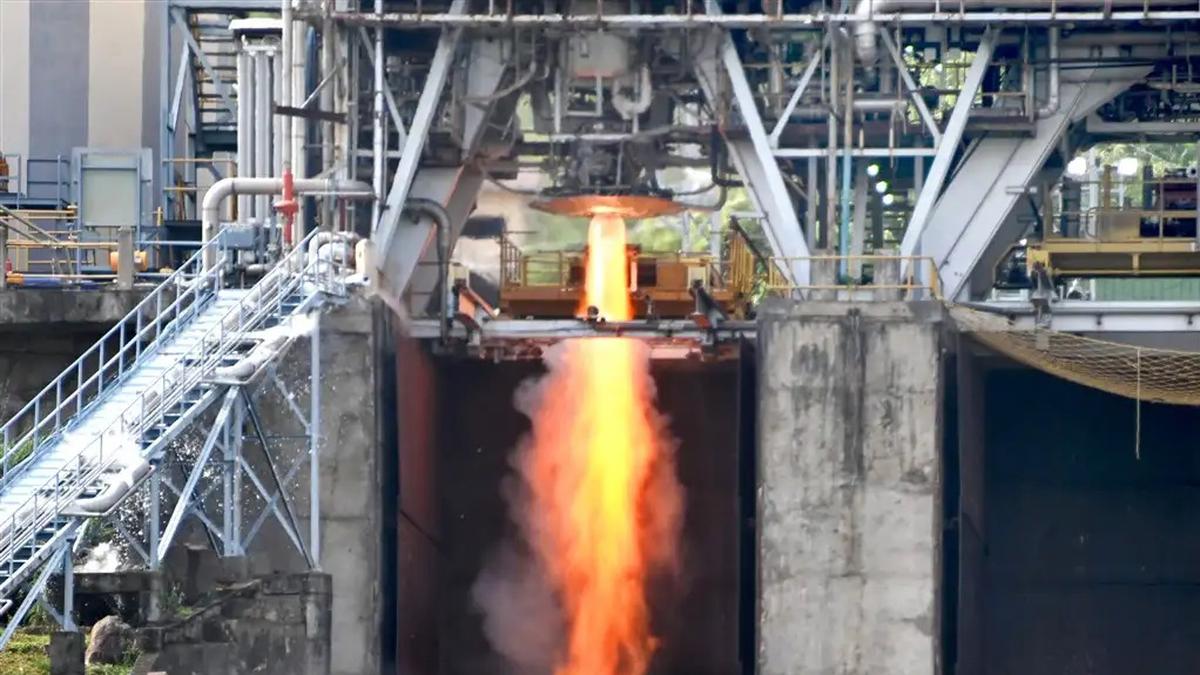
Ahead of Gaganyaan, ISRO CE-20 engine already has a notable legacy Premium
The Hindu
ISRO successfully human-rates CE-20 rocket engine for Gaganyaan mission, showcasing India's self-sufficiency in space launch capabilities.
On February 21, the Indian Space Research Organisation (ISRO) reported it had successfully completed human-rating the CE-20 rocket engine ahead of its use in an important test flight later this year of the country’s mission to launch an Indian astronaut to space onboard an Indian rocket. The CE-20 is an indigenous cryogenic engine ISRO developed to use with the GSLV Mk III, now called the LVM-3, launch vehicle. It represents an improvement on the CE-7.5 cryogenic engine and is instrumental to ISRO successfully realising its human spaceflight, a.k.a. Gaganyaan, mission.
Engineers prefer to use liquid fuels for rocket motors because they are less bulky and flow better than solid fuels. Using hydrogen as fuel is also desirable because when it is combusted, it generates the highest exhaust velocity. For example, combusting hydrogen with oxygen as the oxidiser results in an exhaust velocity of 4.5 km/s whereas that produced by unsymmetrical dimethylhydrazine and nitrogen tetroxide — the combination used by the second stage of the PSLV rocket, e.g. — is around 3.4 km/s. This is why hydrogen is a desirable fuel for rocket motors.
However, hydrogen in liquid form is not well-behaved: it needs to be maintained at -253 degrees C (and the liquid oxygen at -184 degrees C) and leaks very easily. Engineers need special equipment to store and transport liquid hydrogen and special engines that can use it to power a rocket. These are cryogenic engines.
ISRO has used three cryogenic engines over the years: KVD-1, CE-7.5, and CE-20. The last two are India-made, although the design of the CE-7.5 is based on the KVD-1, which Russia (as the Soviet Union) supplied to India in the early 1980s. The GSLV Mk II launch vehicle uses CE-7.5 engines to power the third stage of its ascent.
The operation of a cryogenic engine requires a cryopump, a device to trap and cool the hydrogen and oxygen to liquid form; special storage tanks; and turbopumps to move the cooled fuel and oxidiser to the engine. The CE-7.5 engine uses the staged-combustion cycle. Here, a small amount of the fuel is combusted in a pre-burner. The resulting heat is used to drive the turbine that powers the turbopump. Once the turbopump has brought the rest of the fuel and oxidiser to the combustion chamber, the hydrogen is combusted to power the main engine plus two vernier thrusters — smaller engines that tweak the rocket’s speed and orientation once it’s in flight. The exhaust from the pre-burner is also routed to the combustion chamber.
The CE-20 engine uses the gas-generator cycle, which discards the exhaust from the pre-burner instead of sending it to the combustion chamber. This reduces fuel efficiency but, importantly for ISRO, makes the CE-20 engine easier to build and test. ISRO has also dropped its vernier thrusters in favour of allowing the engine’s nozzle to make small rotations — or gimbal — to adjust the rocket’s flight path. As a result, while the CE-7.5 engine is lighter and sports higher fuel-use efficiency, the CE-20 engine achieves a higher maximum thrust (~200 kilonewton v. 73.5 kilonewton) with a shorter burn duration.
These features support the capabilities of the LVM-3 launch vehicle: from being able to lift up to eight tonnes to the low-earth orbit to being the vehicle of choice for the first Gaganyaan mission, while improving India’s self-sufficiency vis-à-vis launch capabilities and keeping launch costs low.


“Judicial time is a valuable public resource. Every frivolous or misconceived invocation of constitutional jurisdiction results in diversion of time from genuinely deserving litigants,” said the Madurai Bench of the Madras High Court while imposing a cost of ₹50,000 on a man from Theni district who filed a petition with an unusual prayer: permission to conduct daily protests till the ‘World War’ ends.

The Mangaluru city police on Wednesday, arrested Pavan Acharya, 22, of Moodubelle village in Kaup Taluk in Udupi district, on the charge of posting inflammatory content on the social media.

Bengaluru corporations will present five separate budgets on March 27-28, focusing on infrastructure and community funding.

A humorous exchange in the Legislative Assembly highlights CM Siddaramaiah's choice of a Mysore silk shawl over a towel.

Karnataka's fiscal deficit is under control, better than neighboring states, says Chief Minister Siddaramaiah amid revenue challenges.

Capt. S. Divakar takes charge as MD and CEO of Dredging Corporation of India, following board approval for his appointment.

Nara Bhuvaneswari inaugurates a job mela in Kuppam, promoting job creation and welfare initiatives for local youth and women.

Walajah residents protest by hoisting black flags, threatening to boycott elections over poor civic amenities and infrastructure issues.

The Railway Ministry has decided to regularise the services of Surat-Mangaluru Junction-Surat bi-weekly Special Express along with nine other special trains.

Training held for zonal election officers in Thoothukudi

Defence Minister highlights BRO's vital role in enhancing border infrastructure, national security, and socio-economic growth in India.

Andhra University celebrates its 91st and 92nd convocations, honoring graduates and distinguished personalities for their contributions and achievements.

Coimbatore students receive earthen bowls to provide water for birds, promoting conservation on World Sparrow Day.