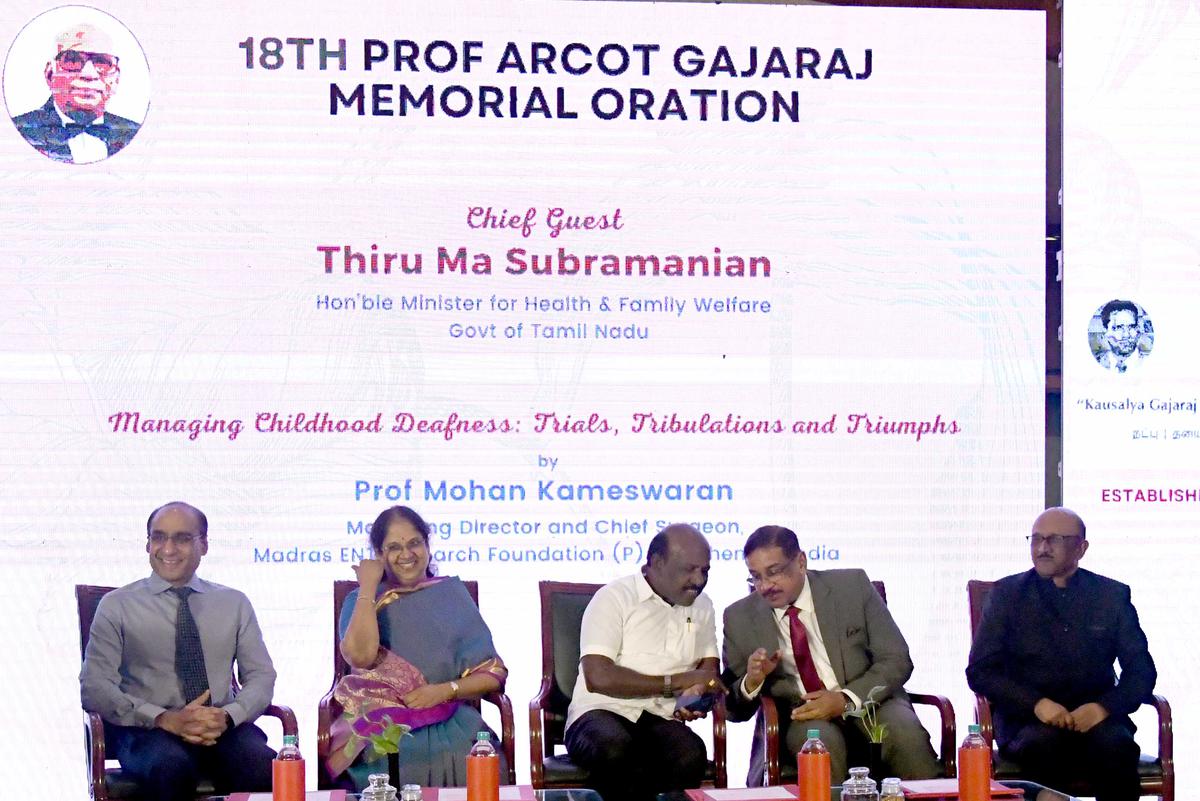
Advances, neural prosthesis helped many children with hearing issues, says expert
The Hindu
Many children who were born deaf and received cochlear implants are now studying in IITs and IIMs, says Mohan Kameswaran
Advances in biomedical engineering and neural prosthesis have greatly helped in habilitation of hearing loss and have helped thousands of children — over 5,000 in Tamil Nadu — to make the transition from the world of silence to the world of sound, Mohan Kameswaran, managing director and chief surgeon, Madras ENT Research Foundation, said.
Delivering the 18th Prof Arcot Gajaraj Memorial Oration on “Managing childhood deafness: trials, tribulations and triumphs” on Saturday, he stressed that early detection and management of hearing loss in children was crucial as it impacted their language acquisition. Early diagnosis and intervention can help a child born with deafness lead a normal life — with normal language acquisition, cognitive development, social skills and normal communication, he said.
Calling cochlear implants as a “life-changing technology”, Professor Kameswaran mentioned how children who were born deaf and received cochlear implants were now studying in IITs and IIMs, in the U.S. and one of whom was making an entry into medical college and another who could speak six languages.
It was in 2004 that the former Chief Minister M. Karunanidhi introduced cochlear implants in the then “Kalaignar Kapeetu Thittam” (now Chief Minister’s Comprehensive Health Insurance Scheme). Today, over 5,000 children in Tamil Nadu, who were born with congenital profound deafness, could hear through cochlear implants, he said.
In the rest of the world, one out of 1,000 babies was born with congenital deafness, he said. “In India, it is double the numbers. In Tamil Nadu, it is six per 1,000 live births.” He attributed the higher incidence in Tamil Nadu to consanguineous marriages and later mentioned that in almost all of them, the main problem was in the cochlear.
He traced how diagnostic tools and interventions for hearing loss evolved over the years.
Talking about rubella and its effects on children, he said that maternal screening in early pregnancy was considered as the standard of care and it was important for girls in high schools to receive vaccination and mass immunisation should be done.


Explore North East India with South Star Rail's three unique 14-day train tour packages from Mangaluru, starting April 25.

A woman and her son sustained burn injuries in a gas cylinder fire in Bagalkot, Karnataka, and were hospitalised.

Directed by Nicholas Kharkongor, the show also stars Angira Dhar, and Ranveer Brar in pivotal roles

T.N. CM Stalin blames Centre's delimitation focus for diverting attention from the cooking gas shortage crisis.

UDF plans to challenge Kerala BJP chief Rajeev Chandrasekhar over alleged asset concealment and criticizes CPI(M) for corruption.

Telangana's Civil Supplies Commissioner assures no fuel shortage, with 20,000 kilolitres of petrol available

Delhi Assembly faces second bomb threat in two days amid Budget session; security measures intensified, but no suspicious items found.

Protect your eyes this summer with simple habits like wearing sunglasses, staying hydrated, and maintaining proper hygiene.

Hyderabad Collector assures no fuel shortage, urges public to ignore rumors and avoid panic buying.

Learn how elderly and disabled voters can easily cast their ballots from home in the 2026 Assembly Elections.

Parliament Budget Session LIVE: Track updates on the Parliament Budget Session as the Transgender Bill moves to the Rajya Sabha. Follow The Hindu for the latest updates on the Budget Session on March 25, 2026.

Congress leaders in Kerala accuse LDF and NDA of a secret deal to undermine their influence in the upcoming Assembly elections.

Agnikul Cosmos successfully test-fires a revolutionary 3D printed booster engine, enhancing launch efficiency and scalability in space transportation.