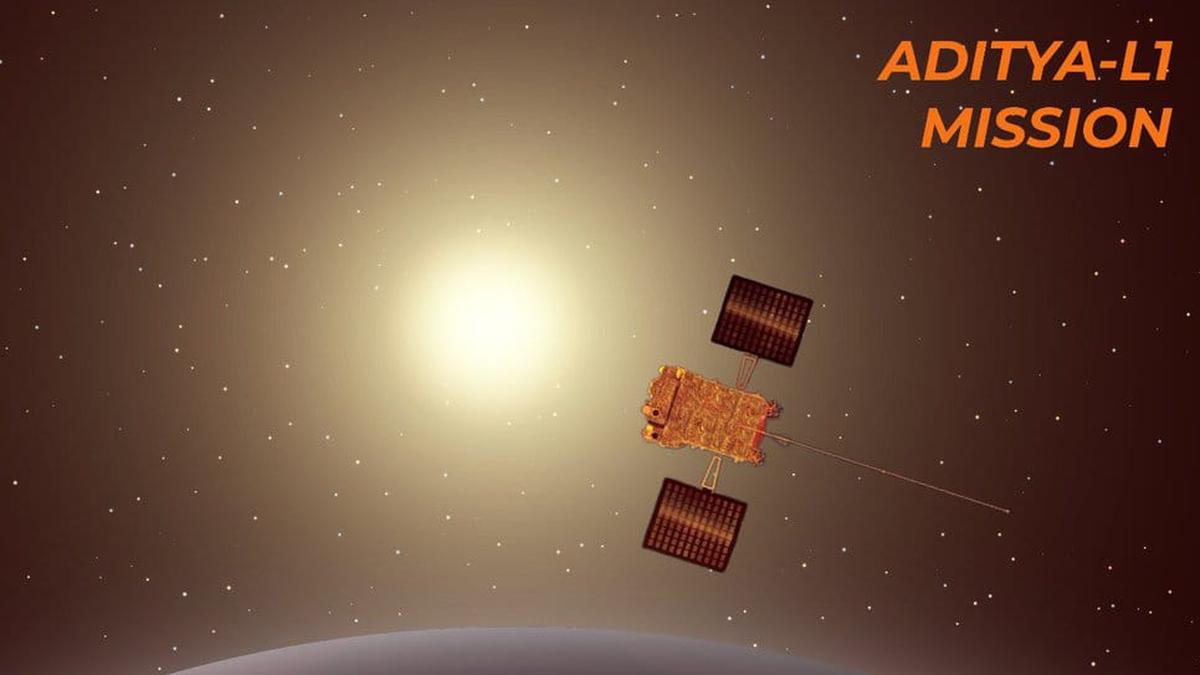
Aditya-L1 mission: IIA scientists report observations of a flareless coronal mass ejection from the solar atmosphere
The Hindu
Indian scientists report flareless coronal mass ejection observations from the Sun using VELC instrument on Aditya-L1 mission.
Scientists from the Indian Institute of Astrophysics (IIA) have reported observations of a flareless coronal mass ejection (CME) from the solar atmosphere with the Visible Emission Line Coronagraph (VELC) instrument onboard Aditya-L1 mission.
The Aditya-L1 mission is India’s first scientific mission dedicated to studying the Sun and the VELC payload was developed by the Bengaluru-based IIA.
Scientists associated with the IIA said that using the VELC payload, it was possible to observe the corona not only closer to where its base is located in the solar atmosphere, but also obtain data at shorter time intervals compared to other existing coronagraphs in orbit.
The VELC team observed the onset of a CME that erupted from the Sun on July 5, 2024, with no association to any flare.
They said that the data obtained provides valuable clues to understand and differentiate the magnetic instabilities on the Sun that causes the flares and the CMEs.
The results of the study will be appearing soon in the Astrophysical Journal, an international peer-reviewed scientific journal.
“Observation of CMEs as and when they originate on the Sun and understanding their association with flares is one of the major science goals for VELC, and we are happy that the instrument is doing that,” said R. Ramesh, senior professor at the IIA and the principal investigator for the VELC.


Vibha Batra’s latest book, Spotless (Hachette India) is a novel in verse for young adults

In its first edition, the Madras Art Salon spotlights the works of journalist and artist Narayan Lakshman at The Botanical Club, a social space in the British Deputy High Commission, Chennai

Cholesterol enhances melanoma cell invasion by making nuclei squishier, revealing a potential treatment target in cancer progression.

The designers reinterpret the Swedish artist’s symbolic forms and colour energy through contemporary resortwear silhouettes

Discover the inspiring legacy of Bibha Chowdhuri, a pioneering woman in physics and a trailblazer in STEM history.

Discover the inspiring legacy of Bibha Chowdhuri, a pioneering woman in physics and a trailblazer in STEM history.

Ashdeen’s Spring 2026 collection features saris inspired by the designer’s Parsi gara archive

Red ochre burials, ritual markings and myths across cultures show that red repeatedly marks liminal thresholds such as puberty, sacrifice and death; anthropologists argue that the colour functions as a technology of collective ritual and value, binding communities through shared symbolic acts

India approves 23 institutions for quantum labs under the National Quantum Mission, aiming to advance quantum technology and research.

India approves 23 institutions for quantum labs under the National Quantum Mission, aiming to advance quantum technology and research.

The Gaza conflict exacerbates environmental damage, emitting millions of tonnes of CO2 and threatening climate stability in West Asia.

Chefs and cookery experts share smart kitchen hacks, hybrid cooking methods and appliance tips to help households reduce LPG use without compromising on food

Discover groundbreaking research on Titan's lakes, bat vaccinations, and the unique aroma of ripening bananas in just one minute.