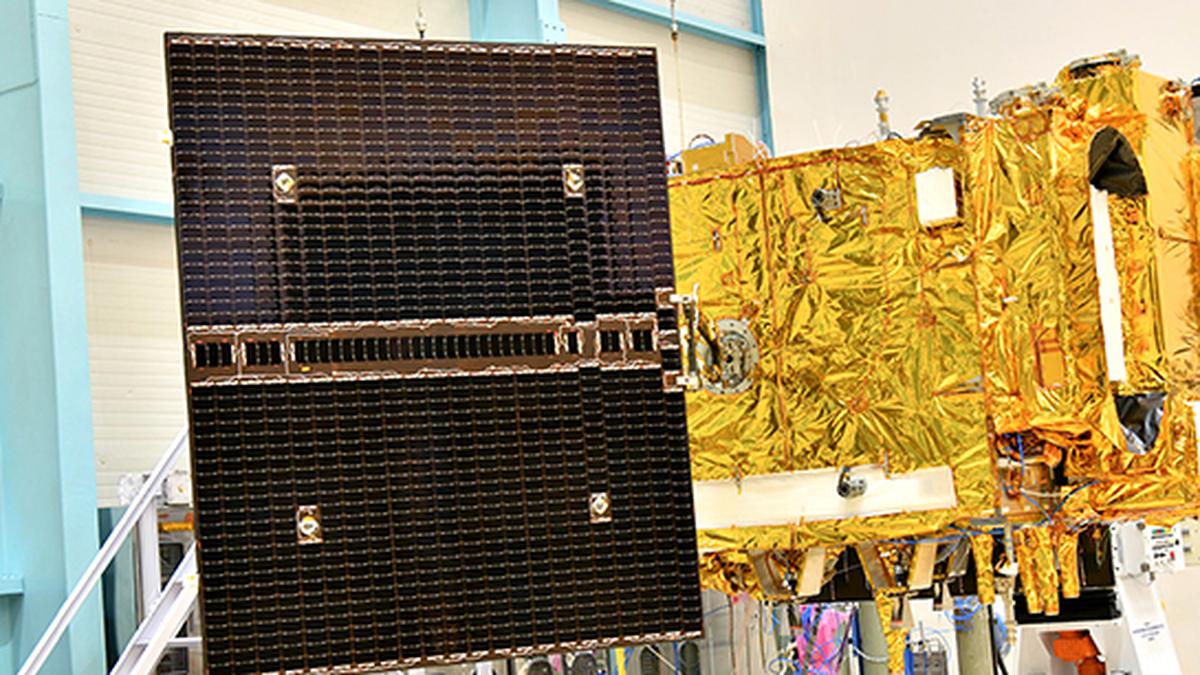
Aditya-L1, first space-based Indian observatory to study the sun, to be launched on Sept. 2
The Hindu
Aditya-L1 will be launched on September 2, the Indian Space Research Organisation announced on Monday. “The launch of Aditya-L1, the first space-based Indian observatory to study the sun, is scheduled for September 2, 2023, at 11:50 Hrs. IST from Sriharikota,” ISRO posted on X, formerly Twitter. It is expected to take more than 120 days for the spacecraft to reach the L1
Aditya-L1, first space-based Indian observatory to study the sun, will be launched on September 2, the Indian Space Research Organisation (ISRO) announced on Monday
“The launch of Aditya-L1, the first space-based Indian observatory to study the sun, is scheduled for September 2, 2023, at 11:50 Hrs. IST from Sriharikota,” ISRO posted on X, formerly Twitter
According to ISRO, the spacecraft will be placed in a halo orbit around the Lagrange point 1 (L1) of the sun-earth system, which is about 1.5 million km from the earth. It is expected to take more than 120 days for the spacecraft to reach the L1.
“A satellite placed in the halo orbit around the L1 point has the major advantage of continuously viewing the sun without any occultation/eclipses. This will provide a greater advantage of observing the solar activities and its effect on space weather in real time. The spacecraft carries seven payloads to observe the photosphere, chromosphere and the outermost layers of the sun (the corona) using electromagnetic and particle and magnetic field detectors. Using the special vantage point L1, four payloads directly view the sun and the remaining three payloads carry out in-situ studies of particles and fields at the Lagrange point L1, thus providing important scientific studies of the propagatory effect of solar dynamics in the interplanetary medium,” states the Aditya L1 mission profile.
The suits of Aditya L1 payloads are expected to provide the most crucial information to understand the problem of coronal heating, coronal mass ejection, pre-flare and flare activities and their characteristics, dynamics of space weather, propagation of particles and fields etc.
The seven payloads onboard the satellite are Visible Emission Line Coronagraph, Solar Ultraviolet Imaging Telescope , Solar Low Energy X-ray Spectrometer , High Energy L1 Orbiting X-ray Spectrometer , Aditya Solar wind Particle Experiment, Plasma Analyser Package For Aditya ) and Advanced Tri-axial High Resolution Digital Magnetometers.


Explore unique Christmas ornaments from Tiffany, Swarovski, and more, blending luxury with festive charm for your holiday decor.

Inside Copenhagen’s Alchemist: Chef Rasmus Munk on food, provocation and his India-inspired dishes

Explore the debate surrounding a potential dark matter discovery, highlighting skepticism and the need for rigorous validation in astronomy.

Discover how ice cores from the Pamir Mountains could unlock secrets to protect the world's glaciers from climate change.

Discover why spicy food causes a runny nose and how capsaicin triggers a protective response in our bodies.

In October this year, India announced its intention to build Maitri II, the country’s newest research station in Antarctica and India’s fourth, about 40 forty-odd years after the first permanent research station in Antarctica, Dakshin Gangotri, was established. The Hindu talks to Dr Harsh K Gupta, who led the team that established it

Study reveals rising artemisinin resistance in Africa, echoing Asia's past, urging urgent action to prevent widespread crisis.

Michelin launches The Grappe, a new wine distinction, recognizing excellence with one to three grapes, starting with the Burgundy and Bordeaux regions

A groundbreaking experiment transforms skin cells into egg-like cells, offering hope for infertility treatments amidst ethical considerations.

Discover Niraba, a collaboration merging Odisha's sabai grass weaving and dhokra craft into contemporary furniture and lighting design.

How do you create a Christmas tree with crochet? Take notes from crochet artist Sheena Pereira, who co-founded Goa-based Crochet Collective with crocheter Sharmila Majumdar in 2025. Their artwork takes centre stage at the Where We Gather exhibit, which is part of Festivals of Goa, an ongoing exhibition hosted by the Museum of Goa. The collective’s multi-hued, 18-foot crochet Christmas tree has been put together by 25 women from across the State. “I’ve always thought of doing an installation with crochet. So, we thought of doing something throughout the year that would culminate at the year end; something that would resonate with Christmas message — peace, hope, joy, love,” explains Sheena.

Max Born made many contributions to quantum theory. This said, he was awarded the Nobel Prize for physics in 1954 for establishing the statistical interpretation of the ____________. Fill in the blank with the name of an object central to quantum theory but whose exact nature is still not fully understood.

Join the Moms of Kochi for the Purple Carnival, a vibrant lifestyle exhibition featuring stalls, competitions, and entertainment on December 13-14.