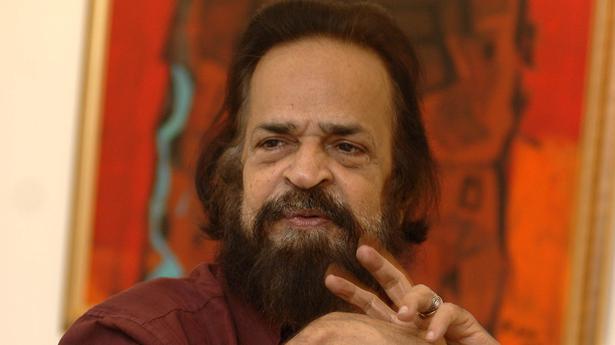
Achuthan Kudallur’s life was a cosmic dance with art in all its magnificence and ambiguity
The Hindu
Canvases in red, or beyond the definition of red, have always been a part of Kudallur’s paintings
Achuthan Kudallur has now travelled beyond the abstractions of his canvases, filled with signs and symbols encoded in colour.
Canvases in red, or beyond the definition of red, have been a part of Kudallur’s paintings ever since I can recall. It explains why Gita Hudson, who has been documenting the works of South Indian artists, has produced a video of Kudallur’s work, ‘Red Symphony’. As the camera pans over the paintings that were exhibited at the Durbar Hall Art Gallery in Kochi, there are hypnotic drumbeats of Kerala’s ritualistic performers marking the pulse of life and death.
ALSO READ Achuthan Kudallur: India’s influential abstract artist and a quiet mentor to many
Against the red of his abstract creations, you often get tiny streaks of white. They appear like pulsars, pin-points of light that he has instinctively placed at random to create a sense of expanding space. At other times, Kudallur fragments his canvas with black strokes. Like black holes that devour the light, or create them anew, they reflect the concerns of the tantric rituals enacted in Kerala temples when patterns in colour placed on the floor are stamped out by the feet of performers.
As his name suggests, the artist belongs to Kudallur, a town in the Pattambi Taluk of Palakkad that borders one of the most majestic of Kerala’s rivers, the Bharathapuzha. The ebb and flow of these rivers haunt those who have lived by their banks.
“I would like my paintings to flow from my hands like a child playing with colours in a stream of water,” he had once confessed. Quite apart from the iconic reds, with their intimations of darkness, Kudallur also painted abstractions loaded with a palette of the darting blues of a kingfisher, the yellows of the flowering amaltas and palm frond greens that decorate the offerings made at the harvest time of Vishu. In retrospect, they appear to celebrate memories of a carefree childhood. He had been trained to be a civil engineer, maybe even a writer, as he once admitted. When he was introduced to the Government College of Art in Chennai, and a group of art lovers who started the Madras Art Club, he discovered his vocation.
In time, he received several honours and particularly enjoyed the camaraderie of the art camps in different parts of the country. He was invited to the 7th Art Triennale in New Delhi in 1991, as well as the Asian Art Show in Fukuoka, Japan.


South African naturalist Steve Boyes speaks on ghost elephants, ancestral tracking, and Werner Herzog’s documentary exploring Angola’s elusive highland giants

Actor-director Amol Palekar will receive META's Lifetime Achievement award for 2026 on March 25 in New Delhi.

India's artists unite against rising censorship, advocating for creative freedom and support for marginalized voices in the arts.

Written and directed by Kunal, the film also stars Sparsh Shrivastava and Vanshika Dhir

This year, Bharatnatyam artistes will present the Tyagaraja Aradhane as a dance performance

This year, Bharatnatyam artistes will present the Tyagaraja Aradhane as a dance performance

The actor, along with director Sushant Shah, speak about their upcoming series ‘Chiraiya’, Divya’s process of working on the dialect, Sushant’s approach to telling a story about women, and more

An independent video, ‘Feel the Spark’ by Raleigh Rajan with vocals by Ciera Dumas that celebrates Tamil literary giants, garnered 1.4 million views in less than 36 hours.

In ‘Jack Ryan: Ghost War’, John Krasinski is back as the savvy CIA analyst, diving headfirst into a high-stakes mission that unravels a deadly conspiracy and pits him against a rogue black-ops unit

Shriram Bharatiya Kala Kendra’s Shankarlal festival showcased rare ragas, radiant artistry, and inclusive performances, from Pt Madhup Mudgal’s serene morning ragas to Ramana Balachandran’s Saraswati veena.

Explore "Threads that Bind: The Kantha Project," an exhibition in Delhi reimagining kantha as a medium of repair and renewal.

Sean Penn skips the Oscars to meet Ukraine's Zelenskyy, who praises him as a "true friend" amid the war.

The teaser of Tamil star Suriya’s much-awaited film with director Venky Atluri, titled Vishwanath and Sons, was unveiled by the makers on Monday