Access to libraries as critical element of social justice Premium
The Hindu
We walk past glass-shuttered shelves holding books about India’s prehistory, a translation of A.R. Krishna Shastri’s Vachana Bharatha and the library’s enviable collection of rare manuscripts and books. We flip open one, The Travels of Monsieur de Thevenot into the Levant by the French traveller, botanist and linguist Jean de Thévenot, to find ourselves stumbling across an unfamiliar, now-forgotten letter — the archaic long ‘s’ written as ‘I’ — catapulting us to a time before it was discarded by most printers in the latter half of the 18th century.
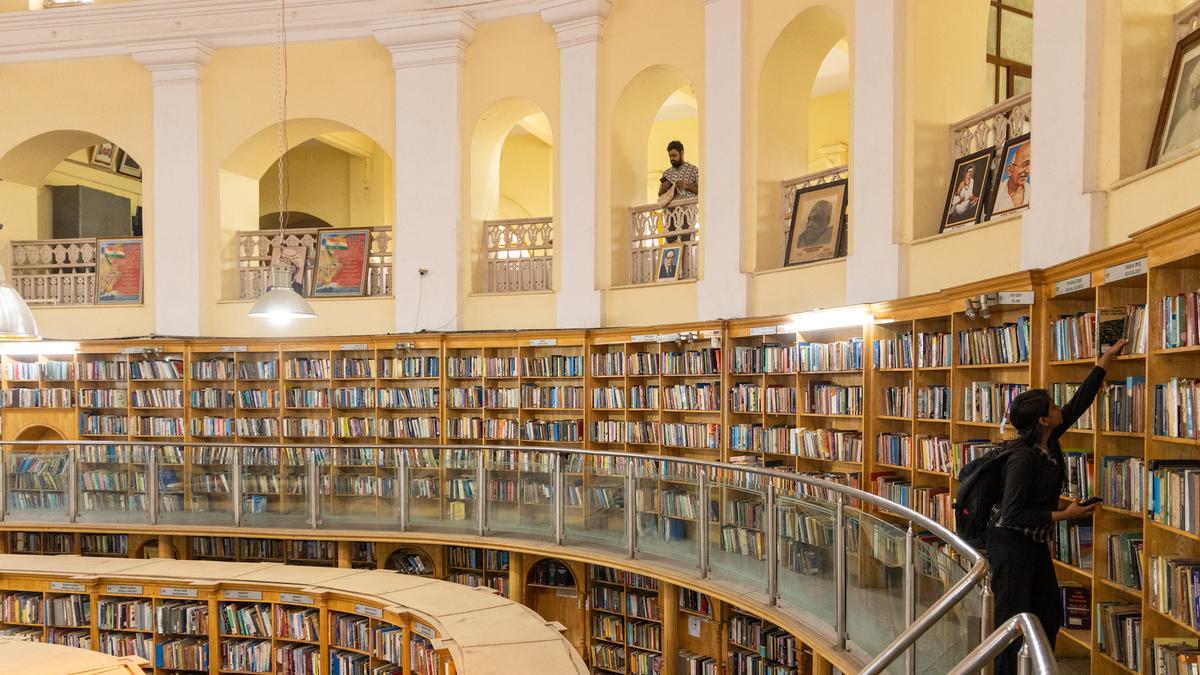
It’s a Saturday. The midmorning sun beats down on the 40-odd people alighting from a bus and fanning across the quiet interiors of the Mythic Society library housed in the Daly Memorial Hall on Nrupathunga Road, a gorgeous heritage building constructed in 1917.
We walk past glass-shuttered shelves holding books about India’s prehistory, a translation of A.R. Krishna Shastri’s Vachana Bharatha and the library’s enviable collection of rare manuscripts and books. We flip open one, The Travels of Monsieur de Thevenot into the Levant by the French traveller, botanist and linguist Jean de Thévenot, to find ourselves stumbling across an unfamiliar, now-forgotten letter — the archaic long ‘s’ written as ‘I’ — catapulting us to a time before it was discarded by most printers in the latter half of the 18th century.
The Mythic Society library is one of the five we visit as part of the recently-held Bengaluru Public Libraries, an initiative by the Indian Institute for Human Settlements (IIHS) in collaboration with the Goethe-Institut/Max Mueller Bhavan. The other four covered include the Goethe-Institut Library, the State Central Library in Cubbon Park, the Alliance Francaise de Bangalore Library and finally, the IIHS Library.
Preedip Balaji, the founding librarian at IIHS, Sadashivanagar, who curated the walk, expands on why these specific libraries were chosen. According to him, institutions, even public-funded ones, often make it hard for people to just walk into their libraries to use them. The publicness of a library, therefore, became a central aspect of this walk.
While at first glance, all these libraries are different from each other, aesthetically and thematically, one thing ties them all together: they are accessible to everyone who wants to use them. “Of course, there are membership plans and other things if you want to check out. But there is no cost for walk-ins, and many services are free. That was one major factor that we looked at,” he says. “I see the library door as a critical element of social justice.”
The idea for a walk of this sort emerged in 2019 as part of IIHS’s City Scripts, the institute’s annual urban writing festival. “We could conceptualise it and make public libraries be just a part of the festival,” says Balaji, pointing out that they could add to the narrative around promoting literature and writing in this case. While many literature festivals occur nationwide, public libraries don’t get spoken about often enough at these festivals. “That was the idea, and we thought we could do it,” he says. “The idea is to voice the concerns of building public institutions like libraries, which would be more heard, seen and participated in as they manifest time and space in our cultural memory and crucially safeguard our democracy through principles of freedom, access, and inclusion.”
The initial two iterations of the walk, in 2019 and 2020, took place on a smaller scale, with only three libraries covered: the Mythic Society Library, the State Central Library in Cubbon Park, and the IIHS Library. Then, the pandemic happened, and everything came to a standstill for two years, including these walks. “We’ve been meaning to pick this up for a while and have been looking for sponsors who could help us to scale it up from the original conceptualisation we had,” says Balaji. “In the Goethe-Institut, we found a good partner who understood and provided the means.”


Air India's New York-Mumbai flight was safely diverted to Medina due to a false fire indication before resuming its journey.

Kerala's Malampuzha Assembly seat sees LDF-BJP rematch as UDF fields A. Suresh in a high-stakes 2026 election battle.

BJP's Ramchander Rao assures fuel security in India amid global turmoil, emphasizing stable LPG prices and strategic reserves.

Congress announces candidates for Kerala Assembly elections 2026, selecting Mohammad Shiyas for Kochi and denying Eldhose Kunnappilly a ticket.

What does it take to design gloves, masks and uniform that factor in the various challenges faced by workers on the waste beat? Indore, Bengaluru and Pune have an answer

Explore the behind-the-scenes of political strategy with "Inside the War Room," a must-read for aspiring politicians and managers.

Villivakkam faces civic challenges despite infrastructure improvements, with residents demanding better healthcare, transport, and green spaces ahead of elections.

District Collector launches e-dip lottery for Settipalle land plots, benefiting 2,111 beneficiaries with planned infrastructure development.

Chengalpattu's horticulture farm launches herbal tea, Idhazh, made from sun-dried hibiscus and organic herbs.

Hyderabad is set to become a global film hub, says CM Revanth Reddy at TGFA 2025, highlighting its cinematic potential.

Sivananda Damodara Pai appointed head of RMC Chennai, known for advancing seasonal rainfall and temperature forecasting models.

Madurai Collector chairs meeting with Election Observers

CBI interrogates Anil Ambani in a ₹2,929-crore cheating case involving alleged loan fund irregularities from State Bank of India.