Abu’s World: An exhibition celebrating the birth centenary of the cartoonist set to open in Bengaluru
The Hindu
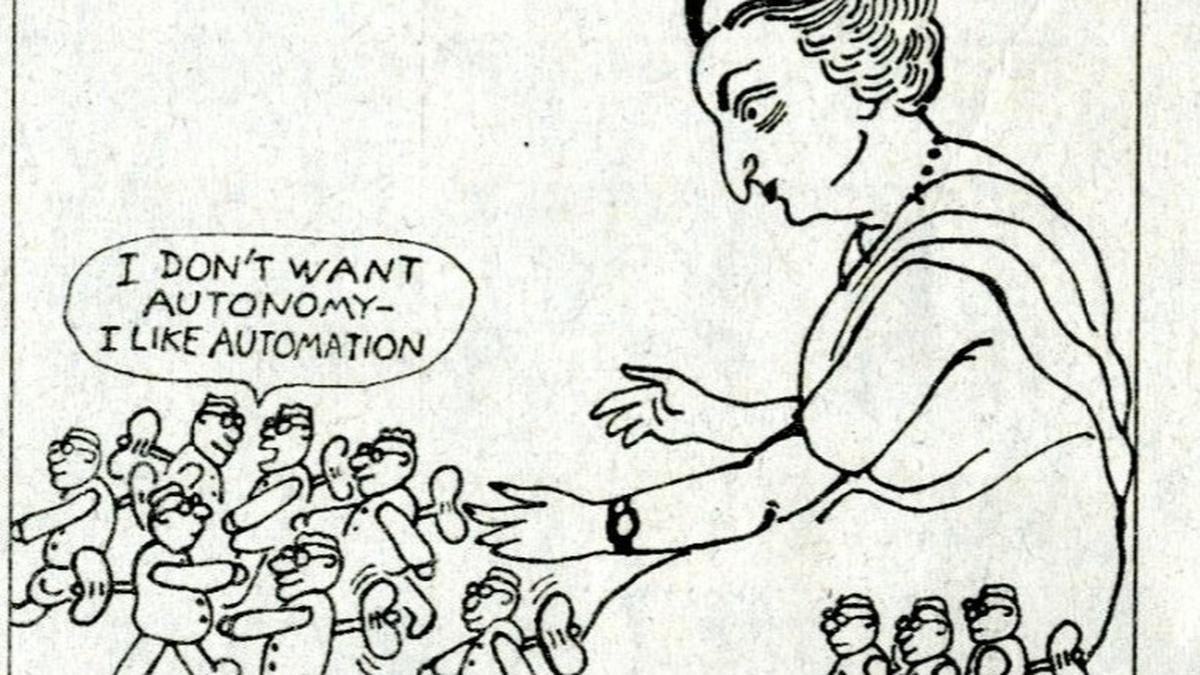
Abu’s World, an exhibition of the work of the iconic cartoonist Abu Abraham, will open in Bengaluru on 3rd August 2024. This display, part of his birth centenary celebrations, will be held at the Indian Cartoon Gallery until the end of the month. “We wanted to do something to mark his 100th birth anniversary,” says his daughter Ayisha Abraham, who co-curated the exhibition with her sister Janaki Abraham. Also, since they have been housing his work since his death in 2002, 22 years ago, they felt it was time to bring it out to the public. “Memory fades, and the younger generation didn’t know he did work like this, chronicled Indian politics with such humour and satire,” she says
Abu’s World, an exhibition of the work of the iconic cartoonist Abu Abraham, will open in Bengaluru on 3rd August 2024. This display, part of his birth centenary celebrations, will be held at the Indian Cartoon Gallery until the end of the month. “We wanted to do something to mark his 100th birth anniversary,” says his daughter Ayisha Abraham, who co-curated the exhibition with her sister Janaki Abraham. Also, since they have been housing his work since his death in 2002, 22 years ago, they felt it was time to bring it out to the public. “Memory fades, and the younger generation didn’t know he did work like this, chronicled Indian politics with such humour and satire,” she says
The exhibition opened in Kochi’s Durbar Hall earlier this year, featuring around 310 selected drawings from his exhaustive repertoire of “one or two cartoons a day for fifty years,” as Ayisha remembers. However, since the Indian Cartoon Gallery is a smaller space, only around 120-130 of these original 310 will be on show at the upcoming exhibition, while another subset will be displayed at the Bangalore International Centre towards the end of the month, around 250 drawings in all. Additionally, the historian, Janaki Nair, has annotated a selection of cartoons for a booklet which will be available at the exhibition venues.
According to Ayisha, the exhibition offers both a political history of post-independence India and post-war world events, as well as insights into Abu’s journeys, life experiences, and the aesthetic development of his art. It also provides insights into his experiences in the U.K., where he lived and worked for about 15 years and documents other key moments in Indian history, including Prime Minister Indira Gandhi’s era and the rise of the Hindutva, among other things. ““The exhibition is a chronology of his work, and it also reflects our present political context (cartoons that speak of democratic processes and elections, the push-and-pull between Centre and State, the Palestine-Israel conflict, war and peace from Vietnam to the Gulf War. Much of the work remains relevant today,” she says.
Attupurathu Mathew Abraham, popularly known as Abu, was born on June 11, 1924 in Tiruvalla, and grew up in Kollam, Kerala. “He was an untrained artist and was obviously gifted,” says Ayisha, pointing out that Abu, who came from a family of modest means, started drawing from a very young age, even when there was not much paper and pencil available.
He went on to study at the University College in Thiruvanthapuram before taking up a job as a crime reporter for The Bombay Chronicle and moving to Mumbai. “He first worked as a crime reporter in Bombay, and published his drawings in miscellaneous journals,” she says. Then, in 1951, he joined Shankar’s Weekly, an Indian satirical magazine published between 1948 and 1975 founded and run by Keshav Shankar Pillai. “He was really trying to develop a style of his own,” she says. “His drawing was more tentative earlier and the exhibition has some of these early drawings.”
In 1953, Abu went to England, where he spent the next 15-odd years, contributing to publications like Punch magazine, the Daily Sketch, The Observer, and The Guardian. “He travelled extensively in Europe and sketched as he travelled,” says Ayisha. Abu, in his early years, also attended some evening classes in England to develop more confidence. “Over the years he evolved his own unique style,” she says.
One of the most iconic sketches of Abu is this: an image of former President Fakhruddin Ali Ahmed wallowing in a bathtub, hurriedly signing the declaration of Emergency from there. Merely six years after he returned to India in 1969, going on to work at The Indian Express, he found himself documenting this period, some of the darkest days of Indian democracy. “He followed the Congress party and Mrs. Gandhi’s era till her defeat and re-election,” she says.


Walajah residents protest by hoisting black flags, threatening to boycott elections over poor civic amenities and infrastructure issues.

The Railway Ministry has decided to regularise the services of Surat-Mangaluru Junction-Surat bi-weekly Special Express along with nine other special trains.

Training held for zonal election officers in Thoothukudi

Defence Minister highlights BRO's vital role in enhancing border infrastructure, national security, and socio-economic growth in India.

Andhra University celebrates its 91st and 92nd convocations, honoring graduates and distinguished personalities for their contributions and achievements.

Coimbatore students receive earthen bowls to provide water for birds, promoting conservation on World Sparrow Day.

Residents of Hosahundi village in Kasaba hobli of Mysuru taluk have opposed the proposed construction of a flyover at Devalapura Cross on National Highway 275-K (Outer Ring Road), urging the authorities to drop the project and adopt alternative measures to improve road safety.

A brain-dead head constable’s family consented to organ donation under the Jeevandan programme, giving two patients a new lease of life through kidney transplants.

A-G informs Madras High Court no govt. sanction needed for FIR in K.N. Nehru's cash-for-jobs scam case.

President of Karnataka Beary Sahitya Academy U. H. Umar on Wednesday appealed to Madhu Bangarappa, Minister for School Education and Literacy to introduce Beary as the third optional language from Class 6 from the academic year 2026-27.

Karnataka Dalit Sangharsha Samiti (DSS) has urged the State government to begin the process of filling up 56,432 posts only after rectifying the mistakes in fixing the roster and implementing the internal reservation among Scheduled Castes.

Rebel nominations in Karaikal expose tensions within electoral alliances, risking voter fragmentation ahead of the Puducherry Assembly elections.

CCPA prohibits restaurants and hotels from imposing unfair LPG charges, labeling them as unjustified and against consumer protection guidelines.