Aadujeevitham costume designer Stephy Zaviour terms being part of the film a once in a lifetime experience
The Hindu
Costume designer Stephy Zaviour reflects on the meticulous process of designing costumes for the film Aadujeevitham.
Never before or since Aadujeevitham, has costume designer Stephy Zaviour ever given serious thought to the chemical component or the material density of the fabrics she used. “In the past I have used fabric without thinking about their chemical bond. Resul Pookutty sir wanted to know it lest the rustling of polyester fabric interfere with the sound recording,” she reminisces. Working on Blessy’s opus ranks top on her list of films she has been part of.
Research was tricky. There is no photograph of Najeeb during his ‘goat days’. “Nobody has ‘seen’ him when he was living in the desert. What we know is what Benyamin chettan has written and Blessy sir’s visualisation. I hope the picture of Najeeb that Blessy sir has (shown through my work) and that of how people have imagined him meet.” She had not read the novel by Benyamin then, but knew enough of it from what her mother, an avid reader, had told her.
Old photographs and videos were sourced from photo studios for accuracy. Although films based in the 1980s-90s are being made, and costumes designed, this film, Stephy says, needed precision and attention since Blessy is a stickler for detail and perfection. It was reassuring as well. “There would be no goof-ups because he would check everything.”
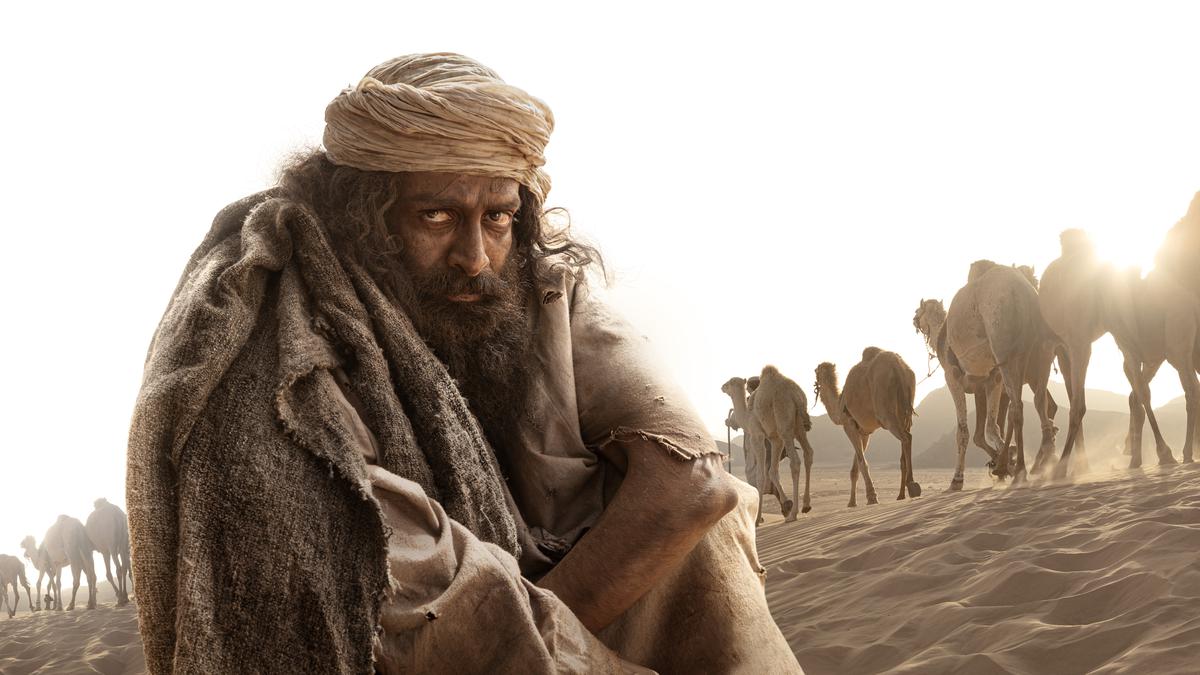
Most of Najeeb’s (Prithiviraj Sukumaran) costumes (while in the desert) are handsewn.
“Everything ages differently in a desert. The garments show the movement of the story and the passage of time. The audience will see Najeeb in the same garment over a period of time. But it was not just that one piece, there were multiple thawb or thobe (the long-sleeved, ankle-length garment worn by Arab men) of the one Prithviraj wore. The stains, the tears, the ageing — all of which had to be uniform in every piece. A lot of effort went into the film’s costumes.”
A question about the shoes is inevitable. “The shoes are also handmade. Blessy sir sent me a drawing of the shoes with specifications: the look, the wear and tear. It also had to convey the difficulty of wearing it in a desert,” Stephy adds.
Research also meant studying how weather impacted fabric because Najeeb is at the mercy of the elements. “We costume designers have enough tricks to ‘age’ fabrics and garments, that would not do for this film. I got scarecrows made, placing them in the sun for several days in a row to see how a garment fades.” She also had to look up methods to make fabric crumble.


South African naturalist Steve Boyes speaks on ghost elephants, ancestral tracking, and Werner Herzog’s documentary exploring Angola’s elusive highland giants

Actor-director Amol Palekar will receive META's Lifetime Achievement award for 2026 on March 25 in New Delhi.

India's artists unite against rising censorship, advocating for creative freedom and support for marginalized voices in the arts.

Written and directed by Kunal, the film also stars Sparsh Shrivastava and Vanshika Dhir

This year, Bharatnatyam artistes will present the Tyagaraja Aradhane as a dance performance

This year, Bharatnatyam artistes will present the Tyagaraja Aradhane as a dance performance

The actor, along with director Sushant Shah, speak about their upcoming series ‘Chiraiya’, Divya’s process of working on the dialect, Sushant’s approach to telling a story about women, and more

An independent video, ‘Feel the Spark’ by Raleigh Rajan with vocals by Ciera Dumas that celebrates Tamil literary giants, garnered 1.4 million views in less than 36 hours.

In ‘Jack Ryan: Ghost War’, John Krasinski is back as the savvy CIA analyst, diving headfirst into a high-stakes mission that unravels a deadly conspiracy and pits him against a rogue black-ops unit

Shriram Bharatiya Kala Kendra’s Shankarlal festival showcased rare ragas, radiant artistry, and inclusive performances, from Pt Madhup Mudgal’s serene morning ragas to Ramana Balachandran’s Saraswati veena.

Explore "Threads that Bind: The Kantha Project," an exhibition in Delhi reimagining kantha as a medium of repair and renewal.

Sean Penn skips the Oscars to meet Ukraine's Zelenskyy, who praises him as a "true friend" amid the war.

The teaser of Tamil star Suriya’s much-awaited film with director Venky Atluri, titled Vishwanath and Sons, was unveiled by the makers on Monday