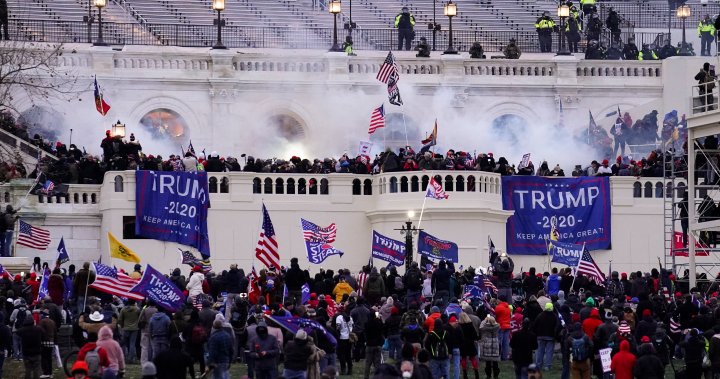
A year after Jan. 6, Americans divided over how the Capitol riot unfolded
Global News
A year after Jan. 6, Americans are divided over whether the Capitol riot should be considered an attack on the government.
Beneath a pale winter light and the glare of television cameras, it seemed hard not to see the Jan. 6 Capitol riot for what it was. The violent storming of the Capitol by Donald Trump supporters bent on upending the election of Joe Biden was as clear as day: democracy under siege, live-streamed in real time.
Yet a year later, when it comes to a where-were-you moment in U.S. history, there is far from national consensus.
A Quinnipiac poll found that 93% of Democrats considered it an attack on the government, but only 29% of Republicans agreed. A poll by The Associated Press and NORC Center for Public Affairs Research found that about 4 in 10 Republicans recall the attack — in which five people died — as violent, while 9 in 10 Democrats do.
Such a disparity in memory may be inevitable in our hyper-polarized politics, but it’s striking given the stark clarity of Jan. 6 at the time and in its immediate aftermath. House Minority Leader Kevin McCarthy, R-Calif., said then that “the president bears responsibility” for the attacks. Sen. Mitch McConnell, R-Ky., then the majority leader, said: “They tried to disrupt our democracy. They failed.”
But since that day, separate versions — one factual, one fanciful — have taken hold. The Capitol riot — the violent culmination of a bid to delegitimize the 2020 election and block its certification — has morphed into a partisan “Rashomon,” the classic Japanese film about a slaying told from varying and conflicting points of view. Indeed, the act of remembering can be a highly mercurial thing — particularly when deep-seated political views are involved.
“We keep using terms like post-factual, but it almost feels like there’s this national psychosis or amnesia about what happened a year ago,” says Charles Sykes, the former conservative Wisconsin radio host and founder of the website The Bulwark. “It’s not just that we’re two nations. It’s as if we live on two different reality planets when it comes to the memory of Jan. 6.”
Nations remember the way people do: imperfectly. Neuroscientist Lisa Genova, author of “Remember: The Science of Memory and the Art of Forgetting,” describes how even the most searing memories are edited each time they’re revisited. An original memory is replaced with a 2.0 version, a 3.0 version and beyond.
“Outside influences can sneak in every time we revisit and recall a memory for what happened. So for these collective memories, we have a lot of chances to revisit them,” says Genova. “Depending on your political point of view, the news channels you watch, what this meant to you, this memory is going to have a different slant based on the story that you tell yourself.”


Prime Minister Mark Carney endorsed a statement after it was released by allies Thursday, expressing willingness to contribute to efforts to reopen the Strait of Hormuz..

James 'Jimmy' Gracey was reported missing after he didn't return to the short-term rental where he was staying with friends during spring break.

The Mina Al-Ahmadi refinery in Kuwait, which can process some 730,000 barrels of oil per day, is one of the largest in the Middle East.

U.S. intelligence, military and law enforcement officials unanimously agreed that an intelligence assessment doubting a foreign role in the 'Havana syndrome' should be withdrawn.

The federal Conservatives accuse the government of being too secretive about the war and point out that Canada's allies are sharing such information openly at daily briefings.

Canada is amongst several nations who 'condemn in the strongest terms recent attacks by Iran on unarmed commercial vessels in the Gulf.'

Gas prices in Canada have been climbing sharply since the Iran war began, but how much higher they could go is unclear as consumers struggle with the higher cost of living.

The Oscar-winning actor has denied all allegations against him and maintains that the incidents raised in the lawsuits either did not happen or were consensual.

European leaders have deflected entreaties from U.S. President Donald Trump to send military assets to secure the Strait of Hormuz.

All six crew members of a KC-135 Air Force refueling aircraft were killed last week in a plane crash over friendly territory in western Iraq, supporting operations against Iran.

U.S. Director of National Intelligence Tulsi Gabbard testified that the regime remains intact and Tehran and its proxies remain capable of attacking U.S. and allies' interests.

James 'Jimmy' Gracey was reported missing after he didn't return to the short-term rental where he was staying with friends during spring break.

The U.K. Health Security Agency described the event as 'rapidly evolving' and warned of the potential for further cases.