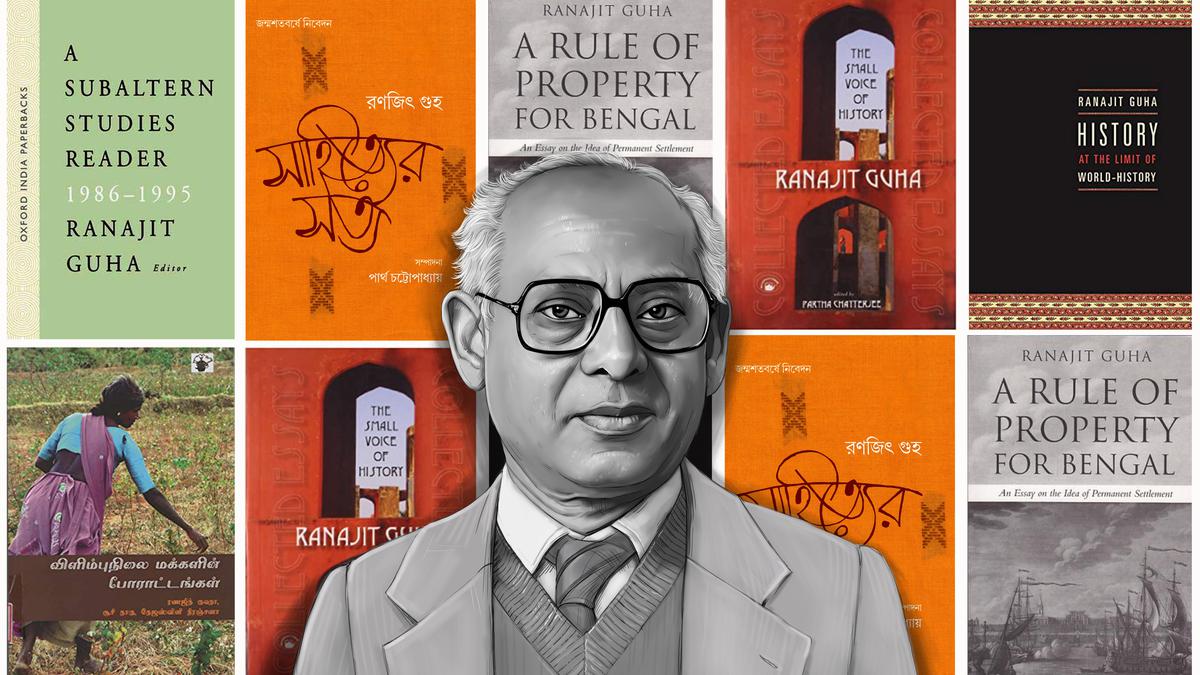
A tribute to historian Ranajit Guha who pioneered ‘Subaltern Studies’
The Hindu
Guha’s ideas carried a certain revolutionary air, undoubtedly drawn from his own long background as a political worker
It was 1996. I was a young doctoral student with the department of anthropology at Rice University on the cusp of embarking on my own field research, tasked with keeping an invited guest company and ferrying him around Houston.
The guest in question was none other than Ranajit Guha, the historian who had pioneered ‘Subaltern Studies’, a project to recover the largely neglected histories of the subordinated classes — peasants, tribes, labourers and other exploited groups — from the biases of elite historiography, whether colonial or Indian. Eight volumes of essays by the Subaltern Studies group of scholars were already out, the first six edited by Guha himself, grappling variously with questions of how to read official, elite historical records for signs of subaltern groups’ own self-making.
In his earlier work on Elementary Aspects of Peasant Insurgency in Colonial India, Guha had shown accounts of peasant uprising to exist almost only as administrative documents. They were but data points in the “life-story of Empire” which did nothing to “illuminate that consciousness which is called insurgency.” This profound irony of the rebel having “no place in history as the subject of rebellion” provided powerful impetus for a radical new approach to history: reading fragments as an archive in order to ‘dignify them as sites of struggle’ and to reclaim for history these experiences ‘buried in the forgotten crevices of our pasts.’
Guha’s ideas carried a certain revolutionary air, undoubtedly drawn from his own long background as a political worker. Born in 1923 to a landowning family in erstwhile East Bengal, he moved with his family to Calcutta in the 30s, studied at Presidency College, became involved in left-wing student politics in the final years of British rule, and eventually joined the World Federation of Democratic Youth in London as a representative of the Communist Party of India. Although Guha would later withdraw from political work, his intellectualism was clearly suffused with its insights. The idea that colonial history wasn’t to be accepted as stentorian authority but rather read ‘against the grain’ for its record of indigenous autonomies, a hitherto unrecognised “politics of the people,” was compelling, mould-breaking. It opened out exciting new possibilities both for history and post-colonial critique across disciplines and even regions. Indeed, Guha’s visit to Rice University had been at the invitation of historian Patricia Seed to engage with a Latin American Subaltern Studies group, who would take significant inspiration from the South Asian collective in charting the course of their own subaltern engagements.
By the time I drove over to meet Guha, then, he was already a formidable figure — and I was nervous about interaction at such close quarters. Academics could be as stuffy as they were brilliant, and Indian academics, even those on the Left, rather more status-conscious than most.
But not Guha. In the lobby of the Medical Center Hilton, the Ranajit Guha greeted me with folded palms and the sort of wide, warm smile one reserves for only the most anticipated of meetings with close family. He seemed happy just to be in the company of a fellow Indian. As we drove about, he asked about me: my family, my interests, my plans in avuncular fashion, insisting, when I told him of my husband working as a scientist in a Medical Center lab: “I must meet this boy.” I summoned Shrikanth home at once. As we fed Guha chai and hastily-prepared pakodas in our tiny apartment, that one October evening, with him seated on an embarrassingly worn armchair set beside an eternally-in-bloom pot of purple African violets, we learned many lessons about the warmth, empathy, and deep human commitment that the old Indian Left best exemplified: all without speaking a single word about politics or historiography.
Yet, the depth of feeling captured in his account of “Chandra’s death” now was all the more evident. Using mere legal fragments, Guha had reconstructed the 1824 event of a lower caste woman’s death following an illicit affair and abortion to show how structures of power colluded to render women’s solidarity invisible. Such “small voices” speaking in undertones “as if in pain” and usually “drowned in the noise of statist commands” were what he was listening for, his historiography almost a series of small acts of solidarity. “To listen is already to be open to and existentially disposed towards: one inclines a little on one side in order to listen,” Guha wrote in an essay on “The Small Voice of History” (which I hastily photocopied and had him autograph). Naturally, then, when Guha urged me towards Anveshi, a women’s studies collective in Hyderabad, for my own field studies on women’s activism, I listened, too.


Erode district conducts first EVM randomisation for April 23 Assembly elections, ensuring transparency and fairness in allocation.

TNCC conducts public consultation in Erode to gather community input for its upcoming election manifesto.

CID to investigate sexual assault allegations against suspended Moodbidri Police Inspector P.G. Sandesh, reveals Home Minister Parameshwara.

A 50-year-old woman was found dead in southwest Bengaluru’s Kengeri in the early hours of Monday, the police said.

Papanasam dam's water level reaches 66.15 feet, with inflow at 76 cusecs and discharge at 300 cusecs.

Development without impact: Coastal residents of Kanniyakumari and Nagercoil constituencies voice discontent

Rampant encroachments in Tiruchi threaten pedestrian safety and traffic flow, undermining smart pavement initiatives and exacerbating congestion.

Discover Kerala's electoral history in 'Vottarivu,' a 201-page booklet released ahead of the 2026 Assembly elections.

Experts at a floriculture conference in Shivamogga stress the need to reduce greenhouse gas emissions and enhance soil carbon levels.

First randomisation of EVMs and VVPATs for Tiruchi and Perambalur districts completed with political party representatives present.

Puducherry elections see ongoing DMK-Congress rift over seat-sharing, leading to candidate conflicts on nomination day.

Einstein College and Sri Sarada College in Tirunelveli celebrated significant events, honoring academic excellence and cultural heritage.

Priyanka Gandhi criticises PM Modi's West Asia remarks, urging for a comprehensive Parliament discussion on the matter.