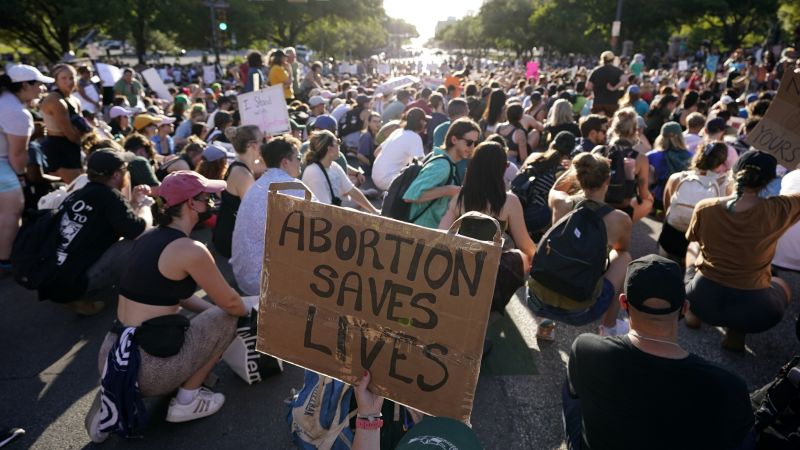
A Texas woman is suing the prosecutors who charged her with murder after her self-induced abortion
CNN
A woman in Texas is suing prosecutors and Starr County for more than $1 million after she was arrested and unlawfully charged with murder for an abortion she had in 2022.
A woman in Texas is suing prosecutors and Starr County for more than $1 million after she was arrested and unlawfully charged with murder for an abortion she had in 2022. Lizelle Gonzalez was arrested and charged with murder in Starr County, Texas, in 2022 after using abortion medication to self-induce an abortion 19 weeks into her pregnancy. The then-26-year-old spent two nights in jail, as her name, mugshot and private medical information made national news, the lawsuit said. The charges were dismissed days later. The arrest took place months before Roe v. Wade was overturned by the US Supreme Court and at a time when abortions after six weeks were illegal in Texas. However, pregnant people cannot be criminally prosecuted for their own abortions under state law – not now, nor at the time of Gonzalez’s 2022 arrest. Gonzalez is now suing prosecutors, claiming in her lawsuit they knowingly misrepresented facts and disregarded her rights in order to have her arrested and charged, irrevocably changing the course of her life. The complaint was filed last week against Gocha Allen Ramirez, the Starr County district attorney, Alexandria Lynn Barrera, the assistant district attorney, and the county itself. CNN has reached out to all the defendants. “We have no doubt that the Starr County District Attorney, and his office, were well-aware that Texas law exempts a woman who receives an abortion, by any means, from a murder charge and yet chose to pursue an unjust and unconstitutional indictment,” Gonzalez’s attorneys, Cecilia Garza and Veronica S. Martinez, told CNN in a statement. “Such a flagrant violation of Ms. Gonzalez’s basic civil rights cannot be regarded as a mere ‘mistake.’”


An Air Canada plane traveling from Montreal collided with an emergency vehicle on the runway at New York City’s LaGuardia Airport in the late hours of Sunday night, killing two pilots and injuring dozens of people.

Top Senate Republicans on Capitol Hill believe their party is unified behind a plan to reopen the Department of Homeland Security. Now, they need to sell the plan to Democrats.

Markwayne Mullin will serve as Donald Trump’s next Department of Homeland Security secretary, elevating the US senator to helm the agency at the center of the president’s controversial immigration enforcement effort and an ongoing shutdown.

President Donald Trump’s sudden turnabout and, according to him, rapidly advancing peace talks made for an abrupt shift in the administration’s approach to the Iran war.

The Supreme Court’s conservative majority appeared dubious of state laws that allow the counting of mail ballots that arrive at election offices after Election Day as justices heard oral arguments in a challenge to Mississippi’s five-day grace period for mail ballots.

The chief district judge in New Jersey appointed Robert Frazer, a career prosecutor, to serve as US attorney for the state, ending for now a dispute over the legality of the office’s leadership that threatened to derail criminal investigations.

Tens of thousands of taxpayer dollars were spent on expenses for hair and makeup artists and a horse for the advertisement showcasing outgoing Department of Homeland Security Secretary Kristi Noem in front of Mount Rushmore, according to invoices seen by CNN.

President Donald Trump was presented Sunday with a potential off-ramp to the more than month-long Department of Homeland Security shutdown: fund every part of the department except enforcement operations by Immigration and Customs Enforcement, two sources familiar with the conversations told CNN.

Immigration and Customs Enforcement agents are heading to 13 airports today to help with crowd management as travelers at some airports wait in hours-long security lines amid the DHS shutdown. Follow here for the latest.

A consortium of the nation’s top architectural and historic preservation groups is targeting President Donald Trump’s plans to temporarily close and extensively renovate the Kennedy Center, filing a new lawsuit Monday that asks a federal judge to indefinitely halt the project.

ICE agents sent to airports as TSA callouts remain high; separately, two people have died after a plane collided with a fire truck at New York’s second biggest airport. Follow for live updates

Mike Pence used to dream of following two successful Donald Trump terms with his own turn in the White House.

An Air Canada plane was damaged after colliding with a vehicle on a runway at New York’s LaGuardia Airport Monday, according to video from the scene and air traffic control audio.