A silent witness to centuries of change of Neeleswaram
The Hindu
French cannon repurposed for metalwork in Neeleswaram sheds light on 18th-century battles, alliances, and mysteries.
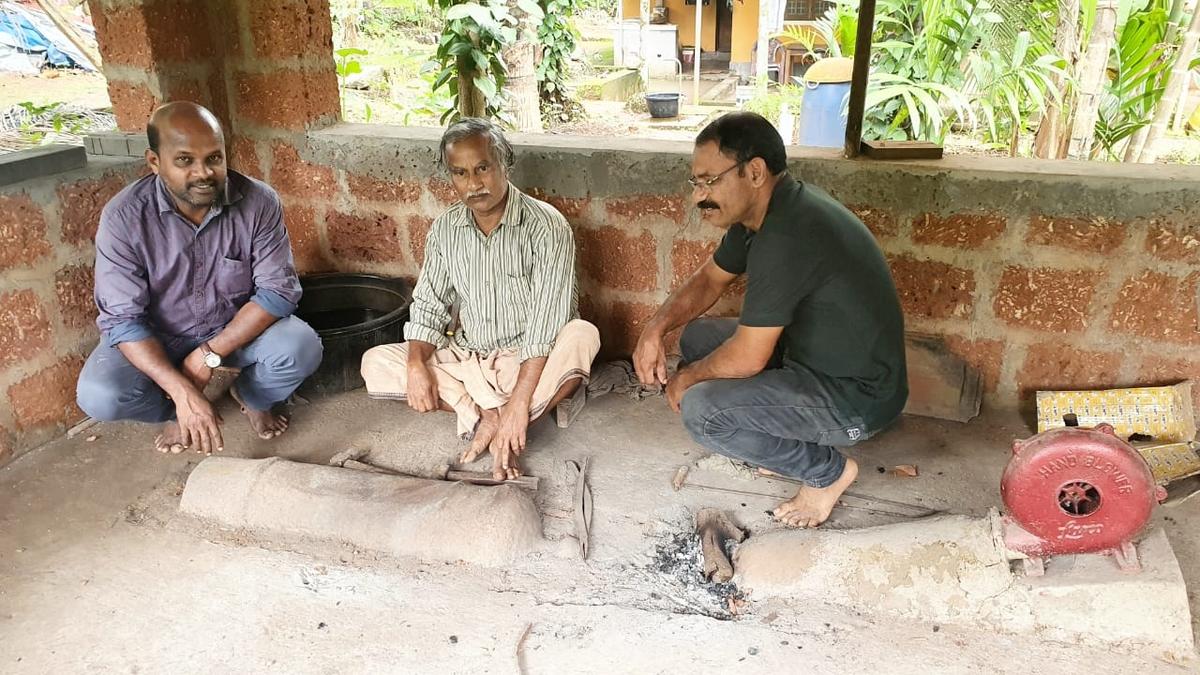
Not known to many in Neeleswaram lies a French-made cannon, repurposed for metalwork at an ‘ala’ (traditional blacksmith shed) near Karimoola Padarkulangara Bhagavathy Temple. This artifact, now part of the blacksmith’s tools, symbolises the Neeleswaram dynasty’s struggles, alliances, and battles in the 18th century.
The cannon, long forgotten, resurfaced when history teacher Jayachandran Chamakuzhi read about it in Kanal Vazhikal Thandiya Jeevitham, a book by Theyyam artiste Kelu Panicker.
Intrigued, Chamakuzhi visited the site and engaged with local people. Dr. Nandakumar Koroth, a history teacher at Nehru Arts and Science College, referenced French texts suggesting the cannon’s French origins, confirming its historical significance.
The cannon, about a metre-long, is half-buried in P.P. Ravi’s shed. Ravi, a traditional blacksmith, uses it to shape metals, a testament to its enduring strength. He says the cannon has been in his family’s possession for generations, believed to have been passed down from the Thamburan (king) of Neeleswaram. However, there’s no documentary evidence to support the claim.
Koroth traces the cannon’s origins to the mid-18th century, citing the writings of Abraham Hyacinthe Anquetil Duperron, a French scholar. On December 3, 1757 Duperron visited Neeleswaram and recorded seeing a French cannon near Palai. This cannon, left behind after a French military defeat on June 22, 1756 may have found its way to Ravi’s forefathers, who integrated it into the ‘ala’.
Dr. Koroth explains that Neeleswaram’s cannon is part of the broader narrative of the Second Carnatic War (interference of the English and the French in politics of the native rulers with a view to enhancing their political power and area of influence), which extended far beyond Hyderabad and Karnataka. Duperron’s writings from 1771, including the first European translation of Zend-Avesta, offer vivid accounts of the era.
He had detailed how the King of Neeleswaram allowed the French to build a fort, only for it to be partially occupied by the Canarians (Ikeri Nayakans) when the king failed to pay 1,000 gold pagodas. Eventually, the French captured the Mattalayi (Matelaye) Fort in 1752, but their victory was short-lived. They were defeated by the forces of the ‘Munnamkur’ Neeleswaram Raja in the Second Carnatic War.


NCSC reviews the reservation policy at Kalpakkam's atomic energy units, ensuring effective implementation and addressing concerns with officials.

Shivamogga Deputy Commissioner Prabhulinga Kavalikatti stated that the philosophy of the 12th-century Vachanas has served as a daily guiding principle in his role as an officer.

CM Siddaramaiah says he presented the State Budget at an "auspicious" time, owing to pressure from family and officials.

India's first open-source psychiatric disorders database, CALM-Brain, launched in Bengaluru, aims to enhance understanding and treatment of mental health issues.

Political parties in Tamil Nadu ramp up their election strategies in high-tech war rooms, focusing on youth engagement and real-time responses.

‘Follower’ dives into the heated border dispute between Karnataka and Maharashtra in Belagavi while tackling the messy world of social media and its impact on friendships

India's NavIC satellite system faces setbacks, limiting its security capabilities amid concerns of reliance on foreign navigation systems

Harish Rana's last rites held, family donates his organs

Telangana's Rythu Bandhu budget allocation for FY 2026-27 is expected to decline, affecting agricultural support for farmers.

In Surendranagar, Gujarat, where only a handful of families continue to practise tangaliya weaving, we visit artisanal communities working with brands like Jaypore to revive the intricate craft for contemporary wardrobes

Madras High Court allows police to arrest YouTuber 'Savukku' Shankar if needed, dismissing claims of solitary confinement.

Lula leads Brazil's largest-ever business delegation to India, aiming for trade deals and global governance reforms amidst geopolitical challenges.

AIADMK reveals its first candidate list for Tamil Nadu Assembly election, featuring familiar names and few surprises.