A school for the visually challenged: Designed for the senses
The Hindu
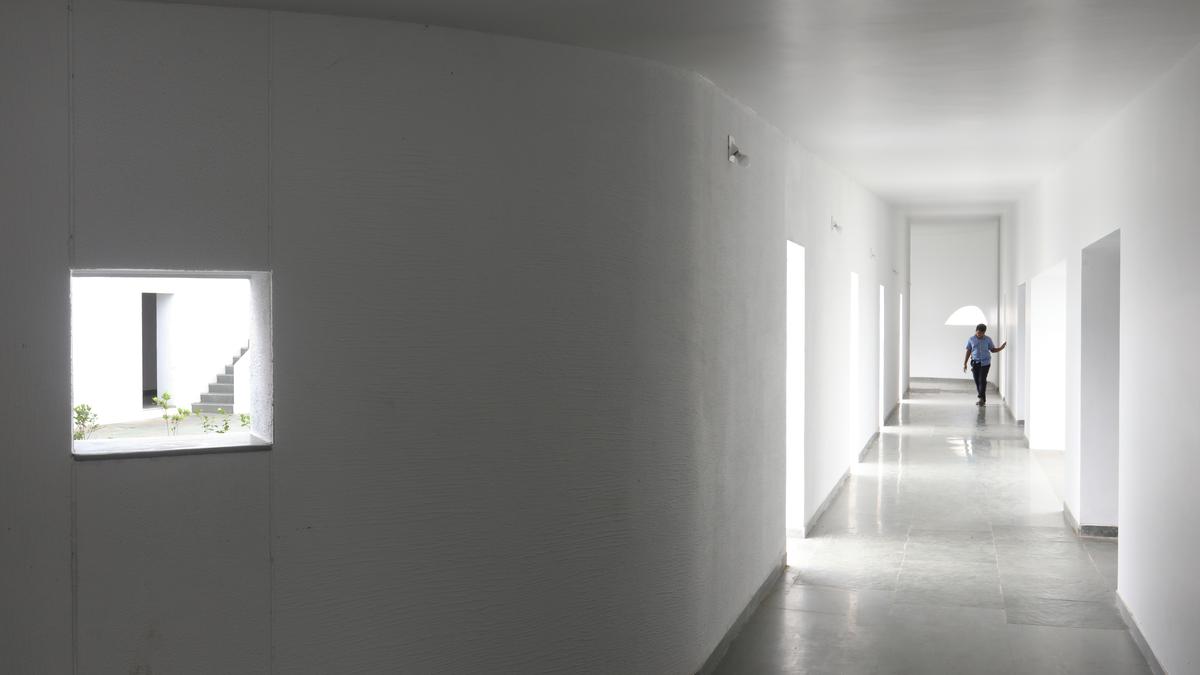
Eight years ago, 2016 to be precise, Viren Joshi, President of Gujarat’s Service Association for the Blind approached Ahmedabad-based architecture practice Sealab with a unique project. This was to visit Gandhinagar’s School for the Blind and Visually Impaired Children and help him improve its living conditions and education facilities for students. And thus was born a school designed to be navigated with the help of more than one of the five primary senses. The new academic building, to the west of the existing one, has ten classrooms with five different types arranged around a central courtyard. Each classroom around the central plaza has different features for specific uses – music rooms, meeting spaces, workshops, etc., and based on their functions, the classrooms have various forms, volumes, and light qualities.
Eight years ago, in 2016, Viren Joshi, president of Gujarat’s Service Association for the Blind, approached Ahmedabad-based architecture practice Sealab with a unique project. This was to visit Gandhinagar’s School for the Blind and Visually Impaired Children and help him improve its living conditions and education facilities for students.
Designed for children from remote villages and towns in Gujarat, the school was then functioning in a two-storey building where children lived on the ground floor and studied on the first floor. When the student numbers increased, the school was left overcrowded. Anand Sonecha, Principal Architect and founder, Sealab, says it was then “collectively decided to renovate the existing building and transform it entirely into the hostel block and a new academic building would be built which could accommodate 100 students. We were appointed as architects of the project in 2017 and the construction of the school was completed in 2021.”
And thus was born a school designed to be navigated with the help of more than one of the five primary senses. The new academic building, to the west of the existing one, has 10 classrooms with five different types arranged around a central courtyard. Each classroom around the central plaza has different features for specific uses — music rooms, meeting spaces, workshops, etc., and based on their functions, the classrooms have various forms, volumes, and light qualities.
Sonecha explains that with many students having low vision, they can distinguish spaces that have the contrast of light and shadow or contrasting colours and surfaces. “Specific skylights and openings are designed to create contrasting areas with light and shade. For example, the entrance vestibule of the special classrooms is marked by a high ceiling with a skylight making a flare of light. Also, contrasting colours are used on the doors, furniture, and switchboards so that the students can easily differentiate the elements during navigation,” says the architect, adding that as students with low vision are sensitive to direct sunlight, the classroom has indirect, filtered light from the private courtyards and skylights.
To bank on their sense of hearing, the sound of voices or people walking changes according to the echo produced in the spaces. “The design attributes different heights and widths to areas of corridors and classrooms so that children can recognise them by sound. For example, the entrance corridor has a high ceiling height (3.66m), and it gradually reduces in height (2.26m) and width, giving an identifiable sound quality to each space.”
Sealab collaborated with landscape architect Lokendra Balasaria who planted more than 1000 shrubs, plants, and trees of 37 species on campus, and also set up a traditional rainwater harvesting system. “The landscape has a significant role in the design,” says Sonecha, “Courtyards, located next to the classroom and connected to the corridor, have aromatic plants and trees, which help in the navigation of the building. The material and textures of the walls and floor, with smooth and rough surfaces, guide the students throughout the spaces.”
For instance, there are five different wall plaster textures used in the building. The two longer sides of the corridor have horizontal textures, whereas the shorter side has vertical textures. “This helps students identify which sides of the corridor they are navigating. The central courtyard has a semi-circular texture, whereas the external surface of the overall building is sand faced plaster,” explains the architect currently working on Gram Setu, a community centre for farmers in Valuna village in Meghraj, Gujarat.


Test your knowledge with the quiz on Science films at the Oscars through history

Set between the Siwalik hills and the plains, Butwal offers travellers a mix of regional cuisine, pilgrimage trails to Lumbini and the comfort of Hyatt’s new hospitality landmark

Explore 2026's wallpaper trends in India, highlighting botanicals and handmade designs that enhance modern homes with nature-inspired aesthetics.

Mercedes-Benz CLA 250+ with EQ Technology review: design, performance, range and features explained. Discover how the new electric CLA combines advanced AI, long range, fast charging and futuristic styling for the next generation of luxury EVs.

AI tool for sparrow conservation

BTS’s comeback with ‘Arirang’ marks a major global music event. When does the album release, and where can you watch their concert live stream? We have all the details

The 2026 U.S. cholesterol guidelines urge starting screening and treatment at 30 to prevent cardiovascular disease effectively.

Olam Festival 2026 in Thiruvananthapuram returns March 27-29 with 120+ vendors, music, art, and cultural zones.

A few storytellers in Thiruvananthapuram share their journeys, challenges, and evolving methods on World Storytelling Day, inspiring young minds.

76-year-old Kurian Jacob from Kerala triumphs with seven medals, including five golds, at the Open Masters Games in Abu Dhabi.

Explore the nature of the human mind as an emergent property of brain activity and complex neural interactions.

CERN's Large Hadron Collider discovers the Xi-cc-plus particle, enhancing understanding of quantum mechanics and baryon behavior.

Vibha Batra’s latest book, Spotless (Hachette India) is a novel in verse for young adults