A river that was once the lifeline of Coimbatore needs restoration
The Hindu
G. Chandrasekaran and environmentalists share hope for the revival of River Noyyal in Coimbatore through art and conservation efforts.
What happens when Nature takes on grey hues? “A pall of gloom descends, a sign of bad tidings,” says G. Chandrasekaran, a retired art teacher, as he describes a painting on River Noyyal. Mr. Chandrasekaran, with 30 fine arts students, had a decade ago followed the trail of the Noyyal, a 167-km glorious journey from Kooduthurai near Alandurai in Siruvani all the way to the Cauvery near Karur, and made on-the-spot sketches of what they saw.
“The work by one of my students captured the landscape, the tree, and flowers in grey streaks, indicating the disaster waiting to unfold on the environment. Though it was done a decade ago, it holds true even today,” says Mr. Chandrasekaran, who headed the Department of the Government College of Fine Arts, Chennai. “The objective was to use art as a tool to create social awareness of the importance of conserving natural resources, and water gets the priority,” he says.
Coimbatore is known for its many lakes. Historians often describe the city as a beautiful woman adorned with a garland of navaratnams, represented by the lakes of River Noyyal at Narasampathy, Krishnampathy, Selvampathy, Puttuvikki, Selvachintamanikulam, Puliakulam (now a town), Vaalankulam, and Kurichikulam to name a few.
With the last Tamil Nadu Budget announcing plans for revival of the Noyyal, environmentalists and artists hold out a gleam of hope even as the river struggles to survive in the face of development.
“A vivid childhood memory is fishing using a wet rag in pristine waters of the river,” says K. Mohanraj, 53, an environmental activist, who has mapped and documented the river basin over 15 years. Originating in the Vellingiri Hills of the Western Ghats as a small rivulet, the Noyyal finds a place in ancient Tamil literature. Through the centuries, the river has stood testimony to generations taking holy dips and conducting ceremonies on its banks. Hundreds of fishermen families and farming communities depend on its water for livelihood.
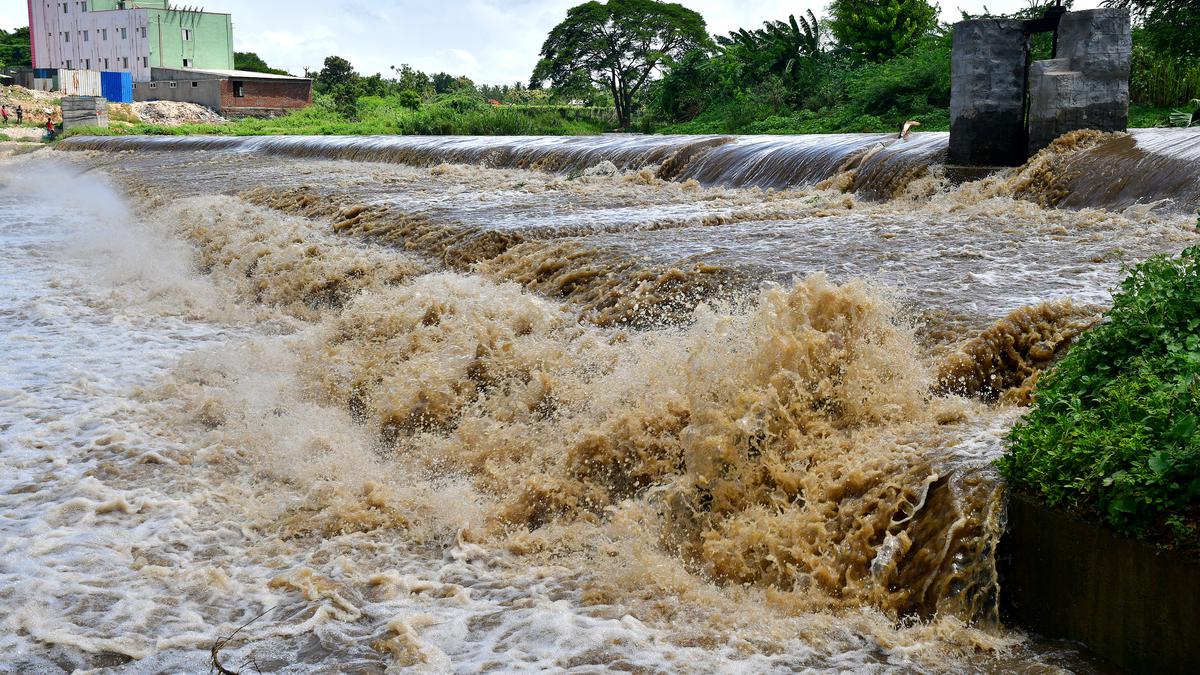
“While the first zone from the point of origin to the Perur Puttuvikki lake is still pollution-free and supports a thriving bio-diversity of aquatic life, migratory and resident birds, and butterflies, the second zone that stretches from the city limits to the Orathupalayam Dam near Tiruppur is choked with domestic and industrial wastes. The third zone from here is downhill and it is reduced to a gutter before it branches into Noyyal village near Karur,” he adds.
Encroachments along the river bank, infrastructure development, and dumping of waste along the channels that interlink the tanks are a growing concern. A collective effort of people and the government can go a long way in restoring the river’s glory. “A scientific approach is the key to reviving the river. It should go beyond building new check-dams or adding walkways and greenery. We need micro-sewage treatment plants,” says Mr. Mohanraj.


Anuradha Jonnalagadda took over as in-charge Vice-Chancellor of the University of Hyderabad, focusing on continuity during the transition.

Telangana government awaits committee report on TGSRTC staff absorption, with decisions to be made at an appropriate time.

Telangana's revised pay scale implementation for employees will take timer. The tenure of Pay Revision Commission extended. Govt likely to take decision on reccomendation based on its report.

Vizianagaram's SP A.R. Damodar highlights 20 accident-prone areas and urges drivers to prioritize safety with helmets and seat belts.

Kerala HC stays disqualification of SNDP Yogam leaders, reversing a single judge's order regarding financial and regulatory compliance issues.

Karnataka announces daily supply of 10,000 LPG cylinders to hotels, easing the commercial shortage for the hospitality industry.

Malayalam superstar Mohanlal will be reuniting with filmmaker Priyadarshan, it was announced recently. It will mark the 100th film of Priyadarshan and is backed by Mohanlal’s longtime collaborator, Antony Perumbavoor

Gautham Vasudev Menon loses Madras High Court appeal, ordered to pay ₹4.25 crore to R.S. Infotainment with interest.

AIADMK faces its toughest challenge in 53 years as it prepares for the crucial 2026 T.N. Assembly elections.

Lakmé Fashion Week x FDCI 2026 in Mumbai: What worked and what didn’t

Telangana CM announces underpass beneath Begumpet Airport runway to alleviate traffic congestion in Hyderabad.

Congress leader Ramesh Chennithala claims an alliance between Pinarayi Vijayan, Modi, and Shah aims to undermine UDF in Kerala elections.

CCB arrests Bengaluru couple for running a fake government job scam, cheating over 100 victims out of crores.