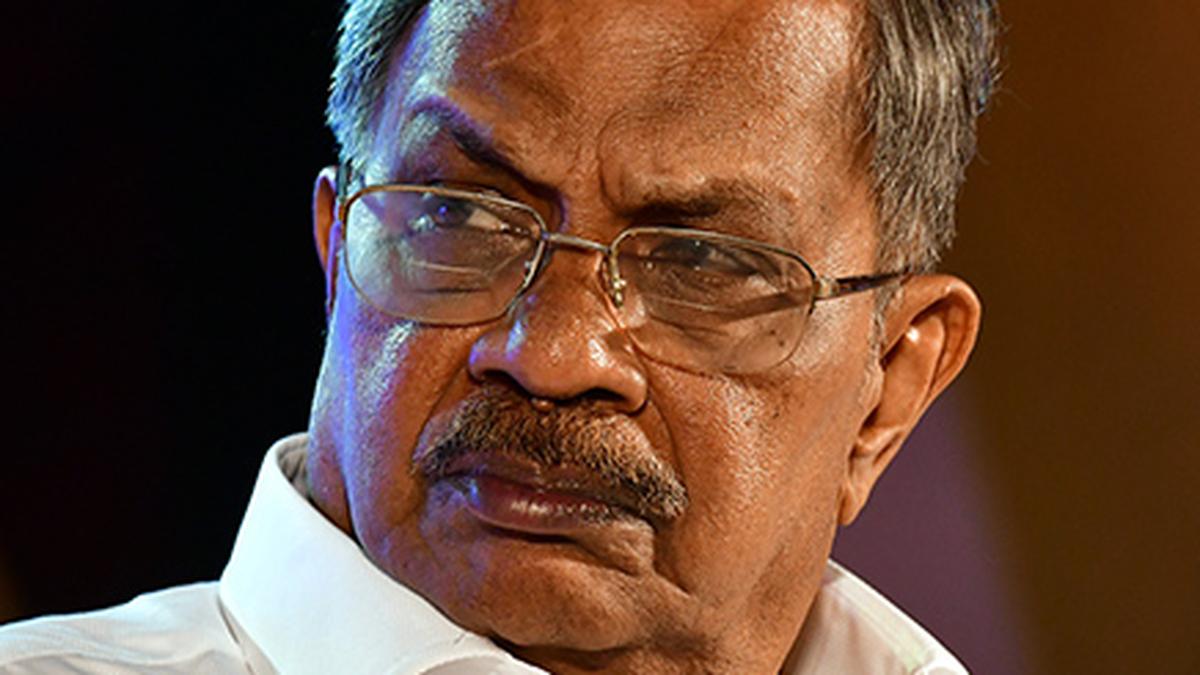
A reluctant filmmaker who created classics on celluloid
The Hindu
Bless the soul of Sobhana Parameswaran Nair, the man behind the revolution of Malayalam cinema's screenwriting.
Bless the soul of Sobhana Parameswaran Nair.
If he had not succeeded in persuading M.T. Vasudevan Nair to adapt his own short story, Snehathinte Mukhangal, for a feature film that he wanted to produce, Indian cinema may perhaps have not got one of its greatest scriptwriters and Malayalam cinema several of its classics.
Murappennu, the 1965 feature film directed by A. Vincent, was the result of Parameswaran Nair’s persuasion. M.T. had no wish to write for films. He was happy writing his short stories and novels. He eventually agreed to write the script. He had not even read a script till then.
Murappennu revolutionised the art of screenwriting in Malayalam cinema. It was refreshingly realistic, and the characters spoke like real men and women, and not as if they were on stage. In fact, the screenplays in Malayalam cinema can be divided into two— before Murappennu and after Murappennu.
Over the next five decades, M.T. wrote one classic after another. He collaborated with directors like Hariharan, I.V. Sasi and Bharathan to create many unforgettable films. The characters he wrote for the silver screen became parts of Malayali’s life. Such was the power of his words that Chanthu of Oru Vadakkan Veeragatha became a tragic hero, from the ballad’s treacherous Chanthu. Unnimaya of Parinayam and Indira of Panchagni became of the strongest female characters in Malayalam cinema with their admirable courage to take on the society.
M.T. gave us the convincing reasons for Perumthachan to kill his own son. He moved us with the plight of the ‘Velichappadu’ (Nirmalyam) and the guilt of Dr. Haridas (Amrutham Gamaya). In Thazhvaram, he showed us how a Malayalam film can be conceived as a Western thriller (he was glad when one pointed it out to him during an interview once).
He directed six feature films, including Nirmalyam, his directorial debut that won the National Award for the best film in 1974, Bandhanam and Manju. He had offers to direct more films, but he didn’t want to be burdened by the financial commitment of the producer who would invest big money in a film. So, when it came to cinema, he limited himself to writing scripts (some 60 of them).


Decomposed body of a missing 25-year-old man discovered in Dindigul stone quarry, prompting calls for investigation and quarry closure.

SVEEP activities launched in The Nilgiris aim to boost voter turnout at 13 polling booths with low participation rates.

Learn who can vote by postal ballot in the upcoming Tamil Nadu Assembly election, including seniors and persons with disabilities.

Shorts News:Watch: UDF linked to communal forces in Kerala: CPI(M) leader A Vijayaraghavan

Karnataka government postpones Deendayal Upadhyaya event at KSOU Mysuru due to protocol violations and lack of government involvement.

Sameer Wankhede denies bribery allegations involving Shah Rukh Khan’s son in drugs case during Bombay High Court proceedings.

What does it take to design gloves, masks and uniform that factor in the various challenges faced by workers on the waste beat? Indore, Bengaluru and Pune have an answer

Gaurav Gogoi files nomination for Jorhat Assembly seat, marking his electoral debut in the upcoming Assam elections.

A round-up of events and programmes held at colleges in Tiruchi and other Cauvery delta districts

CPI(M) and Congress clash over accusations of aiding BJP, threatening the LDF-UDF duopoly ahead of Kerala Assembly polls 2026.

Shivamogga veterinarians demand accountability for the death of trainee vet Dr. Sameeksha Reddy, citing systemic failures in zoo administration.

BJP launches 'Mana Ooru–Mana Jenda' campaign on April 6 to strengthen grassroots connections and promote development in Andhra Pradesh.

Anuradha Jonnalagadda took over as in-charge Vice-Chancellor of the University of Hyderabad, focusing on continuity during the transition.