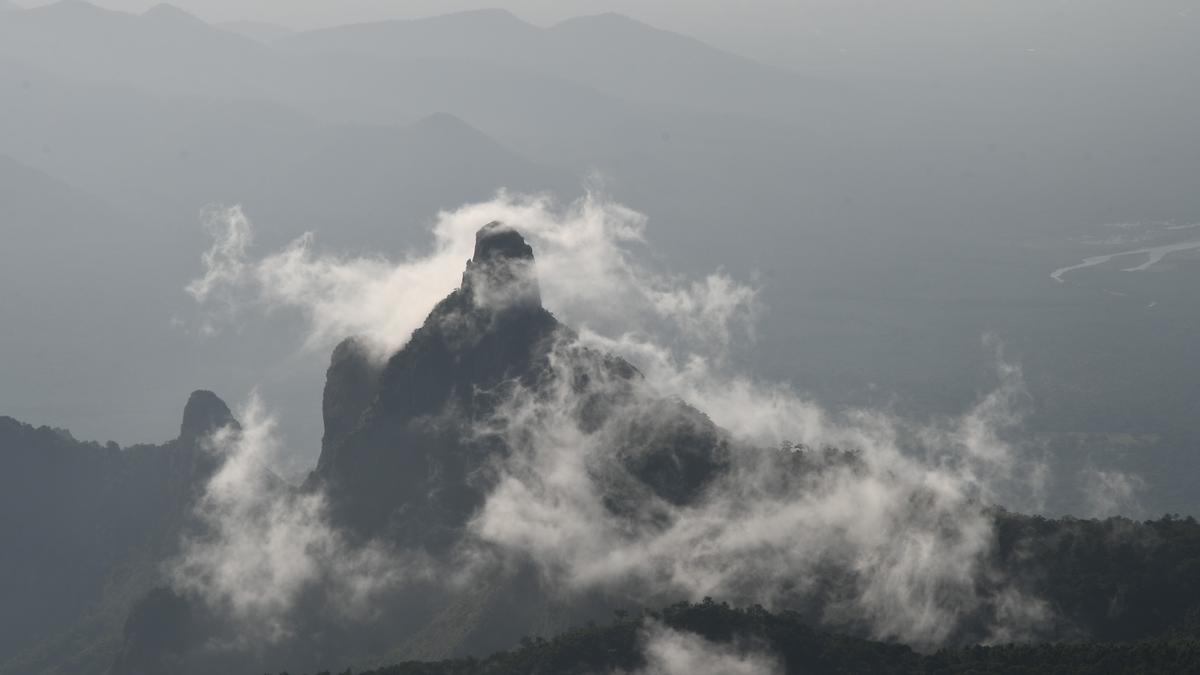
A pillar and a peak that are held most sacred by the Irula tribe
The Hindu
Discover the sacred Rangaswami Peak and Pillar in Kil Kotagiri, Nilgiris, a site of worship for the Irula tribe.
In a lesser known part of Kil Kotagiri in the picturesque Nilgiris, a singular spire rises above the surrounding terrain. Measuring over 400 feet, the spire, known as Rangaswami Pillar, is worshipped by the Irula tribe as a deity. The rock formation, along with the Rangaswami Peak nearby, is one of the most sacred of sites for this indigenous adivasi community. The Rangaswami Peak hosts the annual harvest festival of c in May and June every year. It is attended by the Irulas from surrounding regions; but more recently, it has become popular among non-adivasi members too. The five-week festival ends with a special worship performed only by the Irula community.
P. Kannan, an Irula from Kotagiri, told The Hindu that he had heard tales of the cultural significance of the Rangaswami Peak and Pillar from his elders. He said the Irulas celebrate the harvest from their “millet land” in May and June. “They will perform pujas for five weeks praying to the deity to ensure another good harvest and good spell of rain in the coming year,” he said.
He added that according to adivasi folklore, a particular head of cattle made its way to the peak leaving behind the rest of the herd, leading to the site being worshipped over thousands of years.
Writing in his Encyclopaedia of the Nilgiri Hills, anthropologist Paul Hockings says the Rangaswami Peak is the “holiest mountain” of the Irulas and “perhaps the seat of the original, indigenous worship of a mountain god”. He says the name of the god worshipped here is Ranga or Ranganada. Other members of the community highlight the lore surrounding the main idol at the site, which had allegedly been broken by a foreigner during his visit to the site. “It is said he died soon after he reached his home country,” an elderly member said.
“Several conclusions may be drawn from a visit to the Rangaswami Peak. First, it shows, as do other aspects of the Irula religion, a Vaishnava-Saiva syncretism developed around an indigenous Irula deity.” Mr. Hockings goes on to add that the peak is important for other communities too. “Third... there is the relationship between the Kotas and the Irulas, as suggested by Richard Wolf. He mentions a legend in which the Nilgiri ‘god’ revealed himself to a Kota and an Irula walking together. Both the Kotas and the Irulas began to worship the Nilgiri god at the same spot until some quarrel separated them: the Irulas began worship on Rangaswami Peak and the Kotas near their village.”
The Rangaswami Pillar, located close to the peak, was the site of an air crash in 1950, in which noted statistician Abraham Wald and 19 others died. “The air crash enhanced the magical aura of the pillar’s divinity,” says Czech Indologist Kamil V. Zvelebil.
S. Udhayakumar, Director (in-charge), Tribal Research Center, Udhagamandalam, said the site was of interest to researchers. “The Tribal Research Center, on the State government’s orders, has completed the video and photographic records of all six of the Nilgiris’ adivasi communities, and is set to publish them soon,” he told The Hindu. The exercise will ensure the preservation of the culture, customs, habits, and sacred sites of the Irulas as well as other adivasis in the Nilgiris.


Congress criticises Modi government, citing reports about Pakistan's diplomatic role amid U.S.-Iran tensions, labelling it a setback for India.

Folk music with the Barmer Boys that crosses all boundaries

Tamil comic blockbuster Thaai Kizhavi releases on JioHotstar this week, as actress Radikaa Sarathkumar rewrites rules on pay, age, and women in Tamil films

"The jury has difficulty coming to a consensus regarding one defendant, do you have any advice on how to move forward?" the jurors told Judge Carolyn Kuhl

Maharashtra relocates 25 leopards to Gujarat's Vantara facility amid rising leopard and tiger populations, says Forest Minister Naik.

Assembly polls 2026: Follow updates from The Hindu on the upcoming elections in five States on March 24, 2026

Delhi's per capita income is projected to grow 7.09% by 2025-26, highlighting the city's economic progress and infrastructure challenges.

Review meeting held in Dharmapuri with election observers and nodal officers to discuss upcoming Assembly elections.

Execution of development projects, infrastructure augmentation to occupy centre stage in electioneering

Telangana Cabinet approves Hate Speech and Parents Support Bills, ensuring accountability for neglecting elderly and curbing hate-driven offences.

EU and Australia finalize a free trade agreement and establish a new defense partnership to enhance economic and military cooperation.

U.S.-Israeli war on Iran LIVE: Iran faces deadline of US President Donald Trump warning to open Strait of Hormuz. Follow The Hindu for more LIVE updates on March 23 2026 on Iran-Israel war.

KPCC chief Sunny Joseph emphasizes UDF's focus on Sabarimala and corruption while expressing confidence in winning Kerala's upcoming Assembly elections.