A new secretariat, a heritage institution, and an impassioned protest
The Hindu
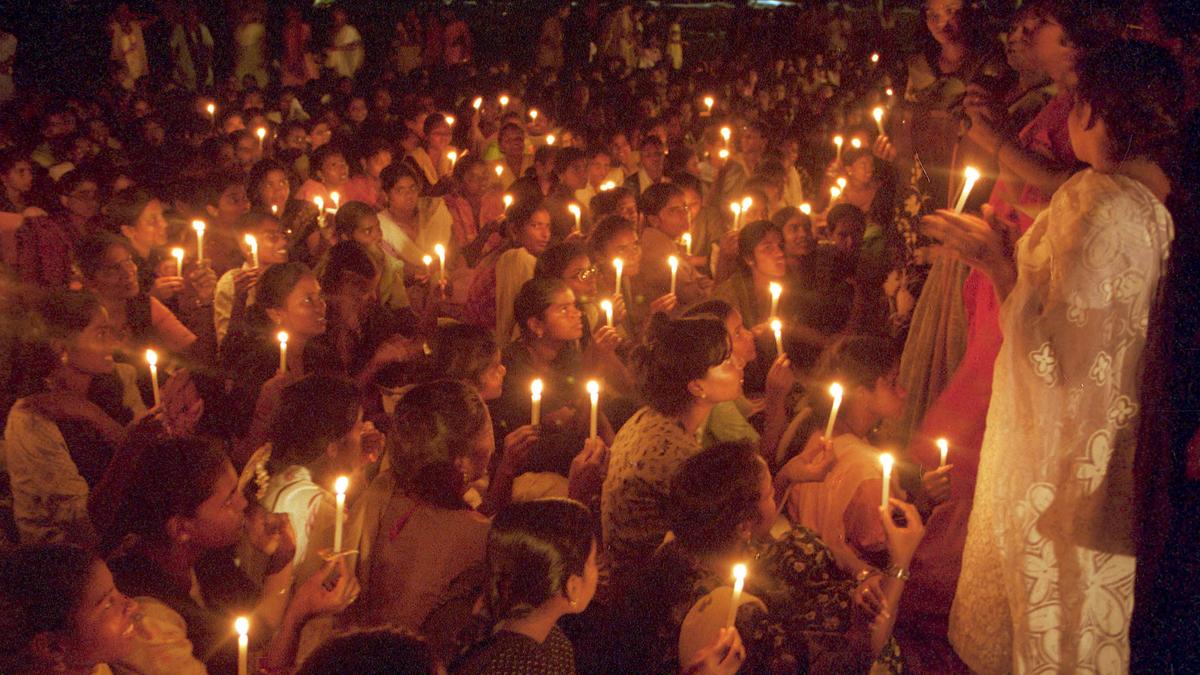
Jayalalithaa's decision to demolish Queen Mary's College sparked an impassioned protest, leading to a historic battle for preservation.
On January 31, 2003, in the ongoing Assembly session, the then Chief Minister Jayalalithaa dropped a bombshell. As these things usually go, it did not seem like a bombshell initially. It was only over days and months that the protest actually gained momentum and fervour. That it ended up as one of the most impassioned protests the city had ever witnessed, because it sprang from the most evocative of emotions — nostalgia and love — a desire to see the past live on.
What did Jayalalithaa do? She announced that since the current Secretariat, operating at Fort St. George, built in the 1970s was in a dilapidated state, a new administrative city would be established at Sholinganallur. So far, so good. She also said that since it would take 15 to 25 years to build a complete township, in the meantime, the Secretariat would be shifted to a vacant space opposite the Marina in the next two years. But if you are building on the Marina, there’s very little space that is already unoccupied, so it became imperative that what already stands must come down. The axe fell on Queen Mary’s College. It was not the original choice though. The earlier proposal to build the Secretariat on the site of the Lady Willingdon Institute was abandoned as it did not have adequate depth. The Queen Mary’s College site, on the other hand, stretched over 26 acres.
Now, the Chief Minister had miscalculated the impact that this decision would have. After all, several generations of students had passed through the college established in 1914, and nothing, nothing binds like a college sorority.
Queen Mary’s College, or QMC as it is known among the people of the city, has been a significant part of Indian history, having been established in colonial times. As a college educating women at a time when it was progressive to do so, it has seen several firsts and has several alumni who made a significant contribution to the Indian freedom struggle, and to independent India. No less were Captain Lakshmi Seghal of the Indian National Army, former Vice-Chancellor and former Chairperson of the State Women’s Commission V. Vasanthi Devi, and IAS officers Shanta Sheela Nair and Jayanthi. The college website records that the first three child widow graduates of south India — Ammukutty, Pavathy, and Lakshmi — were from QMC. It also had colonial structures that were symbols of heritage of the city, and its students, the city soon learned, were feisty and would not take no for an answer.
Some of the QMC staff decided to hold a demonstration in front of the institution on March 27. About 2,000 students and staff members staged a flash protest on the college premises. Others supported their demands outside of it. Educators, politicians of all hues and persuasions, conservationists, architects, heritage enthusiasts, and alumni rose in solidarity. They amplified the students’ protest in the world outside and lent their heft to this rather intense unequal struggle being fought between the all-powerful government on one hand, and a band of committed women students on the other. People pointed to how the college accommodated women from the lower economic strata and urged the government to revise its decision.
Of course, the heritage argument was also loud. In a city, which unfortunately at that point did not have a functional heritage conservation law, activists pointed out that the institution was also famous for its heritage value and location near the Marina. They argued that it was the government’s duty to restore the dilapidated buildings on the QMC campus, and instead it was going to mindlessly demolish the heritage structures, on the pretext that they were falling apart already.
The students began gathering daily in the front apron of the campus after their examinations to continue with the demonstrations and ensure that the government backtracked before the annual holidays started. If they did not protest then, they feared, they might have to come back to mere rubble.


CCB arrests three drug peddlers in Mangaluru, seizing ₹2.5 lakh worth of MDMA and other valuables.

TVK's 28 candidates in Puducherry include former BJP MLAs, a sitting Independent, and a retired police IG.

BRS submits notice on private member bill to Speaker

CPI-M accepts DMK's five-seat offer for Tamil Nadu Assembly elections, prioritizing INDIA bloc unity over seat demands.

Ricky Rai, son of former underworld operative Muthappa Rai, on Monday appeared before the Bengaluru Traffic Police for questioning in connection with a case involving a Lamborghini performing dangerous stunts at Anil Kumble Circle on March 21.

The Dispur election heats up as 'CongBJP' defections shape a high-stakes contest between veteran candidates from BJP and Congress.

Bengaluru's M. Chinnaswamy Stadium conducts readiness drill ahead of IPL 2026, ensuring upgrades and technical preparations are complete.

First-level randomisation of EVMs completed in Nagapattinam for upcoming elections, ensuring transparency and security.

A district-level committee in Krishnagiri has been formed to assess and verify seizure claims of goods and cash.

Minister Anam Ramanarayana Reddy pledges government support for local fishermen and farmers facing challenges in Andhra Pradesh.

MP M. Sribharat urges collective efforts to revive Visakhapatnam Steel Plant, highlighting key reforms for crucial recovery and growth.

141 candidates have filed nominations for Kozhikode's Assembly elections, with scrutiny on March 24 and campaigning intensifying.

BJP's Vijayendra accuses Congress of using money to influence Bagalkot bypolls, urging voters to reject their tactics.