A museum in search of a forever home in Telangana Premium
The Hindu
Discover the rich history of India's ancient forest tribes through ethnographer Jayadheer Tirumala Rao's vast collection of artefacts.
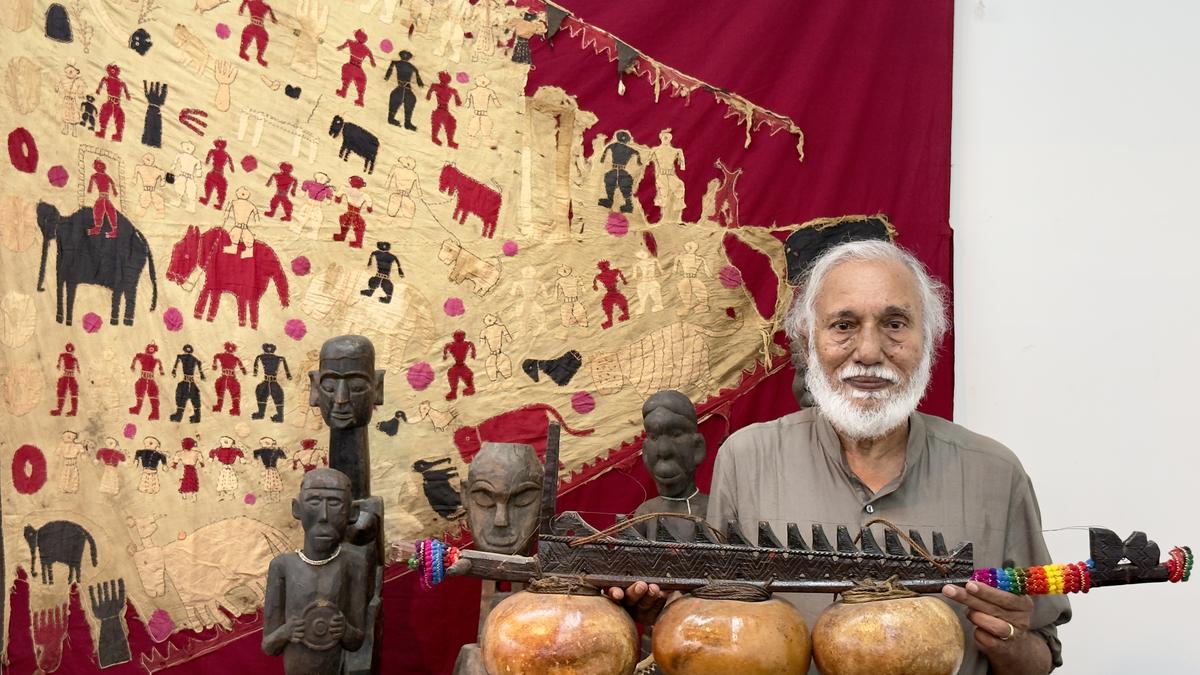
Somewhere inside a forgotten room in Hyderabad, a crow with the hood of a cobra waits. Not a living creature, but a riveting brass totem with a story so rich, it can take hours to tell. Around it lie ghostly wind instruments made of hide and bone, leather bags that breathe music, and shadowy relics from India’s ancient forest tribes.
These are not just objects; they are echoes of long-lost worlds. And now, these artefacts, many of which once mimicked the wind, birds and rain, are in search of a home — a home in Hyderabad bordering the deep jungles and forest tract of central India, where these instruments were first born from ingenuity, ritual, and breath.
These have journeyed far to get here, collected over five decades by one man obsessed with memory and history: ethnographer Jayadheer Tirumala Rao.
His treasure trove lies scattered across six rooms tucked deep within the Telugu University campus in Nampally. Here, between sunlit corridors and dusty alcoves, Rao moves like a man among old friends. The wide courtyard is littered with weathered cartwheels, carved doors, door frames, totem poles and what looks like a sculptor’s madness — but each piece has its own story.
“This is a hanging inkpot made with brass,” the 75-year-old says, lifting a crouched, bull-shaped vessel with a hidden cap for dipping ink. “It was a gift from a student while I was teaching in Hanamkonda.” There are 200 known varieties of hanging inkpots among Adivasi communities, and Rao has managed to collect 40 of them.
It all began half a century ago in Warangal district of Telangana, when a young postgraduate student was nudged away from academia by his mentor, folklorist B.Ramaraju, and asked to take the tougher road — field work. Rao took off, hitchhiking, riding rickety buses and walking for miles through Telangana’s interior in the mid-1970s, when roads were few and forests many.
“I travelled by train, I travelled by bus. I mostly walked, as there were hardly any buses in 1975, to research and understand folk and Adivasi culture. I began collecting musical instruments that did not work,” he recalls, sitting among his archive. “Once, I started walking from Charla in Bhadrachalam in the morning and by 8 p.m., I realised I was lost. I walked all night and somehow ended up at the same point I had started from. That was scary.”


German Chancellor Friedrich Merz visits Bosch campus in Bengaluru, highlighting India-Germany ties in mobility, manufacturing, and innovation.

India falls to 3rd position in Russian fossil fuel imports in December as Reliance slashes crude buy
India drops to third in Russian fossil fuel imports in December, as Reliance cuts crude purchases, totaling €2.3 billion.

Mettur Dam's water level is at 97.43 feet, with an inflow of 218 cusecs and discharge of 1,000 cusecs.

Telangana departments accelerate office relocations from rented spaces to government buildings ahead of the January 31 deadline amid ongoing disputes.

Participating in the Dubai Run 2025

SP Tushar Dudi warns against jallikattu and rooster fights, emphasizing strict legal action for organizers and participants.

Six convicted for the 2013 murder of a fruit vendor in Chennai over a loan dispute, sentenced to life imprisonment.

BCB stands firm on relocating T20 World Cup matches from India due to security concerns, despite ICC's reluctance to accommodate.

CM Stalin inducts 50 transgender individuals into Home Guard services, enhancing inclusivity in Tamil Nadu's public safety efforts.

Former CPI(M) MLA P. Aisha Potty joins Congress in Kerala, citing evolving political dynamics and public encouragement.

Explore the evolution of The Hindu Lit for Life festival and insights from Nirmala Lakshman on literature and wellness.

Raj Thackeray criticizes Adani group's growing monopoly, asserting it threatens fair competition and national development, not opposing progress itself.

CM Fadnavis expresses confidence in BJP-Shiv Sena victory in Nagpur civic polls, citing lack of offerings from the Opposition.