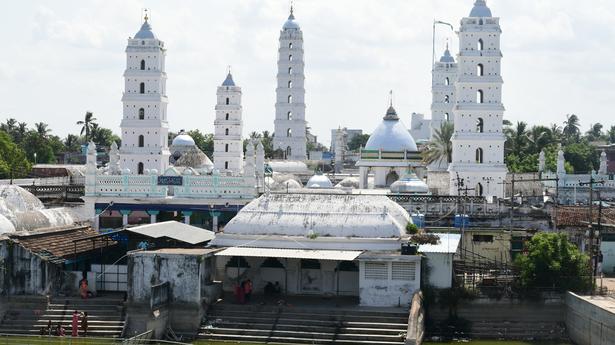
A living symbol of harmony and syncretism
The Hindu
Dedicated to saint Abdul Qadir, born in the present day Uttar Pradesh in 1504, the dargah is the largest shrine of its kind in south India
The Nagore Dargah, with its five imposing minarets and shining gold-plated dome, is almost invisible in the chaos of this small town’s daily traffic. But the steady stream of devotees walking along the winding by-lanes will automatically lead newcomers to the ‘Alangaara Vaasal’, the main entrance of this enduring symbol of religious harmony. The various highway routes to Nagore seem to echo its shrine’s everlasting message: there are many ways to experience the divine.
Dedicated to the Muslim saint Abdul Qadir, born in Manikpur (in the present day Uttar Pradesh) on November 17, 1504, Nagore Dargah is the largest shrine of its kind in south India. The saint is also known by honorifics and titles such as Shahul Hameed, Meera Sahib, Qadir Wali, Periya Ejaman and Nagore Andavar.
Dargah is a composite Persian word that, by extension, refers to a shrine built over the tomb of a revered religious leader. In the Sufi tradition, dargahs have evolved into pilgrim centres, and draw huge numbers of multi-faith congregations from across the globe.
“Without the dargah sharif, there is no Nagore,” S. Syed Mohamed Khalifa Sahib, Qadiri Hashmi, president, Nagore Dargah Advisory Board, told The Hindu. The shrine receives approximately 23,000 to 25,000 pilgrims daily. On Fridays, considered auspicious for both Hindus and Muslims, the number goes up to 40,000. “During the annual 14-day ‘Kanduri’ festival to mark the Qadir Wali’s death anniversary (due in December this year), we receive over a million devotees,” he added.
Abdul Qadir is said to have passed away on November 9, 1570, though the year of death varies in different narratives. Nagore Dargah also contains the graves of the celibate seer’s foster son and spiritual heir Yusuf (also known as Sinna Yejamaan), his wife Sultan Biwi Amma, and some of their children.
Known to be a mystic with a profound knowledge of the 14 ‘tariqa’ (school/method) of Sufism, Abdul Qadir is said to have performed miracles (‘karaamaat’) that earned him a following among royalty and the common man early on.
After mastering Islamic subjects, history, geography, mathematics, logic, astronomy, and music by the age of 18, Abdul Qadir is said to have left his parental home in Manikpur for higher religious studies under the tutelage of Mohamed Ghauth of Gwalior.


The government plans to amend the FCRA, introducing new regulations for NGO asset management and accountability for key functionaries.

The draft policy for “Responsible Digital Use Among Students”, released on Monday by the Department of Health and Family Welfare, has recommended that parents set structured routines with clear screen-time rules and prioritise privacy, safety, and open conversation with children on digital well-being.

Police Observer Sushant Kumar Saxena conducts surprise inspection at Shencottai police station, reviewing warrants and security arrangements ahead of elections.

Andhra Pradesh government to launch key projects in April, focusing on industrial growth and infrastructure development, says Nara Lokesh.

Lok Sabha refers the Corporate Laws (Amendment) Bill to a JPC amid opposition concerns over CSR provisions dilution.

SHG members in Kanniyakumari use snakes and ladders to raise election awareness and boost voter turnout.

Government accelerates consultations for early implementation of the Women’s Reservation Act to ensure women’s representation in 2029 elections.

CM A. Revanth Reddy distributes ₹1 crore insurance cheques to families of deceased Electricity department employees, enhancing financial security for workers.

The Bengaluru Traffic Police (BTP) registered 634 cases of drunk driving during a week-long special enforcement drive conducted across the city between March 16 and March 22.

GHMC intensifies action against property tax defaulters, seizing properties and offering a One Time Settlement scheme for payments.

CCB arrests three drug peddlers in Mangaluru, seizing ₹2.5 lakh worth of MDMA and other valuables.

TVK's 28 candidates in Puducherry include former BJP MLAs, a sitting Independent, and a retired police IG.

BRS submits notice on private member bill to Speaker