A lake ecosystem gasping for breath Premium
The Hindu
Thambi discovers mass fish kill in Ashtamudi Lake due to pollution, sparking concerns about environmental degradation and public health risks.
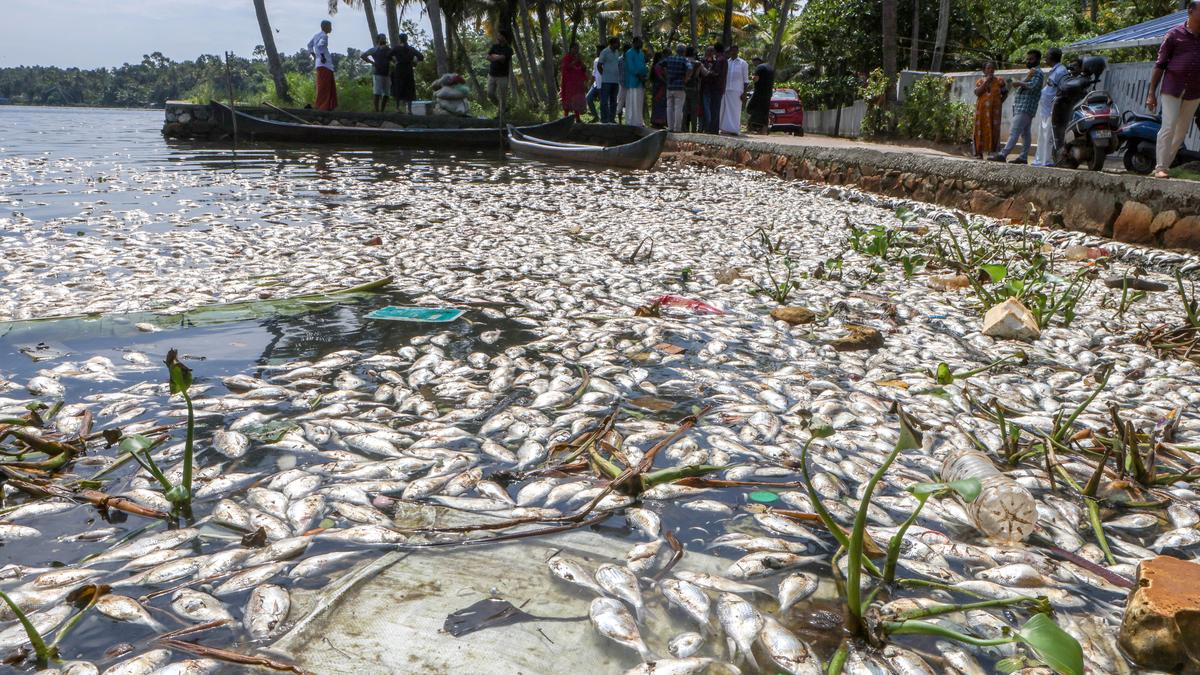
In the last week of October, Thambi, 58, a resident of Kadavur in Kollam, was returning from work when he found several dead fish floating near the banks of Ashtamudi Lake.
At first, he thought they were remnants of fishing with explosives and poison, locally known as ‘thotta’ and ‘nanchu‘, illegal practices still rampant in many parts of the lake that is spread over 5,700 hectares. It was designated by the Union Ministry of Environment, Forests and Climate Change (MoEFCC) as a Wetland of International Importance under the Ramsar Convention in 2002.
As Thambi took a hard look at the waterbody, he noticed species such as pearl spot and tilapia scattered over. It set the alarm bells ringing. “I felt a sense of foreboding as it was nothing like the sporadic deaths we have seen over the years,” says Thambi.
By next morning, the Kuthirakadavu area of the lake was covered with a thick carpet of dead fish leaving a strong stench in the air. While the visuals of the fish kill went viral on social media and experts arrived to collect samples, the people living near the waterbody had no doubts about the cause. “They can no longer fool us with scientific mumbo jumbo as we know very well what led to the mass death of fish. Relentless discharge of effluents into the lake has made its water toxic,” says R. Girija, a resident and homemaker. Her neighbour Rajani echoes her sentiment and says, “everything, including septage and plastic waste, ends up in the lake. If you have any doubts, check the parts where the water is so slimy, and the colour is nearly black“.
According to a preliminary report submitted by the Kerala University of Fisheries and Ocean Studies (Kufos), the mass mortality event was caused by an algal bloom, a phenomenon that occurs due to an overload of nutrients. The proliferation of algae leads to oxygen depletion in water suffocating aquatic organisms. The study also found the presence of streptococci and E. coli in water pointing to sewage contamination in Ashtamudi.
While there has been consistent dumping of plastic, poultry waste, and abattoir waste, sewage lines from many households also open to the lake. In July 2024, the Kerala High Court had directed the Kollam district administration to remove illegal encroachments in and around the waterbody and take immediate steps to prevent waste and effluents from polluting the Ramsar site. “It is high time that we need to secure this kayal poramboke for future generations and also ensure free flow of water in Ashtamudi Lake,” the court had observed.
A study by the Department of Aquatic Biology and Fisheries, University of Kerala, revealed dangerous levels of microplastic pollution in the aquatic ecosystem of Ashtamudi Lake. The presence of microplastics was detected in fish, shellfish, sediment, and water samples with the highest percentage found in macrofauna at 60.6%, fish at 19.6%, and shellfish at 40.9%. While MP (microplastic) types detected are fibres, fragments, and films, the study also identified the presence of a range of polymers, including nylon and polypropylene.


T.N. Chief Secretary and DGP visit Governor at Lok Bhavan, presenting flowers in courtesy call.

Eight TSPC Maoists arrested in Hazaribag, Jharkhand, with weapons and ammunition seized during a police operation.

Four ambulances of a Jewish community service in London were set ablaze in a suspected antisemitic hate crime.

Gautham Manohar hopes his photographs serve as reminders of the Earth’s delicate beauty

Thousand Lights faces parking chaos and traffic congestion despite its political significance and ongoing development efforts.

Generic semaglutide increases accessibility, but doctors caution against misuse and quality concerns

Haryana Police removes 857 links to Badshah's 'Tateeree' for objectionable content, ensuring a safer digital environment.

Congress criticises Modi for not leveraging the upcoming BRICS+ Summit to address the West Asia crisis amid U.S. tensions.

Nagapattinam faces underdevelopment and resource challenges, impacting its rich heritage and the livelihoods of its fishing community.

One of the best games of 2025 makes it over to the PC, with a harder mode and bristling with new graphic tech

Air Force employee arrested for espionage, allegedly sharing sensitive information with Pakistani handlers since 2023 for money.

Four killed and several injured in a Bengaluru–Mysuru Expressway crash; driver arrested for alleged negligence.

Four injured in SUV collision with a stranded goods carrier on Narsingi ORR, causing significant traffic congestion.