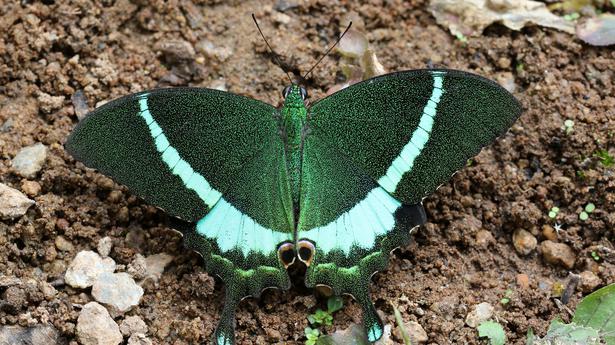
A home to rich and diverse butterfly population
The Hindu
The State has 328 species and the status of 322 of them has been revalidated; it boasts 95% of the 346 species that inhabit the Western Ghats
When ‘Tamil Maravan’ or ‘Tamil Yeoman’ (Cirrochroa thais) was named the butterfly of Tamil Nadu in 2019, it was a credit to years of efforts made by scientists, biologists and butterfly enthusiasts who painstakingly observed, documented and put together their thoughts in butterfly conservation in the Tamil landscape.
Tamil Nadu is home to 328 species of butterflies and the status of 322 of them has been revalidated as of now. The State boasts 95% of the 346 butterfly species that inhabit the Western Ghats, a biodiversity hotspot.
“Many do not know Tamil Nadu is a butterfly-rich State. Tamil Nadu’s unique diverse landscape — which comprises the scrub, deciduous, evergreen to montane Shola and grasslands of the Western Ghats, the Deccan Plateau, the Eastern Ghats, the vast plains and long coastal lines — is the key factor in its butterfly richness,” says A. Pavendhan of The Nature and Butterfly Society.
Early accounts of butterfly documentation from south India supposedly started in 1758 when father of modern taxonomy Carl Linnaeus introduced a system of naming animals and plants, say experts. According to them, Crimson Rose ( Pachliopta hector) could be the first species described in all probability. Collections of butterflies from Tamil Nadu are now housed in museums of Europe and other places. Many of the south Indian collections were from the Nilgiris (Coonoor and Kallar), the Palani Hills and the Coorg Hills.
“Madras Government Museum in 1966 published a descriptive catalogue of butterflies wherein it is stated 228 butterfly specimens from south India were available. Many of the collections were from the Nilgiris, the Palani Hills, the Kalakkad region and Madras. Works of G.F. Hampson (1888), W.H. Evans (1932), J.A. Yates (1930s), G. Talbot (1939), Wynter-Blyth (1957), T.B. Larsen (1987-88) and many others need mention for south India, and especially for the Tamil Nadu region,” says Mr. Pavendhan.
“Some species, including the Spotted Royal and the Banded Royal, were spotted in the Nilgiris which we like to call as a ‘rediscovery’ as they were seen after several decades,” says Manoj Sethumadhavan of the Nilgiri-based The Wynter-Blyth Association. The Kotagiri slopes and the Gudalur region are butterfly hotspots in the Nilgiris. The upper reaches of the district are also rich in butterfly diversity. “We have been able to document the life cycle of Nilgiri Tit, which was found with a particular ground orchid as its host plant,” he adds.
Though parts of the Eastern Ghats are dry, they are also rich in butterfly diversity, according to S.R.K. Ramasamy, a Madurai-based farmer-turned-butterfly expert. “Many butterflies of the Western Ghats are also seen in the Eastern Ghats. This shows the Eastern Ghats hill ranges are also equally good in biodiversity and insect life,” he says.


The government plans to amend the FCRA, introducing new regulations for NGO asset management and accountability for key functionaries.

The draft policy for “Responsible Digital Use Among Students”, released on Monday by the Department of Health and Family Welfare, has recommended that parents set structured routines with clear screen-time rules and prioritise privacy, safety, and open conversation with children on digital well-being.

Police Observer Sushant Kumar Saxena conducts surprise inspection at Shencottai police station, reviewing warrants and security arrangements ahead of elections.

Andhra Pradesh government to launch key projects in April, focusing on industrial growth and infrastructure development, says Nara Lokesh.

Lok Sabha refers the Corporate Laws (Amendment) Bill to a JPC amid opposition concerns over CSR provisions dilution.

SHG members in Kanniyakumari use snakes and ladders to raise election awareness and boost voter turnout.

Government accelerates consultations for early implementation of the Women’s Reservation Act to ensure women’s representation in 2029 elections.

CM A. Revanth Reddy distributes ₹1 crore insurance cheques to families of deceased Electricity department employees, enhancing financial security for workers.

The Bengaluru Traffic Police (BTP) registered 634 cases of drunk driving during a week-long special enforcement drive conducted across the city between March 16 and March 22.

GHMC intensifies action against property tax defaulters, seizing properties and offering a One Time Settlement scheme for payments.

CCB arrests three drug peddlers in Mangaluru, seizing ₹2.5 lakh worth of MDMA and other valuables.

TVK's 28 candidates in Puducherry include former BJP MLAs, a sitting Independent, and a retired police IG.

BRS submits notice on private member bill to Speaker