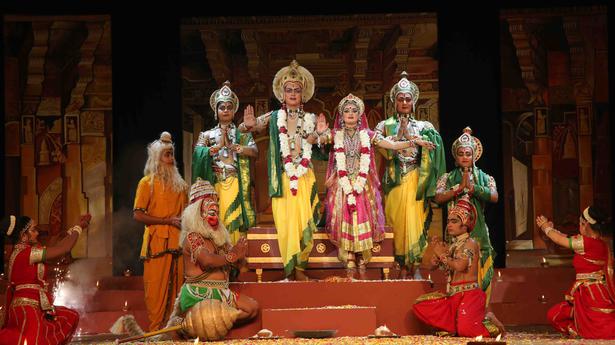
A flavour of festivity
The Hindu
Popular versions of Ramlila return to Delhi after a pandemic break with new choreography, dramatic backdrops and familiar stories
Come Dussehra and one of the most popular event unfurls in the city, celebrated versions of Ramlila that have been entertaining Delhi for decades.
This season too, the Shri Ram Bharatiya Kala Kendra (SRBKK) is all set to open its cultural staple, the dance drama, ‘Shri Ram’, for the 66th time in a row. The inaugural show is slated for September 26 and the performance will have a run of four weeks.
The dance drama, which has travelled across India and to 35 countries over the last six decades, is the troupe’s most iconic production chronicling cultural history. In two hours, forty minutes and 28 embellished scenes, it showcases stories from Lord Rama’s birth to his rajya abhishekam, (coronation) using elaborate costumes, props, fluid choreography and memorable soundtracks.
According to Shobha Deepak Singh, who conceptualised the show in 1957, more than 700,000 spectators have watched ‘Shri Ram’, which draws new generations of viewers through the decades, even as loyal audiences return each year.
Every aspect of the dance drama, from designing of costumes, jewellery and backdrop to the script, choreography and lighting, is an in-house production, she adds.
This year, the artistes will lean on the styles of Bharatanatyam, Mayurbhanj Chau, Kalariyapattu and folk dances of north India, set to the Hindustani classical ragas. “Every year, a new element is added to the show as a surprise, but without changing the essence,” says Shobha. The depiction of characters from the Ramayana, emphasise human values, brotherhood, unconditional love and respect for elders, all virtues needed in modern times, she adds.
There are 250-odd big and small Ramlilas in the city, which will be returning after a gap of two years. The famous Luv-Kush Ramlila at the Red Fort grounds will be a ten-day show from September 26 with the introduction of a new technology of 3D mapping. Organisers are making a triple-storey stage, measuring 180 feet in length and 60 feet high, with the the Ayodhya Ram temple as the backdrop.


BTS's comeback concert in Seoul drew over 100,000 fans, featuring their new album "ARIRANG" and a global livestream.

Prasads Multiplex Hyderabad unveiled one of India’s largest HDR cinema auditoriums, the PCX HDR by Barco

From staged funerals to rented fatherhood, Brendan Fraser turns rented intimacy into something disarmingly real in Hikari’s poignant Tokyo fable

Meet Nivrritii Mahesh, a Bharatanatyam dancer who dances with Cochlear implants

In a surprising turn of events, Urvashi theatre, one of Bengaluru’s iconic single screens, has re-opened, with the much-talked-about Dhurandhar: The Revenge running to a full house in the theatre. After the expiry of the 45-year lease, it seemed like curtains would come down on the king-size theatre but for now, it’s good news for fans.

The thrilling ‘Peaky Blinders’ finale is a farewell tour tailored for Tommy Shelby, while passing the baton to a new generation

BTS's comeback concert in Seoul drew over 100,000 fans, featuring their new album "ARIRANG" and a global livestream.

Khalid Rahman is reuniting with Malayalam superstar Mammootty after Unda (2019). The Thallumaala director has teamed up with the veteran for Mattancherry Mafia.

Bollywood actor Akshay Kumar paid tribute to the martial arts grandmaster and Hollywood’s action star, Chuck Norris, who passed away on Thursday, March 19, 2026.

Renowned Odissi dancer Madhumita Raut, aged 59, dies of cardiac arrest, leaving behind a legacy of artistic achievements.

Chuck Norris, iconic martial arts master and actor, dies at 86, leaving behind a legendary legacy and internet memes.

South African naturalist Steve Boyes speaks on ghost elephants, ancestral tracking, and Werner Herzog’s documentary exploring Angola’s elusive highland giants

Actor-director Amol Palekar will receive META's Lifetime Achievement award for 2026 on March 25 in New Delhi.